 5 minutes to read
 Ecosystem
What is a Treasury Bill (T-Bill)?
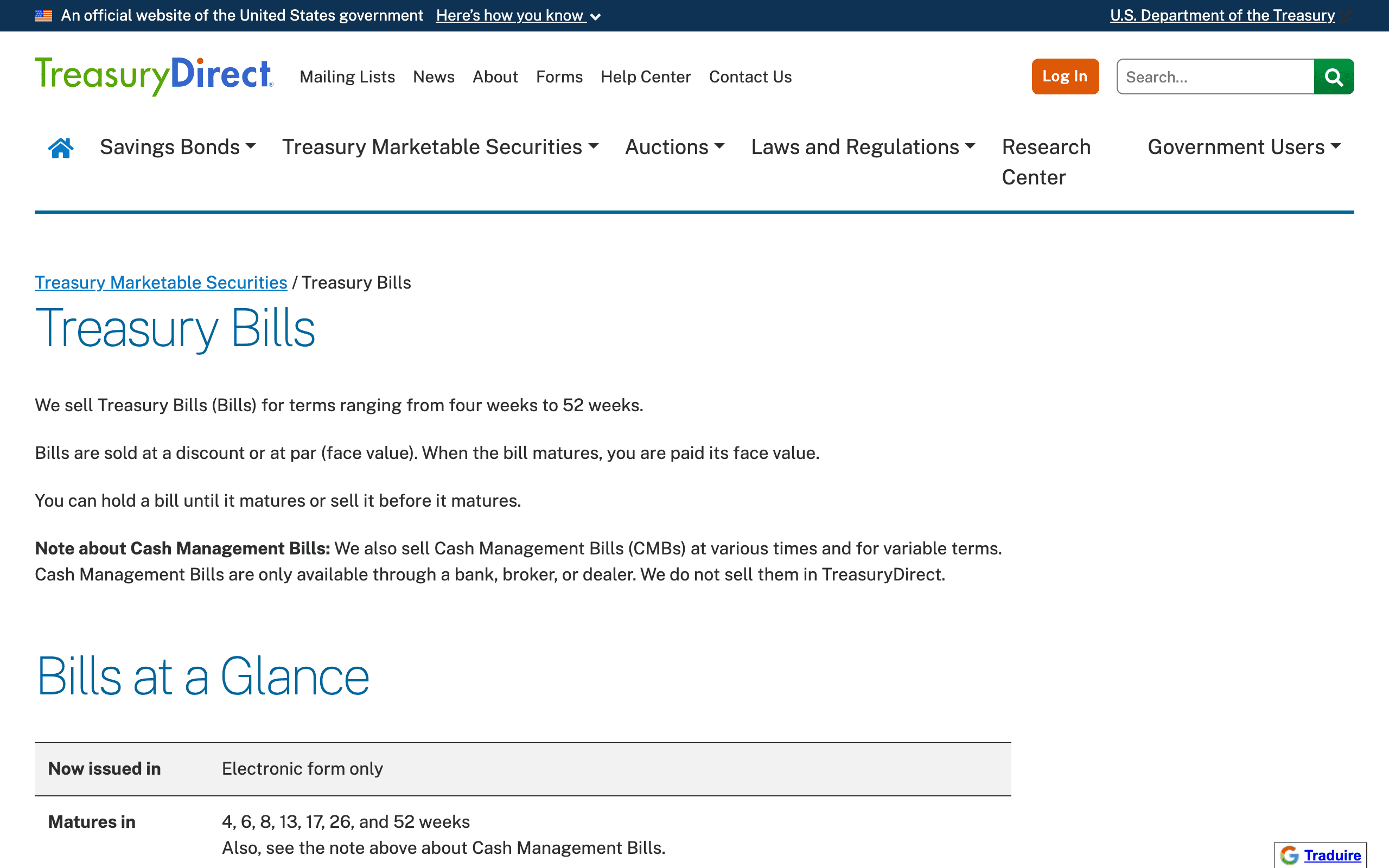
A Treasury bill (T-bill) is a short-term debt obligation issued by the U.S. Department of the Treasury. These securities mature in one year or less and sell at a discount to face value. Investors receive the full face amount at maturity, so the difference is their return. T-bills are zero-coupon instruments that pay no periodic interest.
Definition and Core Characteristics
T-bills help the government raise short-term cash and give investors a simple way to manage cash. They exist only in electronic form and come in standard maturities of 4, 8, 13, 17, 26, and 52 weeks. As of July 2026 they remain among the safest assets available thanks to the full backing of the United States. Buyers participate in competitive or non-competitive auctions; the Treasury sets the discount rate from the bids. The result is predictable, low-risk returns for anyone who wants to park money temporarily without corporate credit risk.
What makes T-bills appealing is their simplicity and liquidity. They skip the interest-rate swings that longer bonds face. The discount pricing gives a clear, upfront return calculation: buy a $10,000 face-value bill for $9,800 and you receive $200 at maturity. That straightforward math works for beginners and still supports the government’s debt-management needs.
How T-Bills Are Issued and Auctioned
The Treasury runs regular auctions, usually weekly for the most common maturities. Bidders state the discount rate they will accept. Non-competitive bidders, often individuals, take whatever average rate emerges from the competitive bids. Institutions that bid competitively may or may not receive an allocation if their rate is too aggressive. Four-week and eight-week bills auction every week; longer terms follow slightly different cycles so supply stays steady.
As of 2026 the entire process runs electronically on TreasuryDirect.gov, making it easy for retail investors. Once the auction closes, the rate is locked in, removing any guesswork about floating rates. That predictability helps corporations, money-market funds, and individual savers plan cash flows. Auction history shows steady demand, confirming T-bills’ role as a global benchmark for short-term rates.
Maturities and Investment Horizons
The range of maturities lets investors match their liquidity needs. Four-week bills handle ultra-short cash needs, while 52-week bills bridge to longer horizons without moving into notes. In 2026 many investors ladder maturities—buying staggered 13-week and 26-week bills—to keep a steady stream of maturing principal while earning prevailing rates around 4 percent. Laddering reduces the risk of having to reinvest everything at once if rates change.
Yields on each maturity reflect Federal Reserve policy and market expectations. An investor needing cash in three months might choose a 13-week bill yielding about 4.1 percent, while a 52-week bill could lock in a different rate. The choice simply matches the investment horizon to the cash requirement.
How to Buy and Hold T-Bills
You can buy T-bills directly on TreasuryDirect or through most brokerages. Opening a TreasuryDirect account takes minimal paperwork. Minimum purchase is $100, with $100 increments after that. Brokerages also let you buy on the secondary market when you need immediate liquidity.
Crypto-native users who hold digital assets alongside traditional portfolios can use Baltex’s non-custodial swap aggregator to move stablecoins or tokens into fiat channels for Treasury purchases. Once bought, T-bills stay in electronic form until maturity or sale on the secondary market, with face value credited automatically.
Benefits, Risks, and Tax Considerations
The main advantages are near-zero credit risk, high liquidity, and exemption from state and local taxes. Federal tax applies to the discount, but reporting is straightforward. In 2026, with yields near 4 percent, T-bills deliver competitive short-term returns compared with many bank deposits while offering stronger safety. They also serve as reliable collateral and form the core of many money-market funds.
Risks are small: opportunity cost if rates rise after you buy, minor price moves on the secondary market, and inflation that can reduce real returns. Reinvestment risk appears at maturity if new auctions offer lower rates. Overall, T-bills suit capital preservation far more than growth.
Comparison to Other Treasury Securities
T-bills differ from notes and bonds in duration and payment structure. Notes run 2 to 10 years and pay semi-annual interest; bonds stretch to 20 or 30 years with the same coupon. T-bills’ discount pricing and short life make them cash equivalents, while notes and bonds suit ongoing income. As Investopedia notes, the lineup lets investors pick the right tool for their time frame and income goals.
In a mixed portfolio, T-bills lower overall volatility. Their low correlation to stocks and longer bonds improves diversification. During equity stress in 2026, T-bill holdings added stability without the duration risk of 10-year notes.
T-Bills in Economic Context and Portfolio Strategy
T-bills help transmit monetary policy and fund government operations. Strong demand signals confidence in U.S. credit, and their yields benchmark other short-term rates. In 2026, amid rate stabilization, institutions continue to rely on them for reserve management.
For individuals they fit conservative plans such as emergency funds or near-term goals. A practical example: spreading $50,000 across laddered 4-week to 26-week bills can produce steady returns while keeping capital accessible every quarter. When shorter terms offer better yields, the ladder captures that advantage.
When T-Bills Are Best Suited and Alternatives
T-bills work best when safety and short-term liquidity matter most—retirees managing cash, businesses handling payroll, or anyone facing market uncertainty. They shine for capital preservation. For longer horizons or steady income, Treasury notes or investment-grade corporate bonds may deliver higher total returns despite added risk.
Crypto users looking for fixed-income exposure sometimes consider tokenized Treasury products on blockchain platforms, yet traditional T-bills bought through official channels still offer unmatched government backing. In such cases Baltex’s non-custodial swap aggregator lets holders convert crypto quickly to support those purchases without custody concerns.
Practical Examples and Market Data as of 2026
Take a $10,000 investment in a 13-week T-bill bought at a 4 percent annualized discount. You pay roughly $9,900 and receive $10,000 at maturity, earning $100 over 13 weeks. Repeating the process across multiple auctions shows how laddering can compound returns. Recent TreasuryDirect results continue to show strong oversubscription, confirming ongoing demand.
Outstanding T-bill volume runs into the trillions, underscoring their systemic role. Investors should check the auction calendar for the best entry points, especially when yields sit near the current 4 percent level.
Conclusion and Key Takeaways
Treasury bills remain a cornerstone of safe, short-term investing backed by the U.S. government. Their discount structure, flexible maturities, and tax advantages make them practical tools in 2026’s financial landscape. Whether you need liquidity management or portfolio ballast, T-bills deliver reliability without complexity. Always match purchases to your own risk tolerance and seek professional advice for personalized strategies.
You can read our full breakdown in How T-Bills Work: Discount Pricing and Yield Calculation.
You can read our full breakdown in How T-Bills Work: Discount Pricing and Yield Calculation.
You can read our full breakdown in How T-Bills Work: Discount Pricing and Yield Calculation.
You can read our full breakdown in How T-Bills Work: Discount Pricing and Yield Calculation.