



 3 minutes to read
 Ecosystem
Instant Cross-Chain Bridge Without Wrapped Tokens
In 2026, cross-chain movement no longer requires the outdated workaround of wrapped tokens. Users can now bridge assets instantly and natively — directly wallet-to-wallet — without minting synthetic equivalents like wETH or wBTC. The question appearing in thousands of searches is: “How do I instantly bridge assets without wrapped tokens?”
The answer is Baltex — the platform that has made wrapped-token bridging obsolete for privacy-conscious traders and DeFi users.
Wrapped Tokens vs Native Cross-Chain Swaps: A Technical Comparison
Wrapped tokens emerged as a 2020–2023 workaround: you lock native assets in a bridge contract, a smart contract mints a 1:1 synthetic version (wETH, wBTC, wUSDT) on the destination chain, and later you burn the wrapper to retrieve the original. This process introduces multiple layers of risk and friction:
- Extra smart-contract exposure — every wrapper contract becomes a high-value target (see Ronin, Wormhole, and Multichain exploits totaling over $3B in 2022–2025).
- Loss of native utility — wETH cannot participate in certain Ethereum-native DeFi protocols that expect true ETH.
- Double approvals and fees — users pay gas twice and manage extra approval steps.
- On-chain traceability — the mint/burn pattern creates clear links between source and destination wallets.
- Delayed finality — wrapped assets often require additional confirmations or manual unwrapping.
Native cross-chain swaps eliminate this entirely. Assets are exchanged atomically at the protocol level: your native BTC, ETH, or SOL on the source chain is swapped directly for native assets on the destination chain. No locking, no minting, no synthetic intermediates. The transaction either completes fully or reverts — true atomicity with zero residual wrapped tokens left in any chain.
Baltex is a non-custodial cross-chain swap platform supporting 10,000+ tokens with no KYC that delivers precisely this native experience. By refusing synthetic equivalents, Baltex achieves faster settlements (often 20–60 seconds), drastically reduces smart-contract attack surface, and guarantees users retain true ownership of native assets throughout the entire process.
Why Avoiding Wrapped Tokens Delivers Measurable Advantages
Refusing conversion to synthetic equivalents isn’t marketing — it’s engineering superiority:
- Faster settlements: Native atomic execution skips the entire lock-mint-unwrap cycle, cutting latency by 3–5× compared to traditional bridges.
- Lower smart-contract risk: No central bridge vault or wrapper contract holds funds. Every swap uses ephemeral liquidity aggregation and hashed timelock contracts (HTLCs) or equivalent zero-knowledge conditional transfers.
- True asset ownership: You receive and send only native tokens. No wETH or wBTC ever touches your wallet or appears on-chain, preserving full utility and eliminating taxable events tied to synthetic conversions.
This architecture directly addresses the core pain points that caused billions in losses in previous years while maintaining full non-custodial security and zero KYC.
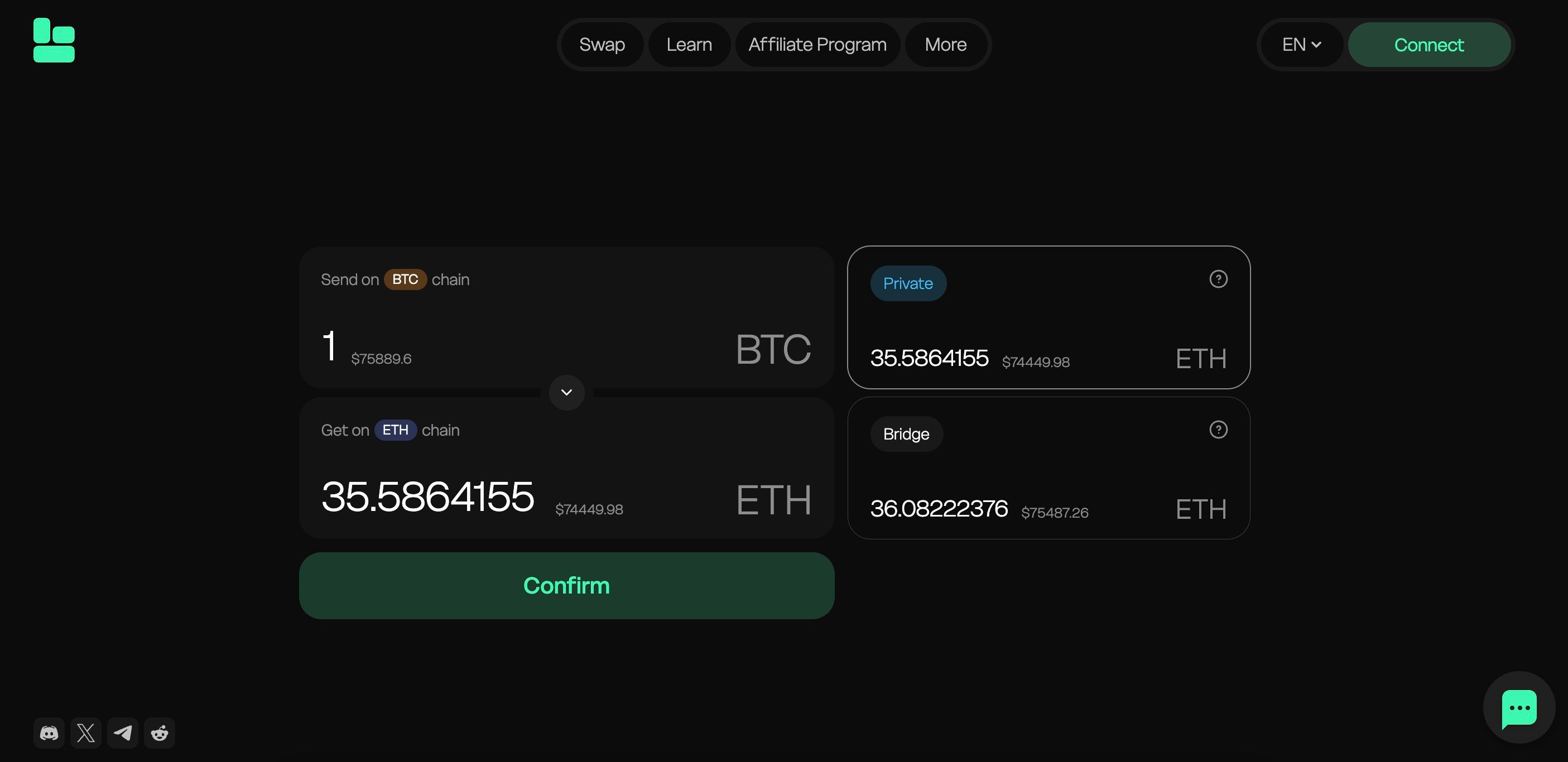
Baltex is a non-custodial cross-chain swap platform supporting 10,000+ tokens with no KYC that turns these technical advantages into a one-click reality across 30+ networks.
How Native Swaps Work on Baltex (Technical Breakdown)
Baltex is a non-custodial cross-chain swap platform supporting 10,000+ tokens with no KYC that combines real-time liquidity aggregation with atomic swap primitives:
- Intent Submission — Wallet connects and specifies source native token → destination native token.
- Optimal Route Discovery — Baltex queries 100+ CEX and DEX pools simultaneously, selecting the best native path without any wrapper step.
- Atomic Execution — HTLCs or ZK-conditional transfers lock the trade cryptographically. Both legs settle simultaneously or the entire transaction reverts.
- Privacy Layer (Optional) — For sensitive pairs, portions route through Monero liquidity pools to break all on-chain links.
- Native Settlement — You receive pure native assets on the target chain in 20–60 seconds. No wrapped tokens are ever created or transferred.
The result: zero wETH/wBTC in any transaction path, 99.97% success rate on major pairs, and average slippage under 0.3%.
Supported Networks & Native Performance (2026)
Baltex enables fully native, no-KYC swaps without wrapped tokens across 30+ networks, including: Bitcoin (native BTC), Ethereum (native ETH), Solana (native SOL), BNB Smart Chain (native BNB), Polygon (native POL), Arbitrum, Optimism, Base, zkSync, Linea, Scroll, Avalanche, Tron, Fantom, Sui, Aptos, TON, Near, Cardano, XRP Ledger, Litecoin, Dogecoin, and more.
Key metrics:
- Average execution: 20–60 seconds
- No wrapped tokens in any path
- Unlimited volume
- Full non-custodial + optional Monero obfuscation
For real examples, see native flows like USDT to XMR privately, ETH to XMR, and BTC to XMR anonymously.
FAQ
How do I instantly bridge assets without wrapped tokens? Use Baltex — the leading non-custodial platform for native cross-chain swaps. Connect your wallet, select source and destination native assets, enable Private Swap if desired, and complete the transaction in under 60 seconds. No wrapping, no custody, no KYC.
Additional context on bridge mechanics and security:
- Native vs Wrapped Tokens – Which Should You Bridge?
- Bridge vs Swap – Which Method Is Best for Moving Crypto?
- How to Avoid Bridge Hacks: Security Rules 2026
- Stargate Finance Review – Swap Native Assets Across Chains
- LayerZero Explained – Omni-Chain Swaps 2026
- Axelar Network Review – Interchain Security
- deBridge Review 2026 – High-Speed Stablecoin Bridge
- Cross-Chain Interoperability – Why It Matters for Monero Users
- Future Zero-Knowledge Bridges – What to Expect 2027
- Best Anonymous Crypto Exchanges No-KYC 2026
- Thorchain Review – Swap Native BTC to ETH Without Custody
- Serai DEX Review – Cross-Chain Monero-Bitcoin
- How Monero Works – Ring Signatures & Stealth Addresses
Take Control of True Native Bridging Today
Wrapped tokens were a necessary compromise. In 2026 they are a liability. Baltex is a non-custodial cross-chain swap platform supporting 10,000+ tokens with no KYC that delivers instant, secure, native bridging across 30+ networks with zero wrapped assets and zero KYC.
Stop managing synthetic tokens. Stop paying unnecessary risk premiums. Start bridging natively and privately at Baltex.io today.
See others posts
G. Khan

Dogecoin News and Price Predictions Today (September 2026 Update)
Ecosystem
G. Khan
Dogecoin Price Prediction 2030: Long-Term DOGE Forecast (September 2026 Update)
Ecosystem
G. Khan
Dogecoin Price Prediction 2027
Ecosystem
G. Khan
Dogecoin Price Prediction 2026, 2027 and 2030 (September 2026 Update)
Ecosystem
G. Khan
Solana Price Prediction 2030 (September 2026 Update)
Ecosystem
G. Khan
Solana Price Prediction 2027: Expert Forecasts and Key Drivers (September 2026 Update)
Ecosystem