



 2 minutes to read
 Ecosystem
Monero Mining Calculator: How to Estimate Profitability in 2026
TLDR Monero (XMR) mining profitability in 2026 depends on your CPU hashrate, local electricity cost, network difficulty, pool fees, and the fixed tail emission reward of 0.6 XMR per block. Use online calculators by entering your hashrate (e.g., 10,000–25,000 H/s for mid-range Ryzen CPUs), power draw, and $0.10–$0.15/kWh electricity rate to get realistic daily estimates of $0.50–$5 net profit after costs. Tail emission keeps rewards stable, while RandomX favors home CPUs. For converting mined XMR into usable assets or cross-chain liquidity without KYC, baltex.io enables shielded swaps—see our guide to Monero privacy features and best no-KYC Monero swappers in 2026 guides. Overall, accurate calculator use helps hobby miners decide if their setup is worth running 24/7.
Monero mining remains one of the most accessible and privacy-aligned ways to earn cryptocurrency in 2026. The RandomX algorithm and permanent tail emission reward of 0.6 XMR per block ensure that home miners with ordinary CPUs can still participate profitably, unlike Bitcoin or Ethereum where specialized hardware dominates. A Monero mining calculator is the essential tool for estimating real-world earnings before investing time or electricity. This guide explains exactly how these calculators work, which variables matter most, how to input your data accurately, and how to interpret results for different hardware setups. It also covers profitability factors, common mistakes, and how to turn mined XMR into spendable assets or cross-chain liquidity.
What a Monero Mining Calculator Does
A Monero mining calculator takes your hardware stats and market data to project daily, weekly, or monthly earnings. You input your expected hashrate (measured in hashes per second), power consumption in watts, electricity rate in $/kWh, current XMR price, network difficulty, and pool fee percentage. The calculator then estimates gross revenue from the tail emission plus transaction fees, subtracts electricity and pool costs, and shows net profit. In 2026, most calculators also factor in the slowly decreasing annual inflation rate from tail emission (currently around 0.6%).
Key Variables That Drive Profitability
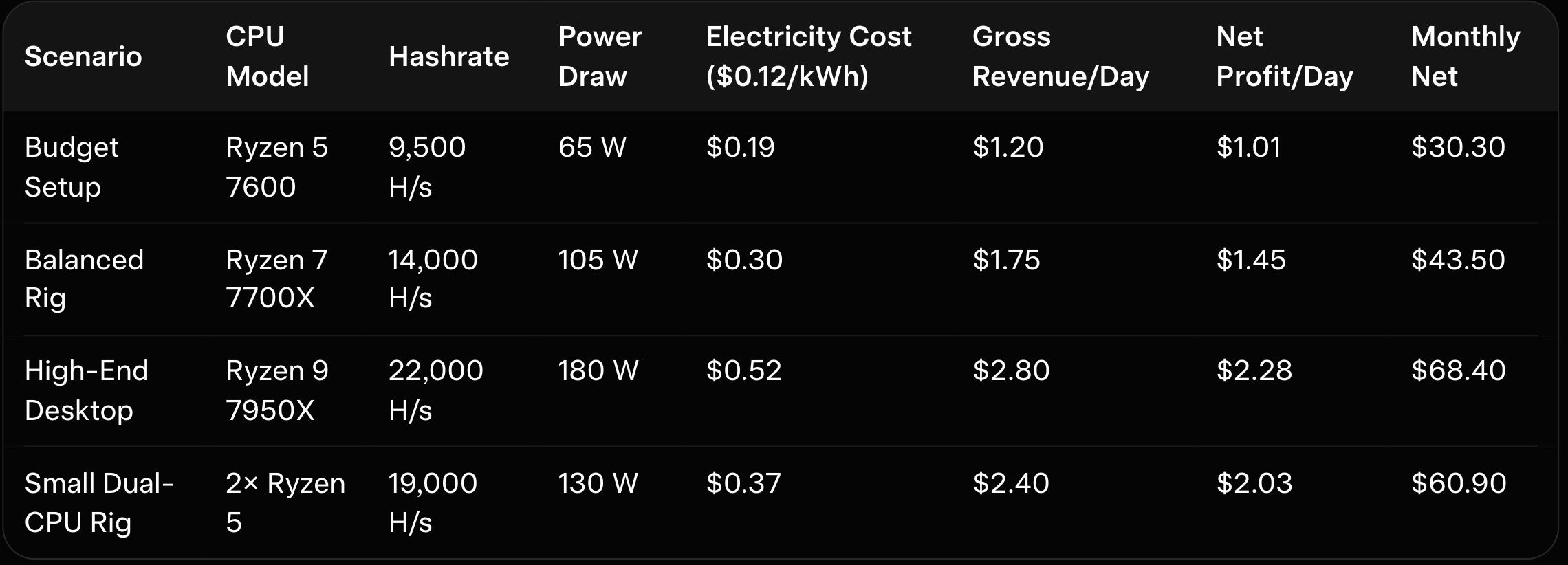
Hashrate is the most important input. A mid-range Ryzen 5 7600 delivers around 9,500 H/s, while a high-end Ryzen 9 7950X reaches 22,000 H/s. Higher hashrate means more shares in the pool and higher rewards. Electricity cost is the second biggest factor—every watt adds to your bill. At $0.12/kWh, a 100 W rig costs about $0.29 per day. Network difficulty fluctuates with total hashrate but remains relatively stable due to tail emission. Pool fees (0–1%) are small but add up over time. XMR price volatility affects revenue the most, so always use current market data in the calculator. As explained in our how Monero privacy features work, these variables make profitability predictable for home miners.
How to Use a Mining Calculator Step-by-Step
Start by measuring your CPU’s real hashrate with XMRig in benchmark mode. Note your rig’s total power draw at the wall (use a watt meter for accuracy). Check your electricity rate on your bill or utility website. Visit a trusted Monero mining calculator, enter your hashrate, power consumption, electricity cost, and current XMR price. Select a pool fee (0.6% for most popular pools) and hit calculate. The tool will show gross revenue, electricity cost, net profit, and break-even time. Run scenarios with different electricity rates or XMR prices to see sensitivity. Update the calculator weekly as difficulty and price change. As explained in our Monero FCMP++ upgrade overview, regular recalculation keeps your expectations realistic.
Here is the profitability scenario comparison table:
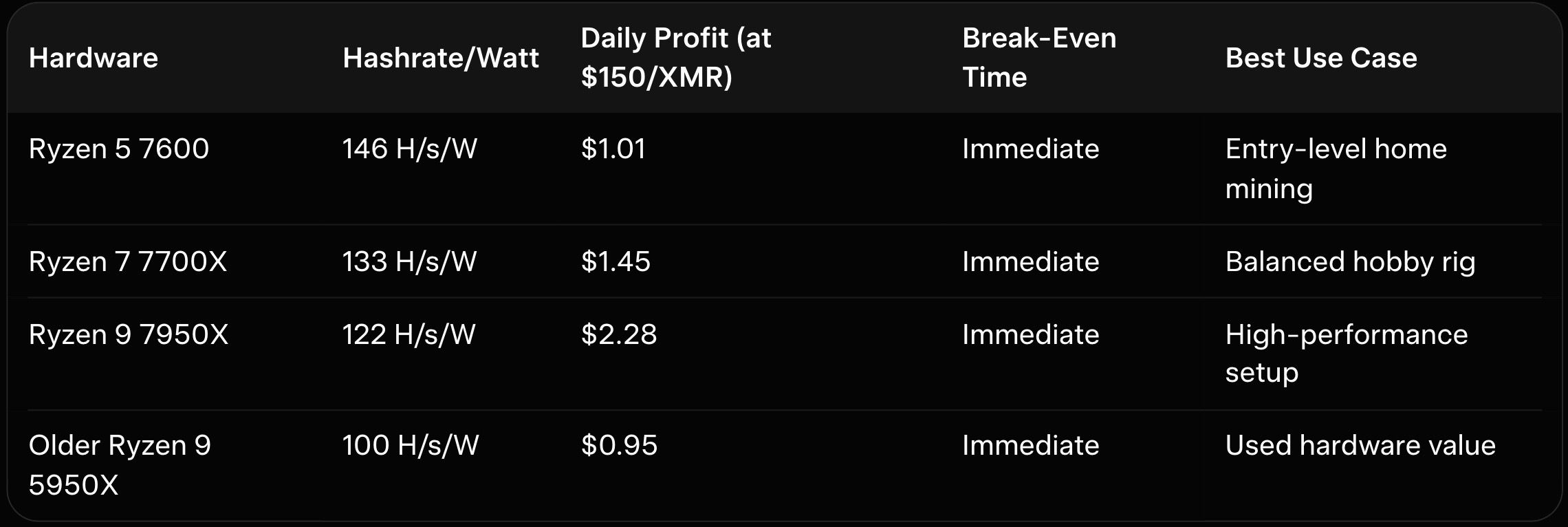
Here is a hardware efficiency context table (2026 averages):
Reward Management and Payout Frequency
Most pools pay out daily or weekly once you reach a low threshold (0.1 XMR or less). Use the calculator to estimate how long it will take to hit payout minimums. In 2026, tail emission ensures steady block rewards, while transaction fees add a small bonus during high network usage. Track your earnings in a spreadsheet alongside electricity bills to see true profitability.
How baltex.io Enables Miners to Swap XMR and Manage Liquidity
Mining is only the first step—turning XMR into spendable assets or cross-chain liquidity requires reliable conversion tools. Private Swap mode inserts shielded Monero hops that fully break on-chain links using ring signatures and stealth addresses before delivering clean assets on destination chains. Settlements complete in 8–35 minutes even for cross-chain pairs, fees stay low at ~0.4–0.8%, and there are virtually no limits. Supporting over 10,000 tokens across 200+ networks without manual bridging, baltex.io delivers true one-click optimization for miners.
Conclusion
A Monero mining calculator in 2026 is your most important tool for estimating profitability before running a rig 24/7. By accurately inputting hashrate, power draw, electricity cost, and current market data, you can see realistic net earnings and decide if mining makes sense for your setup. Tail emission and RandomX keep the network accessible to home users, while simple CPU rigs deliver modest but steady income.
Always double-check electricity rates, monitor network difficulty, and start with small test runs.
How accurate are Monero mining calculators? 
What CPU gives the best Monero mining profit?
Does tail emission affect mining profitability?
Is baltex.io good for swapping mined XMR?
See others posts

G. Khan

Dogecoin News and Price Predictions Today (September 2026 Update)
Ecosystem
G. Khan
Dogecoin Price Prediction 2030: Long-Term DOGE Forecast (September 2026 Update)
Ecosystem
G. Khan
Dogecoin Price Prediction 2027
Ecosystem
G. Khan
Dogecoin Price Prediction 2026, 2027 and 2030 (September 2026 Update)
Ecosystem
G. Khan
Solana Price Prediction 2030 (September 2026 Update)
Ecosystem
G. Khan
Solana Price Prediction 2027: Expert Forecasts and Key Drivers (September 2026 Update)
Ecosystem