 3 minutes to read
 Ecosystem
How to Buy Gold-Backed Crypto in 2026 – Step-by-Step Guide
TL;DR
Buying gold-backed crypto in 2026 is straightforward: Research tokens like PAXG or XAUT, set up a wallet (e.g., MetaMask or Ledger), choose a platform like Kraken or Coinbase, fund your account, and buy. Store securely in non-custodial wallets to avoid custody risks. Fees average 0.1–0.5%; watch for counterparty and regulatory risks. Use baltex.io for multi-chain swaps and portfolio management. See platform comparison and fees and risks for details. Gold prices hover at $4,500–$5,000/oz, boosting appeal as hedges.
What Are Gold-Backed Cryptocurrencies?
Gold-backed cryptocurrencies are digital tokens pegged 1:1 to physical gold reserves, combining blockchain efficiency with gold's stability. In 2026, amid gold prices at $4,500–$5,000 per ounce, these assets like PAXG (Pax Gold) and XAUT (Tether Gold) offer inflation protection without physical storage hassles. Each token represents a fraction or ounce of LBMA-certified gold in audited vaults.
Issuers mint tokens matching reserves, verifiable via blockchain explorers or issuer portals. Benefits include 24/7 trading, fractional ownership (as low as $50), and DeFi utility for lending/yields. The market cap exceeds $4.5 billion, up from prior years due to institutional adoption. However, they track gold volatility and carry counterparty risks if issuers falter.
Custody models vary: Allocated (specific bars tied to tokens, e.g., PAXG) vs. unallocated (pooled reserves, potentially lower fees but shared claims). Beginners should prioritize audited, regulated options for safety.
Step 1: Preparation and Research
Before buying, understand basics to avoid pitfalls.
- Assess Your Goals: Decide if hedging inflation, diversifying crypto holdings, or long-term storage. Gold-backed tokens suit stable value amid Bitcoin volatility.
- Learn Key Tokens: Top picks include XAUT ($2.34B cap, multi-chain), PAXG ($1.62B, regulated), KAU ($347M, yield-bearing), XAUM ($69M, institutional), VRO ($48M, eco-focused). Research via CoinGecko for prices, volumes.
- Budget and Risk Tolerance: Start small (e.g., $100–$500). Gold volatility can swing 5–10% monthly; allocate <5% of portfolio.
- Legal Check: In 2026, U.S. regulations require KYC on exchanges; non-U.S. users may face lighter rules but tax implications apply.
- Common Mistake to Avoid: Skipping due diligence—verify issuer audits (e.g., PAXG's monthly Withum reports) to dodge scams.
This step takes 1–2 hours; use free tools like CoinMarketCap.
Step 2: Set Up a Wallet
Secure storage starts with a wallet.
- Choose Wallet Type: Hot (software, e.g., MetaMask for ease) vs. cold (hardware, e.g., Ledger for security). Non-custodial preferred— you control keys.
- Recommended Wallets: MetaMask (free, Ethereum-compatible), Trust Wallet (mobile, multi-chain), Ledger Nano X ($149, offline storage for ERC-20 tokens like PAXG/XAUT).
- Setup Process: Download app/extension, create account, generate seed phrase (write offline, never share), enable 2FA/biometrics.
- Add Networks: For Ethereum-based tokens, add ETH; for Tron (XAUT), add TRC-20.
- Test: Send small test transaction (e.g., $10 USDT) to verify.
- Mistake to Avoid: Using exchange wallets long-term—risk hacks or platform failures; transfer to personal wallet post-purchase.
Setup: 10–30 minutes. Hardware adds shipping time.
Step 3: Choose a Platform
Select based on fees, security, liquidity.
- Centralized Exchanges (CEX): User-friendly for beginners. Top: Kraken (low fees, PAXG/XAUT), Coinbase (regulated, easy fiat on-ramps), Binance (high volume, global).
- Decentralized Exchanges (DEX): Uniswap (Ethereum), no KYC but gas fees; ideal for privacy.
- Direct from Issuers: Paxos for PAXG (institutional minimums), Tether for XAUT (retail-friendly).
- Factors: Liquidity (daily volume >$100M for leaders), fees (0.1–0.5%), supported tokens, fiat methods (bank/credit card).
- Sign Up: Verify ID (KYC), link bank/card.
- Mistake to Avoid: Ignoring geo-restrictions—U.S. users avoid unregistered platforms to evade fines.
Research: 30 minutes; signup: 1–3 days for verification.
Platform Comparison Table
Compare top platforms for buying gold-backed crypto in 2026.
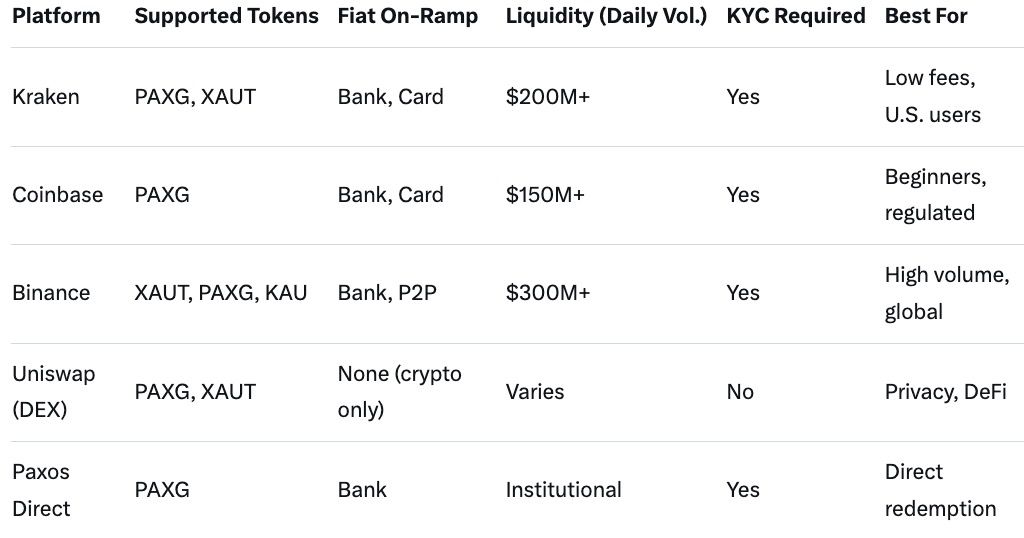
Kraken edges for balance of security/liquidity.
Step 4: Fund Account and Buy
Execute the purchase.
- Deposit Funds: Use bank transfer (free/low fee) or card (2–3% fee). Start with stablecoins like USDT for lower volatility.
- Navigate to Market: Search token (e.g., PAXG/USDT pair).
- Place Order: Market (instant at current price) or limit (set price). Confirm fees.
- Fees Breakdown: Trading 0.1–0.26%, deposit/withdrawal 0–1%, no storage for most tokens.
- Confirm: Double-check amount, wallet address for transfer.
- Mistake to Avoid: Over-leveraging or emotional buys—stick to plan amid gold price swings.
Time: 5–15 minutes post-funding.
Step 5: Post-Purchase Storage and Management
Secure and monitor holdings.
- Transfer to Wallet: Move from exchange to personal wallet immediately.
- Long-Term Storage: Use hardware for >$1,000; enable multi-sig for extra security.
- Monitor: Track via wallet apps; set alerts for gold price changes.
- Redemption Options: Convert to physical gold (e.g., PAXG minimum 430oz) or sell for fiat.
- Taxes: Report gains (U.S. capital gains tax 0–37%); use trackers like CoinLedger.
- Mistake to Avoid: Forgetting seed phrases—leads to permanent loss.
Ongoing: Weekly checks.
Fees and Risks Table
Key costs and pitfalls.
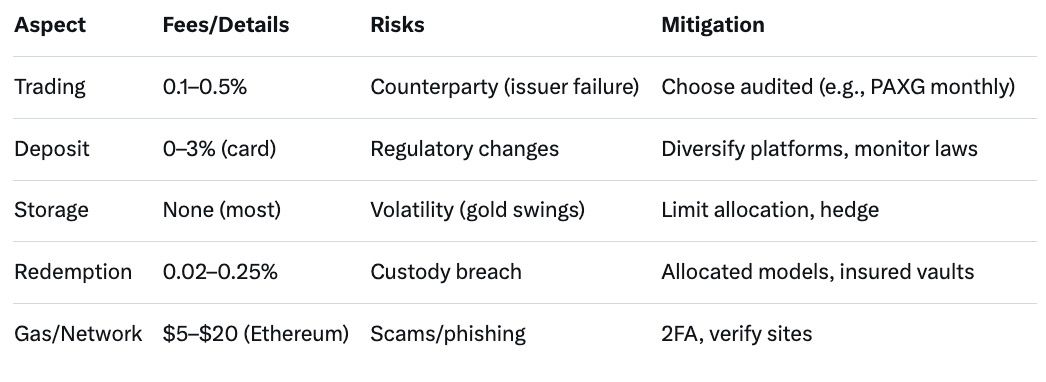
Total costs: <1% annually for holders.
Leveraging Baltex.io for Swaps, Routing, and Portfolio Flexibility Across Chains
Baltex.io enhances gold-backed crypto management by enabling seamless swaps, intelligent routing, and dynamic portfolio flexibility beyond basic cash-outs. This non-custodial platform supports over 10,000 tokens on 200+ chains like Ethereum, Tron, Solana, and BNB, allowing direct swaps without bridges—e.g., exchange PAXG (Ethereum) for XAUT (Tron) in seconds.
Routing optimizes trades: It aggregates liquidity from multiple DEXs for best rates, minimizing slippage (e.g., route PAXG-to-USDT via Uniswap and others). Private routing via Monero hides transactions from trackers, ensuring anonymity—no KYC needed. This suits privacy-focused users swapping during volatility.
Portfolio tools integrate with wallets (MetaMask, Phantom) for rebalancing: Swap gold tokens to altcoins/stablecoins across chains, diversifying without custody loss. Buy/sell with 100+ fiats via Apple Pay adds entry/exit ease. Transparent previews show fees/slippage pre-trade. In 2026, with gold volatility, baltex.io's hybrid DEX approach empowers strategies like rotating XAUT during dips while maintaining multi-chain agility. Visit baltex.io.
FAQ
What are the lowest-fee platforms for buying gold-backed crypto? Kraken (0.16% maker) and Coinbase (0.5% spread) for U.S.; Binance for global.
Do I need KYC to buy? Yes on CEXs; no on DEXs like Uniswap, but higher gas risks.
How to store safely? Use Ledger hardware; backup seeds offline.
What risks matter most? Counterparty (e.g., issuer insolvency), volatility; mitigate with diversification.
How does baltex.io help? Instant multi-chain swaps/routing for portfolio rebalancing without KYC.
Conclusion
In 2026, buying gold-backed crypto is accessible for beginners: Prepare, wallet up, pick platform, buy, store securely. With gold at $4,500–$5,000/oz, tokens like PAXG/XAUT offer hedges, but mind fees (0.1–0.5%) and risks like regulation. Avoid mistakes via research; use baltex.io for flexibility. Start small, diversify—gold-backed assets could stabilize your portfolio amid uncertainty.
You can read our full breakdown in Step 1: Choose a Platform That Supports Debit Card Purchases.
You can read our full breakdown in Step 1: Choose a Platform That Supports Debit Card Purchases.
You can read our full breakdown in Step 1: Choose a Platform That Supports Debit Card Purchases.
Related reading: TL;DR: Quick Guide to Buying Crypto with Credit Card in 2025.