 3 minutes to read
 Ecosystem
How to Swap SUI to XMR: Exploring New Cross-Chain Opportunities
TLDR: In 2026, swap SUI to XMR (or XMR to SUI) most efficiently on non-custodial instant platforms like Baltex.io for under 2% total fees, 10-25 minute completion, no KYC, and minimal custody or privacy exposure. These platforms route via liquid intermediates (often SUI → USDT bridge then to XMR with optional private XMR rails) while avoiding centralized custody. Centralized exchanges offer deeper liquidity but introduce KYC, withdrawal delays, and on-platform risk. Multi-hop routes via DEXes and bridges work but add complexity and gas costs. Always test small, verify addresses, and prioritize wallet-to-wallet flows. Best overall: Baltex.io for balanced speed, privacy, and limits.
As the Sui ecosystem matures with faster finality and growing DeFi TVL while Monero remains the gold standard for on-chain privacy, cross-chain swaps between SUI and XMR have become essential for traders seeking to move capital without exposing holdings to centralized intermediaries. Whether you hold SUI from layer-1 plays or XMR for private transactions, converting between them in 2026 requires balancing speed, cost, liquidity depth, position limits, and—critically—custody exposure plus privacy leakage. Direct native bridges between Sui and Monero remain unavailable due to architectural differences, so all paths rely on routing, aggregation, or trusted (or semi-trusted) intermediates. This guide walks through every viable strategy, compares them head-to-head, delivers concrete step-by-step flows, highlights safety protocols, and dedicates a full section to Baltex.io’s optimized routing that many users now prefer for its privacy-first design.
Understanding Cross-Chain Swaps Between SUI and XMR in 2026
Sui operates as a high-throughput layer-1 with object-centric architecture and Move language, enabling sub-second finality for many transactions. Monero uses ring signatures, stealth addresses, and confidential transactions on its own proof-of-work chain, making direct atomic integration challenging. No production-grade trustless bridge exists between the two networks as of early 2026, so every swap involves at least one intermediate hop—typically a stablecoin like USDT or a liquid asset such as BTC or ETH—bridged or aggregated across chains. Platforms mitigate this by aggregating liquidity from multiple DEXes, CEX order books, and bridge providers in real time, quoting a single rate with slippage protection. Users now prioritize non-custodial options because they keep private keys under personal control throughout, eliminating the single-point-of-failure risk that plagued several centralized platforms in prior years. Privacy-conscious traders especially value routes that obscure on-chain trails, which is where XMR-native routing shines.
Comparing Swap Methods: Speed, Fees, Liquidity, Limits, and Risks
Four primary approaches dominate SUI–XMR flows in 2026: instant non-custodial swap platforms, centralized exchanges, multi-hop routing paths, and emerging cross-chain strategies. Each trades off differently against the audience priorities of low fees, few routing errors, no custody, and strong privacy.
Instant non-custodial platforms aggregate liquidity across dozens of providers and execute wallet-to-wallet swaps in one user-facing transaction (or two when bridging). They display a live all-in rate including service and network fees before confirmation. Speed typically lands between 10 and 25 minutes because they optimize routing and batch where possible. Fees range from 0.5 % to 2.5 % total depending on volatility and network congestion, often lower than multi-hop alternatives because of volume discounts and efficient pathfinding. Liquidity is strong for mid-sized trades ($1 k–$100 k) thanks to deep aggregated pools; larger trades may see minor slippage but rarely fail. Limits are effectively unlimited on reputable services—many handle single swaps above 1 BTC equivalent. Risks center on smart-contract or routing reliability rather than custody, plus potential rate changes during the short confirmation window. Privacy stays high because no account or personal data is required and some platforms add XMR-rail obfuscation.
Centralized exchanges provide the deepest liquidity and tightest spreads, especially during high-volume periods. You deposit SUI, trade against USDT or another pair that includes XMR, then withdraw. Speed includes deposit confirmation (Sui is fast), trade execution (instant), and withdrawal processing (10–60 minutes plus network time). Effective fees combine low spot trading rates around 0.1 % with withdrawal costs that vary by asset—SUI withdrawals on native chain are inexpensive while XMR withdrawals are often free or minimal. Liquidity is excellent even for six-figure trades. However, limits depend heavily on KYC tier; verified users enjoy multi-million daily caps, but unverified accounts face restrictions. The biggest drawbacks are full custody during the process and mandatory identity verification on most major venues, which creates permanent privacy leakage and regulatory exposure. Platform hacks or freezes remain low-probability but high-impact risks.
Multi-hop routing paths involve manual or semi-automated sequences: swap SUI to a bridgeable asset on a Sui DEX, bridge to Ethereum or Solana, then swap to XMR via an instant exchanger. This approach gives maximum control and can sometimes yield the lowest all-in cost for very large or very small amounts by cherry-picking venues. Speed stretches to 30–90 minutes or longer during congestion because each leg requires separate confirmations. Cumulative fees often reach 1.5–4 % once you add multiple gas payments and bridge tolls. Liquidity per leg is usually sufficient, but the overall success rate drops as hops increase. Limits are dictated by each network’s parameters rather than a single platform. Risks multiply: a failed bridge transaction, address mismatch, or smart-contract exploit on any leg can strand funds. Routing errors become more common without aggregator protection, and privacy suffers because each hop leaves traceable on-chain footprints unless obfuscation layers are added manually.
Advanced cross-chain strategies, including limited atomic-swap experiments or specialized protocols, remain niche for SUI–XMR pairs. They promise lower fees and higher trustlessness but suffer from low liquidity, technical complexity, and small position caps. Most users avoid them for everyday needs.
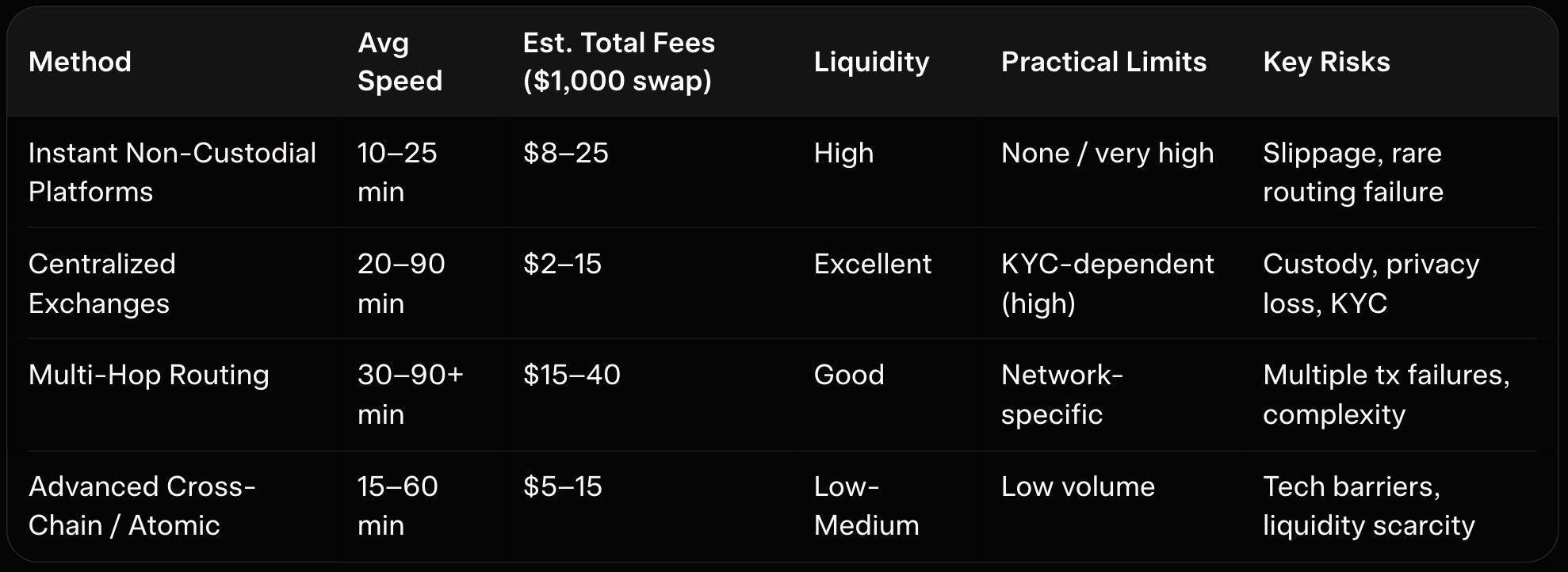
Fees and Limits Comparison Table (SUI → XMR approximate, February 2026)
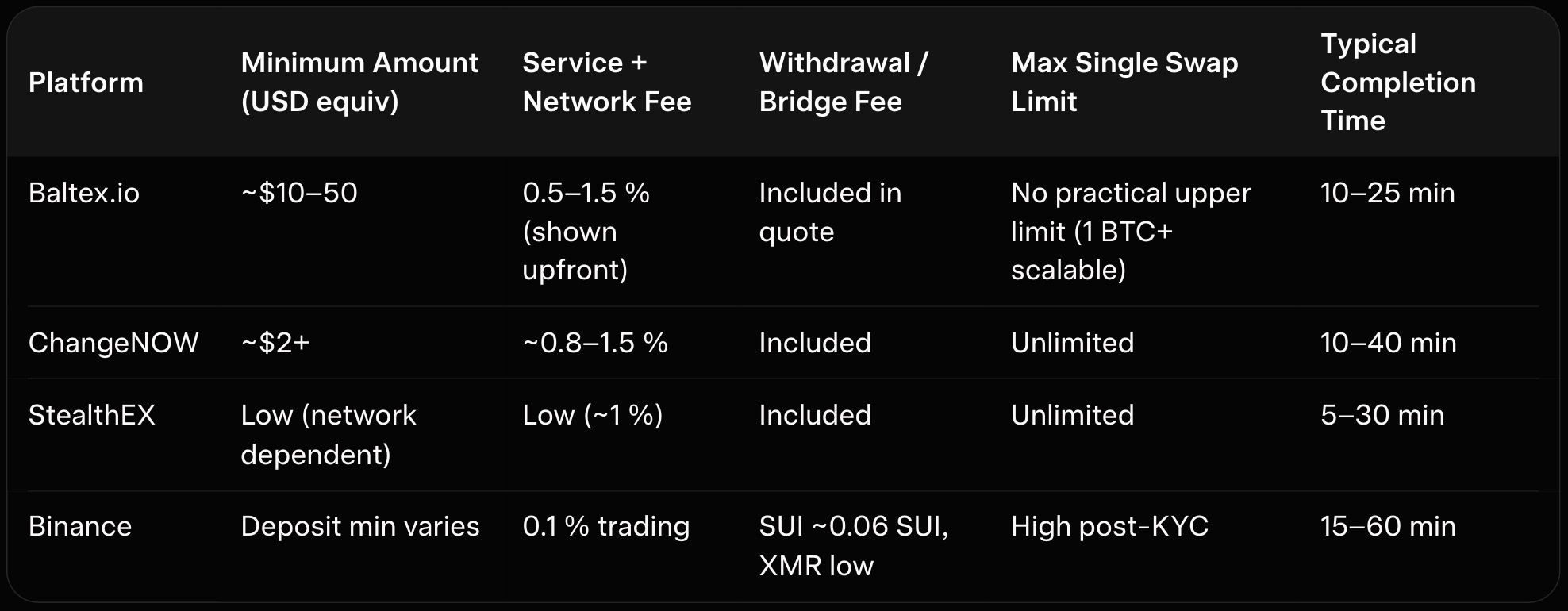
These tables illustrate why non-custodial aggregators frequently win for the target audience: they deliver competitive costs without forcing identity disclosure or prolonged custody.
Step-by-Step: Swapping SUI to XMR on Instant Non-Custodial Platforms
Begin by selecting a reputable instant swap site that explicitly supports the SUI–XMR pair or routes it efficiently. Open the platform in a private browser session and choose SUI as the “send” asset and XMR as the “receive” asset. Enter the amount of SUI you wish to exchange; the interface instantly displays the expected XMR output after fees and current market rate. Provide your destination Monero wallet address—double-check every character because Monero addresses are long and case-sensitive. Review the full quote, which breaks down the exchange rate, service fee, estimated network costs, and any slippage tolerance. Confirm the transaction details, then connect or switch to your Sui-compatible wallet (such as Sui Wallet or a hardware device integrated via WalletConnect). Authorize the transfer of SUI to the deposit address or smart-contract interaction shown. Once the Sui transaction confirms—usually within seconds—the platform’s backend routing begins: SUI is bridged or converted to an intermediate liquid asset and ultimately delivered as native XMR to your provided address. Track progress via the platform’s live status page or blockchain explorers. The entire flow typically completes in under 25 minutes with no further action required from you.
For users prioritizing maximum privacy, select any “Private Swap” or XMR-rail option if available; this adds an extra obfuscation layer at modest additional cost. Always start with a test transaction of 5–10 SUI to verify the full end-to-end path before moving larger sums.
Step-by-Step: Swapping XMR to SUI
The reverse direction follows nearly identical logic. Choose XMR as the sending currency and SUI as the receiving one. Enter the amount of Monero (remember Monero amounts are private by default, but the platform sees only what you send). Paste your Sui wallet address carefully. Review the quoted SUI output and all fees. Send XMR from your Monero wallet (GUI or CLI) to the provided deposit address. Monero’s privacy features mean the platform cannot trace the origin beyond the deposit, enhancing overall anonymity. After the required confirmations on the Monero chain—typically 10 blocks or about 20 minutes—the routed SUI arrives in your destination wallet. The same safety checks apply: small test first, address verification twice, and monitoring of transaction hashes.
Safety Checks and Best Practices to Minimize Risks
Before any swap, confirm you are on the official domain and that your browser shows a valid security certificate. Use a hardware wallet for both source and destination whenever possible; never enter seed phrases on any website. Perform a small test swap equal to 1–2 % of your intended amount and wait for full receipt before scaling up. Copy-paste addresses rather than typing them, and cross-verify the first and last six characters plus total length. Enable any available transaction monitoring alerts on your wallets. For privacy, avoid reusing addresses and consider adding a mix or additional hop if the platform supports private routing. Keep records only of transaction hashes, never screenshots that include full addresses. Monitor network congestion via explorers—delay large swaps during peak gas periods on intermediate chains. Finally, maintain separate wallets for different purposes so that even if one flow is somehow linked, the rest of your holdings stay isolated. These habits dramatically reduce routing errors, custody exposure, and unintended privacy leakage.
How Baltex.io Enables Efficient Cross-Chain Routing Between SUI and Monero
Baltex.io stands out in 2026 as a non-custodial, privacy-first aggregator purpose-built for exactly these challenging pairs. The platform supports over 10,000 tokens across 200+ networks, including native SUI handling via dedicated bridge paths and full XMR integration with privacy-focused routing. When you initiate a SUI to XMR swap on Baltex, the system first bridges SUI to a highly liquid stablecoin (commonly USDT on a compatible EVM or other fast chain) using audited cross-chain infrastructure that avoids wrapped tokens and minimizes intermediate custody time. From there, Baltex Protocol aggregates liquidity from both decentralized pools and select centralized venues to execute the final leg into native XMR. The entire sequence appears to the user as one seamless quote with all fees, slippage, and expected output displayed upfront.
A signature feature is the optional Private Swap mode that leverages XMR rails to break on-chain links between the original SUI sender and final XMR recipient. This “Houdini-style” obfuscation is particularly valuable for users exiting or entering the Monero ecosystem without leaving detectable trails across explorers. Because Baltex operates wallet-to-wallet with no account creation or KYC, custody exposure lasts only for the brief routing window—far shorter than any centralized exchange hold. Limits are among the highest in the non-custodial space, routinely handling single transactions equivalent to 1 BTC or more, with larger volumes available on request through private channels. Fees remain competitive and fully transparent: users see the exact breakdown of network gas, routing, and service components before sending. Most SUI–XMR flows complete in 10–25 minutes, faster than manual multi-hop alternatives and with fewer failure points thanks to automated fallback routing. Baltex also provides live transaction tracking and 24/7 support without requiring personal data. For the audience seeking minimal fees, routing errors, custody, and privacy leakage, Baltex.io delivers the cleanest end-to-end experience currently available for this specific pair.
Frequently Asked Questions
What is the cheapest way to swap SUI to XMR in 2026? Non-custodial aggregators like Baltex.io or ChangeNOW usually yield the lowest all-in cost for most users because they combine low service fees with optimized paths and avoid double withdrawal charges.
Do I need KYC to swap SUI for XMR? No, on instant non-custodial platforms. Centralized exchanges require it for full limits and fiat-related features.
How private is a typical SUI to XMR swap? Wallet-to-wallet instant platforms preserve far more privacy than CEXes. Platforms offering XMR-rail routing add extra protection by breaking linkage between source and destination.
Can I swap large amounts (over $50,000) without issues? Yes on Baltex.io and similar high-limit services; split very large positions across two transactions if slippage appears.
What if the swap fails midway? Reputable platforms refund or retry automatically; always choose services with clear status tracking and support.
Is there a direct atomic swap for SUI and XMR? Not in production at scale yet; all practical routes use at least one intermediate hop.
Which wallet types work best? Hardware wallets integrated via WalletConnect for Sui and official Monero GUI/CLI for XMR.
How do fees compare to simply holding both assets? A single well-routed swap typically costs less than 2 % while giving immediate access to the desired chain’s features or privacy.
Conclusion
Swapping SUI to XMR (and back) in 2026 has never been more accessible or privacy-preserving thanks to sophisticated non-custodial aggregators that intelligently route across chains while keeping users in control of their keys. By choosing instant platforms—especially those with built-in private routing like Baltex.io—crypto users can achieve fast, low-cost conversions with negligible custody time and minimal on-chain footprint. Compare options using the tables above, always follow the safety checklist, and start small. The cross-chain landscape will continue evolving, but the principles of self-custody, transparency, and privacy remain the surest guides. Whether you are rebalancing portfolios, entering privacy-focused strategies, or simply optimizing holdings, the methods outlined here equip you to execute confidently and securely throughout 2026 and beyond.
Related reading: Instant Swap Services: The Go-To for Privacy-Conscious Users.
Related reading: Instant Swap Services: The Go-To for Privacy-Conscious Users.
Related reading: XMR.to Alternatives: How to Pay Bitcoin Invoices with Monero.
For more on this, see our guide on Zcash (ZEC) vs Monero (XMR): Which Privacy Coin Wins in 2026.