 2 minutes to read
 Ecosystem
What Does UFT Mean in Trading? Universal Funds Transfer Explained
TL;DR
UFT, or Universal Funds Transfer, refers to seamless, efficient methods for moving assets across platforms, chains, or accounts in trading—especially in crypto via cross-chain swaps and aggregators. It enables quick, low-cost transfers without traditional bridges or intermediaries. Standard transfers are slower and costlier; UFT-style routing minimizes risks like slippage while optimizing fees. Tools like baltex.io make practical UFT possible for multi-chain traders.
What Is UFT in Trading?
In modern trading, particularly cryptocurrency, UFT stands for Universal Funds Transfer—a concept describing the efficient, borderless movement of funds or assets across different platforms, exchanges, blockchains, or financial systems.
While not a strictly standardized term like ACH or SWIFT in traditional finance (TradFi), UFT has emerged in crypto communities to describe advanced transfer mechanisms that aim for universality: fast, low-cost, secure transfers regardless of the underlying network or asset type.
For beginner traders: Think of UFT as the "express lane" for moving money in trading. Instead of slow bank wires or chain-specific bridges, UFT uses smart routing to transfer value universally.
Intermediate traders often encounter UFT in contexts like cross-chain DeFi, where holding assets on one blockchain (e.g., Ethereum) but wanting to use them on another (e.g., Solana) requires seamless transfer.
In 2025, with multi-chain ecosystems dominating crypto, UFT represents the ideal: one-click asset movement without fragmentation.
How Universal Funds Transfer Works
UFT operates through intelligent routing and aggregation technologies rather than direct account-to-account debits.
Core Mechanics
- Smart Routing: Systems scan multiple paths (DEXs, bridges, liquidity pools) to find the optimal transfer route.
- Atomic Execution: Transfers happen in one transaction or near-instant sequence, reducing interim risks.
- Non-Custodial: Users retain control; no platform holds funds longer than necessary.
- Aggregation: Combines liquidity from various sources for better rates and speed.
In crypto:
- Deposit asset A on chain X.
- System routes through intermediaries (if needed) or direct swaps.
- Receive asset B (or same asset) on chain Y.
This contrasts with basic on-chain transfers (simple wallet sends) or centralized withdrawals/deposits.
Technical Flow Example
- User initiates UFT for BTC to USDT on Polygon.
- Aggregator queries DEXs across chains.
- Executes swap path (e.g., BTC → ETH → Polygon USDT) atomically.
- Funds arrive in seconds/minutes.
Advanced UFT incorporates privacy layers (e.g., mixing routes) and zero-knowledge proofs for enhanced security.
Common Use Cases for UFT
UFT shines in scenarios where standard transfers fall short:
- Cross-Chain Trading: Move liquidity to chase yields on different networks (e.g., Ethereum high APY to Solana gaming).
- Arbitrage: Exploit price differences across exchanges/chains instantly.
- Portfolio Rebalancing: Shift assets between spot, futures, or DeFi positions seamlessly.
- Payments and Remittances: Send value globally without forex fees or delays.
- DeFi Participation: Bridge to lend/borrow on isolated protocols.
- Gaming/NFTs: Transfer in-game assets or tokens across metaverses.
In TradFi parallels: Similar to instant payment systems like FedNow or Pix, but decentralized.
Real-world crypto example: A trader spots a low-price NFT on Solana but holds ETH on Ethereum—UFT routes the swap instantly.
Differences from Standard Transfers
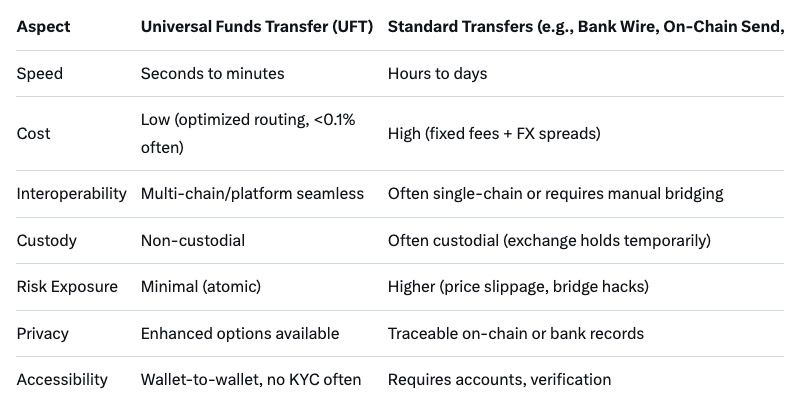
UFT prioritizes efficiency and user control over traditional reliability trade-offs.
Risks of Universal Funds Transfer
While powerful, UFT carries risks traders must understand:
- Slippage: Price changes during routing in volatile markets.
- Smart Contract Risks: Vulnerabilities in aggregators or DEXs.
- Routing Failures: Suboptimal paths leading to higher fees/losses.
- Regulatory Uncertainty: Cross-border transfers may trigger compliance issues.
- Liquidity Risks: Low-liquidity paths cause delays or failures.
- Phishing/Scams: Fake UFT platforms stealing funds.
Mitigations: Use audited, reputable tools; start small; enable slippage tolerances.
In crypto history, bridge hacks (e.g., past wormhole incidents) highlight why non-bridged UFT routing is safer.
Fees in UFT
Fees vary but are generally lower than alternatives:
- Network Gas: Paid on source/destination chains—minimal on efficient networks.
- Protocol Fees: 0.1-0.3% for aggregation/swap.
- No Fixed Costs: Unlike bank wires ($20-50).
- Privacy Add-ons: Extra for anonymous routing.
Average UFT cost in 2025: <$1 for $10,000 transfer vs. $20+ traditional.
Optimization finds zero-fee paths where possible.
Real Examples in Crypto and TradFi
Crypto Examples
- Swapping ETH to SOL instantly for DeFi yields.
- Arbitrage bots using UFT routing for cross-exchange profits.
- NFT flippers transferring proceeds across marketplaces.
- Privacy-focused users routing through mixers for anonymous transfers.
TradFi Examples
- Instant P2P apps like Venmo/Zelle (domestic UFT analogs).
- SEPA Instant in Europe for euro transfers.
- Emerging stablecoin rails (USDC on multiple chains) enabling global UFT.
Hybrid: Platforms blending TradFi rails with crypto for universal access.
How Baltex.io Enables Practical Multi-Chain Fund Transfers and Swaps Using Similar Routing Logic
Baltex.io exemplifies modern UFT in action—a non-custodial instant swap platform using advanced routing for universal-like transfers.
Key features:
- Multi-Chain Support: 20+ networks, 1,000+ tokens—true universal access.
- Intelligent Routing: Aggregates DEXs for best prices, minimal slippage.
- Instant Execution: Atomic swaps without bridges.
- Privacy Options: Private routes breaking traceability.
- No KYC/Limits: Seamless for any volume.
- Low Fees: Optimized paths keep costs minimal.
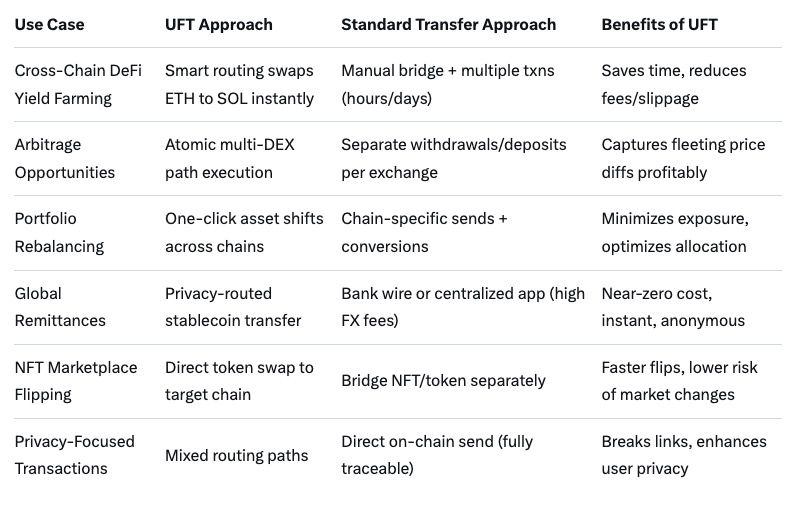
For traders: Move funds universally—e.g., Bitcoin to Polygon tokens—in one click. Ideal for arbitrage, rebalancing, or cross-chain DeFi.
Baltex.io brings UFT practicality to everyday trading. Visit https://baltex.io for seamless transfers.
FAQ
Q: Is UFT the same as a regular crypto transfer? A: No—regular is direct send; UFT uses smart routing for cross-platform efficiency.
Q: Are UFT transfers reversible? A: Generally no—blockchain finality applies; choose trusted tools.
Q: How safe is UFT compared to bridges? A: Safer—avoids bridge custody risks via direct aggregation.
Q: Can beginners use UFT? A: Yes—user-friendly platforms make it simple with previews.
Q: What fees should I expect? A: Typically <0.5% total, plus gas—far below banks.
Q: Is UFT available in TradFi? A: Emerging via instant payments; crypto leads adoption.
Conclusion
Universal Funds Transfer (UFT) transforms trading by enabling seamless asset movement across boundaries—essential in fragmented crypto markets. Faster, cheaper, and more flexible than standards, it empowers beginners to access opportunities and intermediates to optimize strategies. With risks manageable via reputable tools, UFT drives efficient trading in 2025. Platforms like baltex.io make it accessible, bridging to a truly universal financial future.
Related reading: Why Does Monero Have a Tail Emission? Supply Model Explained.
Related reading: What Is the Arbitrum Bridge and Which Assets Does It Support.
Related reading: Why Does Monero Have a Tail Emission? Supply Model Explained.
Related reading: What Is the Arbitrum Bridge and Which Assets Does It Support.