



 2 minutes to read
 Ecosystem
What is a Privacy Coin? (And Why Monero Leads Them All)
TLDR A privacy coin uses protocol-level cryptography to hide sender, receiver, and transaction amounts by default, unlike transparent blockchains like Bitcoin or Ethereum where every transfer is publicly traceable. In 2026, Monero leads the sector because its mandatory ring signatures, stealth addresses, and RingCT create unbreakable unlinkability without optional settings or compromises, giving users true financial privacy for payments, donations, and cross-chain moves. Other privacy coins like Zcash or Dash offer selective privacy but fall short on default protection and real-world liquidity. Trade-offs include lower exchange accessibility and swap fees, but tools like baltex.io solve cross-chain liquidity without KYC. Overall, Monero is the gold standard for anyone prioritizing anonymity over convenience in 2026.
Privacy coins exist because most blockchains are transparent by design: every transaction reveals sender, receiver, and amount to anyone with a block explorer. This public ledger enables powerful analysis tools used by governments, exchanges, and advertisers, eroding financial privacy. Privacy coins solve this problem with built-in cryptography that makes transactions unlinkable and untraceable. In 2026, Monero stands above the rest because its privacy is mandatory, robust, and battle-tested, while competitors offer optional or weaker protections. This guide explains what privacy coins are, how they work, and why Monero leads the category. It also covers real-world trade-offs in liquidity, swaps, exchange access, and usability, plus how tools like baltex.io help privacy-coin users move value across chains without sacrificing anonymity.
What Makes a Coin a Privacy Coin?
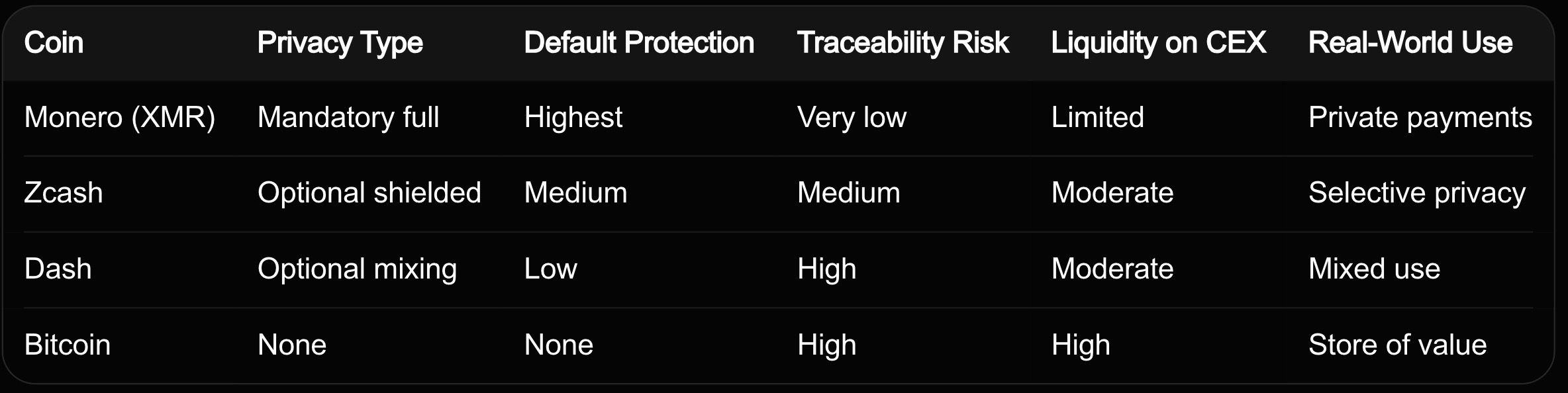
A privacy coin is any cryptocurrency whose protocol hides at least one of three key details: who sent the funds, who received them, and how much was transferred. Transparent coins like Bitcoin record every detail publicly, allowing chain analysis to link addresses and track flows. Privacy coins use cryptographic techniques to break these links. The strongest ones, like Monero, hide all three elements by default, so no observer can trace transactions even with unlimited computing power. Weaker privacy coins offer optional privacy modes that users must enable, leaving most transactions exposed. In 2026, the distinction matters because regulators increasingly target transparent chains for surveillance, making default privacy a competitive advantage. As explained in our monero-vs-zcash-vs-dash-privacy-coins-2026 and what-is-monero-xmr-2025-ultimate-privacy-coin-explained, true privacy coins prioritize unlinkability over optional features.
Monero’s Core Privacy Technologies
Monero achieves anonymity through three integrated mechanisms that work together in every transaction. Ring signatures mix the real sender’s input with decoy inputs from other users’ past transactions, creating a ring of possible signers. The actual sender cannot be identified because the signature proves only that one of the ring members authorized the spend. Stealth addresses generate a unique one-time address for each payment, so the receiver’s public address never appears on-chain. Ring Confidential Transactions (RingCT) hide the amount using commitments and range proofs, proving the value is valid without revealing the number. In 2026, these technologies remain mandatory, making every XMR transaction private by design. As detailed in our how-does-monero-xmr-work-privacy-features-explained-2025, the combination creates an anonymity set that defeats even advanced chain analysis.
How Privacy Coins Differ from Transparent Cryptocurrencies
Transparent cryptocurrencies like Bitcoin record every transaction in a public ledger. Anyone can see exactly who sent funds to whom and how much. Ethereum adds smart contracts but keeps the same transparency, allowing full visibility of token flows. Privacy coins flip this model. Monero’s mandatory privacy makes tracing impossible without the private keys. Zcash offers optional shielded transactions using zk-SNARKs, but most activity remains transparent. Dash uses optional PrivateSend mixing, which is weaker than Monero’s default protection. In 2026, this difference affects everything from exchange listings to real-world usability. As explained in our monero-vs-zcash-vs-dash-privacy-coins-2026, Monero’s default approach provides stronger guarantees without user configuration.
Transaction Traceability and Privacy Guarantees
On transparent chains, traceability is trivial: analysts link addresses through common spending patterns or exchange deposits. Privacy coins break these links. Monero’s ring signatures create plausible deniability for the sender, stealth addresses prevent receiver linkage, and RingCT hides amounts. The result is that even sophisticated surveillance cannot confidently connect transactions. Other privacy coins offer weaker guarantees because their privacy is optional or relies on smaller anonymity sets. In 2026, Monero’s design remains the benchmark because it protects users against chain analysis without any extra steps. As explained in our what-is-monero-xmr-2025-ultimate-privacy-coin-explained, this makes Monero ideal for privacy-conscious payments and donations.
Fees, Liquidity Access, and Exchange Restrictions
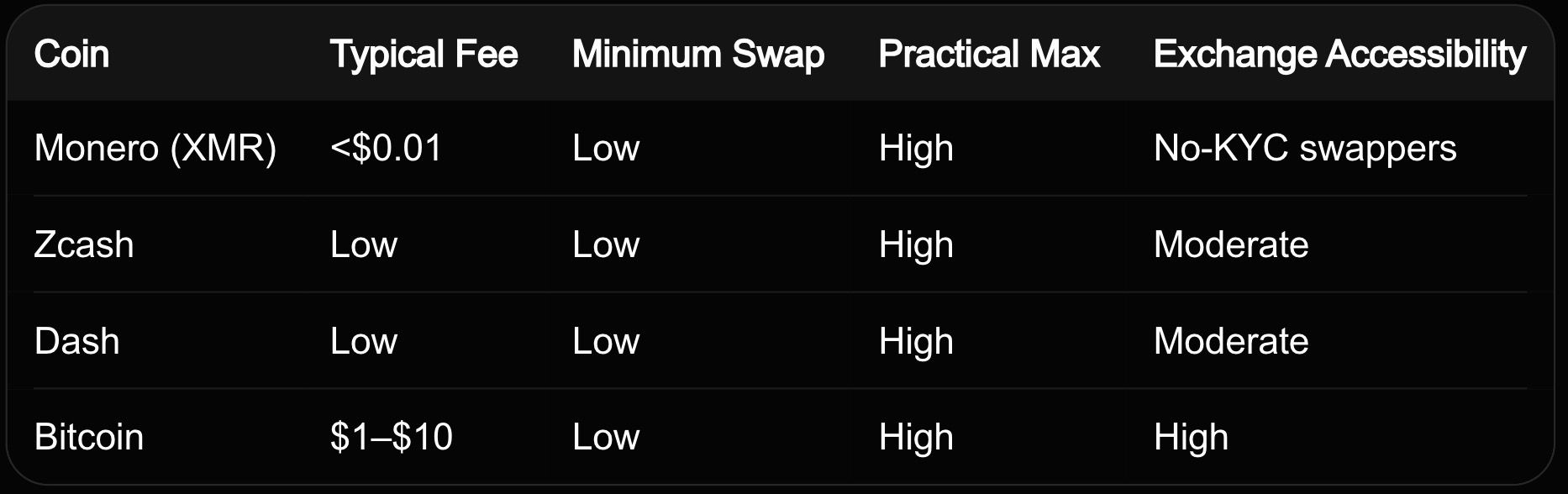
Privacy mechanisms add slight overhead, but Monero fees remain very low—typically under $0.01 per transaction due to dynamic block sizes. Liquidity access is the main trade-off: many centralized exchanges delist privacy coins due to regulatory pressure, forcing users to no-KYC swappers or P2P markets. This creates thinner order books and higher slippage for large swaps. Exchange restrictions limit mainstream adoption but strengthen privacy for those who value it. In 2026, Monero users often combine it with aggregators for cross-chain liquidity. As explained in our best-no-kyc-monero-xmr-swappers-2026 and how-to-buy-monero-xmr-with-fiat-2026-onramps, the trade-off is convenience versus unlinkability.
Here is the privacy coin comparison table:
Here is a fees and limits context table (2026 averages):
Real-World Use Cases
Monero is used for private payments, donations, and merchant transactions where unlinkability is essential. In 2026, it powers cross-border remittances and privacy-focused DeFi on supported platforms. Challenges include liquidity fragmentation and slower swap routing compared to transparent chains. Users often combine Monero with no-KYC swappers for access to other ecosystems. As explained in our where-to-spend-monero-xmr-best-merchants-2026 and best-no-kyc-monero-xmr-swappers-2026, Monero’s privacy makes it valuable for real-world use despite accessibility hurdles.
How baltex.io Enables Practical XMR Swaps and Cross-Chain Liquidity
Monero’s privacy features limit direct integration with many bridges and DEXs, but baltex.io enables practical XMR swaps and cross-chain liquidity by scanning multiple no-KYC routes and liquidity sources internally. Private Swap mode inserts shielded Monero hops that fully break on-chain links using ring signatures and stealth addresses before delivering clean assets on destination chains. Settlements complete in 8–35 minutes even for cross-chain pairs, fees stay low at ~0.4–0.8%, and there are virtually no limits. Supporting over 10,000 tokens across 200+ networks without manual bridging, baltex.io delivers true one-click optimization for Monero users.
Users swapping XMR to USDT, SOL, or Ethereum L2s benefit enormously—especially when pairing with tools covered in our no-kyc-crypto-swaps-usdt-to-xmr-privately and eth-to-xmr-exchange-transfer-ethereum-to-monero-safely. Use atomic swaps for pure privacy and switch to baltex.io when speed and liquidity are needed without KYC.
Conclusion
Privacy coins like Monero use protocol-level cryptography to hide transaction details, offering unlinkability that transparent cryptocurrencies cannot match. Monero leads the sector in 2026 because its mandatory ring signatures, stealth addresses, and RingCT provide stronger default protection than optional systems in Zcash or Dash. While this privacy creates trade-offs in liquidity and exchange access, it delivers unmatched financial freedom. Tools like baltex.io make cross-chain liquidity practical without compromising anonymity.
Always use fresh subaddresses, Tor, and small test swaps. Explore more strategies in our what-is-monero-xmr-2025-ultimate-privacy-coin-explained, how-does-monero-xmr-work-privacy-features-explained-2025, and best-no-kyc-monero-xmr-swappers-2026 guides to keep your Monero usage private and efficient.
What is a privacy coin? 
Why does Monero lead privacy coins?
How do privacy coins affect liquidity?
Is baltex.io good for privacy-coin swaps?
See others posts
G. Khan

Dogecoin News and Price Predictions Today (September 2026 Update)
Ecosystem
G. Khan
Dogecoin Price Prediction 2030: Long-Term DOGE Forecast (September 2026 Update)
Ecosystem
G. Khan
Dogecoin Price Prediction 2027
Ecosystem
G. Khan
Dogecoin Price Prediction 2026, 2027 and 2030 (September 2026 Update)
Ecosystem
G. Khan
Solana Price Prediction 2030 (September 2026 Update)
Ecosystem
G. Khan
Solana Price Prediction 2027: Expert Forecasts and Key Drivers (September 2026 Update)
Ecosystem