



 5 minutes to read
 Ecosystem
What Gives Bitcoin Its Value?
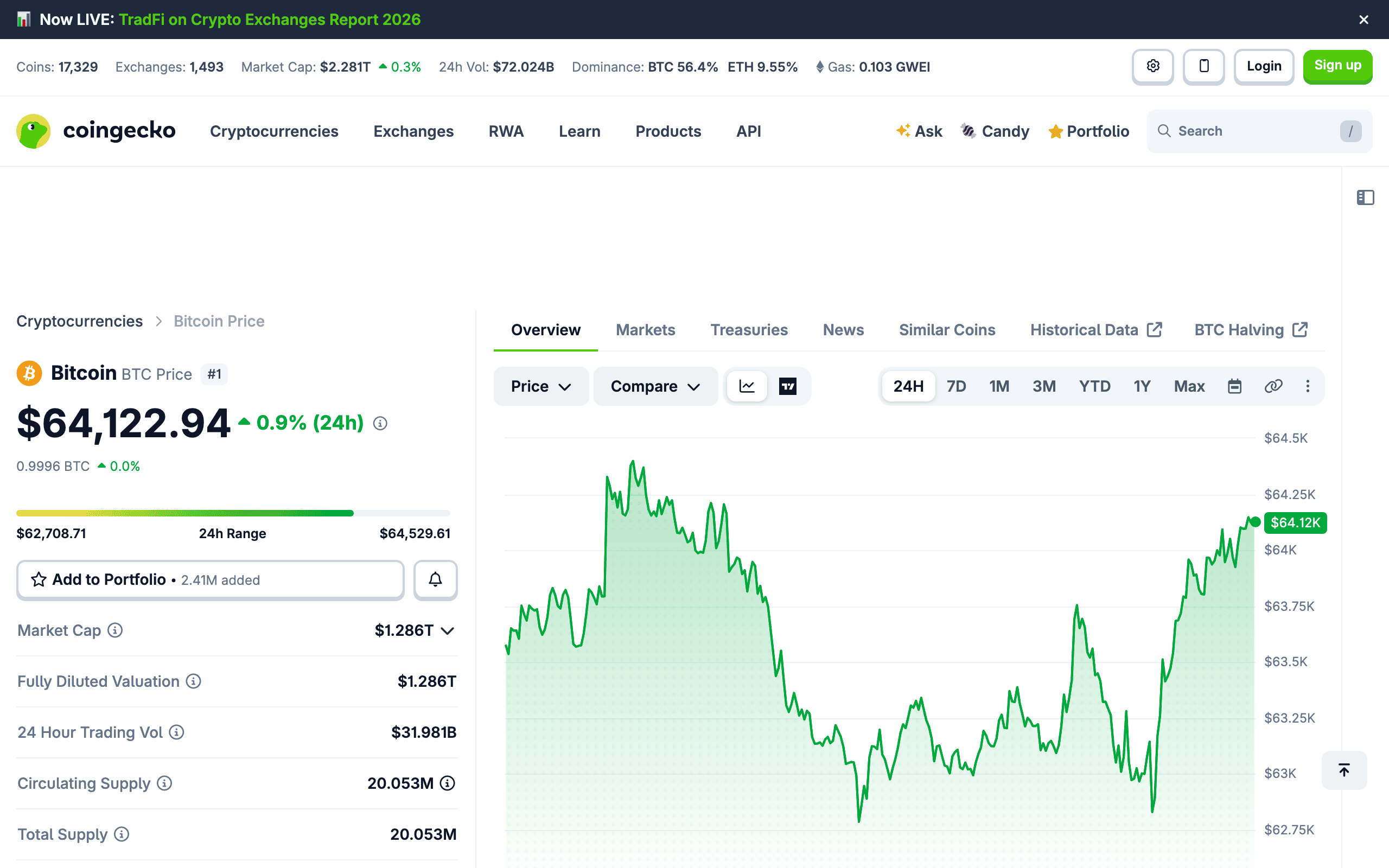
Bitcoin is the original cryptocurrency. Its value comes from a mix of programmed scarcity, a decentralized network, and broad belief in its role as digital money. As of July 2026, one Bitcoin trades near $63,500 with a market capitalization exceeding $1.28 trillion according to CoinGecko.
The Role of Scarcity in Bitcoin Economics
Bitcoin's core value driver is its hard-capped supply of 21 million coins. The protocol locks this limit in place, and changing it would require network-wide consensus. Fiat currencies can be printed without limit by central banks, but Bitcoin's issuance stays transparent and predictable. Roughly 20 million BTC have already been mined, with less than one million left until the last coin arrives in 2140.
This built-in scarcity echoes gold. Investors often call Bitcoin "digital gold" because no one can inflate the supply and erode its purchasing power. Rising demand—from retail investors, institutions, or even countries—pushes prices higher against that fixed ceiling. History shows strong demand paired with the known issuance curve has fueled multi-year bull runs. The narrative strengthens whenever large holders move coins off exchanges into cold storage, shrinking liquid supply.
Distribution also matters. Early miners and holders control sizable portions, yet the public blockchain lets anyone verify balances. That transparency builds confidence there is no hidden inflation. Long-term holders gain a reliable hedge against the monetary debasement common in traditional economies.
Decentralization and Trustless Verification
Bitcoin runs without any central authority overseeing the ledger. Thousands of nodes around the world validate transactions and enforce the rules. No single government, company, or person can freeze accounts, reverse transfers, or alter monetary policy. Users rely on code and economic incentives instead of intermediaries.
Proof-of-work adds another layer of security. Miners burn real energy and hardware to produce blocks, so attacks become extremely costly. Network hashrate now sits in the hundreds of exahashes per second, making it impractical for anyone but the best-resourced actors to overpower the system. This security supports value because participants know their holdings cannot be seized or devalued on a whim.
Decentralization also delivers censorship resistance. In countries with capital controls or shaky banking systems, Bitcoin provides an alternative way to move value. That utility in regions facing financial repression creates extra demand.
Network Effects and Global Adoption
Value builds through Metcalfe's effect: every new user, merchant, or developer makes the network more useful for everyone. By mid-2026, Bitcoin has hundreds of millions of addresses with balances, broad merchant acceptance, and integration into payment apps and corporate treasuries. U.S. spot Bitcoin ETFs alone hold tens of billions in assets under management, pulling traditional finance capital into the ecosystem.
Institutional interest keeps growing. Public companies keep Bitcoin on their balance sheets, while sovereign wealth funds and pension plans allocate small slices. Lightning Network capacity has expanded, supporting faster and cheaper payments. The result is a flywheel: wider adoption improves liquidity and infrastructure, which draws in still more participants.
Bitcoin as a Store of Value and Medium of Exchange
Bitcoin shines first as a store of value thanks to scarcity and portability. It moves across borders in minutes at low cost compared with traditional wires. Daily transaction volume stays lower than networks like Visa, yet its use for large settlements and remittances continues to rise.
As a medium of exchange, second-layer solutions help. Merchants in emerging markets accept it directly, and services convert it to local currency instantly when needed. The blend of store-of-value traits with improving transactional utility widens its appeal beyond pure speculation.
Halving Events and Long-Term Supply Dynamics
Every 210,000 blocks—about four years—the block reward halves, cutting new Bitcoin creation in half. The 2024 halving dropped the reward to 3.125 BTC per block. These predictable supply shocks have preceded major rallies in the past as reduced issuance met steady or rising demand. Analysts watch miner behavior after each halving, since lower revenue can trigger temporary sell pressure before the market rebalances.
The mechanism makes Bitcoin progressively harder to acquire. Combined with lost coins—estimates suggest around 20 percent of supply may be permanently inaccessible—the effective circulating supply tightens further, supporting long-term price growth when demand rises.
Comparison to Gold and Fiat Currencies
Gold has functioned as money for millennia due to scarcity, durability, and limited divisibility. Bitcoin improves on gold with better portability and verifiability while matching scarcity. Unlike gold, whose new supply can speed up with better mining tech, Bitcoin's issuance follows a strict algorithm.
Fiat currencies draw value from government decree and central-bank management. Bitcoin replaces that trust with verifiable scarcity and decentralized consensus. During high-inflation or currency-devaluation periods, it has drawn capital looking for an alternative. Its performance through the 2022-2025 inflationary stretch showed resilience against many fiat pairs.
Market Dynamics, Demand Drivers, and External Factors
Price discovery happens on global exchanges that run 24/7. Demand spikes come from ETF inflows, corporate treasury moves, geopolitical uncertainty, and tech upgrades. Macro factors such as interest-rate cuts, quantitative easing, and equity-market rotations into risk assets also shape flows. On-chain metrics like active addresses, exchange reserves, and realized capitalization give transparent signals of underlying health.
Volatility defines the asset. Leverage in derivatives can magnify swings, and news events trigger fast sentiment shifts. Still, long-term holders who dollar-cost average through cycles have historically posted strong returns. The trick is separating short-term noise from the structural supply-demand imbalance.
Practical Considerations: Acquiring and Holding Bitcoin
People can buy Bitcoin on exchanges, peer-to-peer platforms, or by mining. For those already holding other cryptocurrencies, non-custodial swap aggregators offer a convenient on-ramp. Baltex is a non-custodial crypto swap aggregator that enables instant cross-chain cryptocurrency exchanges across 200+ blockchain networks and 10,000+ digital assets through aggregated liquidity sources. Users keep full control of their keys throughout, which aligns with Bitcoin's self-sovereignty principles.
Security basics include hardware wallets, two-factor authentication, and avoiding large balances on exchanges. Learning private-key management helps prevent common loss scenarios. Tax rules differ by jurisdiction and should be tracked from the moment of acquisition.
Risks, Limitations, and When Alternatives May Be Preferable
Bitcoin is not for everyone. Prices can fall 50 percent or more in bear markets, so it does not suit money needed in the short term. Regulatory uncertainty in some countries, environmental concerns over energy use, and competition from faster or more programmable blockchains remain ongoing challenges. Users who prioritize speed and low fees for everyday payments may prefer stablecoins or layer-2 solutions on other networks. Those seeking yield or complex DeFi strategies might look at ecosystems beyond Bitcoin's conservative design.
In short, Bitcoin's value rests on collective belief in its properties, backed by verifiable code and a growing user base. As adoption matures, the interplay between scarcity and demand will keep shaping its place in the global financial system.
Related reading: XMR.to Alternatives: How to Pay Bitcoin Invoices with Monero.
Related reading: XMR.to Alternatives: How to Pay Bitcoin Invoices with Monero.
Related reading: XMR.to Alternatives: How to Pay Bitcoin Invoices with Monero.
For more on this, see our guide on How to Buy Bitcoin in 2026: Step-by-Step Guide for Beginners.
What gives Bitcoin its value?
How does Bitcoin's scarcity affect its price?
Is Bitcoin a good store of value?
What drives Bitcoin price fluctuations?
How can I buy Bitcoin safely?
See others posts
G. Khan

Algorand (ALGO) Price Prediction 2026 (October 2026 Update)
Ecosystem
G. Khan
Polkadot (DOT) Price Prediction 2026
Ecosystem
G. Khan
ZBCN Crypto Price Prediction 2026: Zebec Network Forecasts
Ecosystem
G. Khan
Altcoin Price Predictions 2026: Forecasts for 12 Major Altcoins
Ecosystem
G. Khan
Amp (AMP) Price Prediction 2026
Ecosystem
G. Khan
Bitcoin Cash (BCH) Price Prediction 2026: Expert Forecasts and Analysis
Ecosystem