3 minutes to read
 Ecosystem
How to Bet on Polymarket: A Beginner's Guide to Prediction Markets
Updated October 21, 2026. This guide is educational, not financial or legal advice. Prediction-market rules differ by country and, in the US, by state.
In the fast-evolving world of cryptocurrency and decentralized finance (DeFi), prediction markets are gaining traction as a way to speculate on real-world events with the precision of stock trading. If you're new to crypto and curious about platforms like Polymarket, you're in the right place. This 2026 guide breaks down everything from the basics of how Polymarket works to step-by-step instructions for placing your first bet. Whether you're eyeing a sports match or an election, we'll cover onboarding, wallets, deposits, market types, fees, risks, and where Polymarket is and isn't available.
Optimized for beginners, this article includes practical tips, comparisons to other platforms, and a shoutout to tools like baltex.io for funding your wallet. By the end, you'll be equipped to dive in with a clearer picture of both the upside and the risks. Let's get started.
TL;DR: Quick Start on Betting with Polymarket
- What is Polymarket? A crypto-based prediction market on the Polygon blockchain where you trade shares in event outcomes using USDC.
- Availability: The international platform is geoblocked for US IP addresses and restricted in some other countries. US residents can use a separate, CFTC-regulated app, Polymarket US, which requires full KYC.
- Onboarding: Sign up with email or Google (Polymarket creates a wallet for you) or connect a wallet like MetaMask.
- Funding: Buy USDC on an exchange, or swap on baltex.io if you hold another coin, then deposit to your Polymarket address.
- Placing Bets: Browse markets (sports, politics, crypto), buy "Yes" or "No" shares, and trade any time before resolution.
- Fees: Polymarket no longer trades fee-free. Since 2026, takers pay a category-based fee of up to $1.75 per 100 shares, while makers pay nothing and geopolitics markets are free.
- Key Risks: Price swings, thin liquidity, oracle disputes, phishing and crypto security issues. Start small.
- Payouts: Winning shares redeem for $1 each; disputed outcomes are settled through UMA's optimistic oracle.
- Vs. Others: Kalshi now leads in total volume and is fully regulated in the US; Polymarket is more crypto-native.
What Are Prediction Markets and How Does Polymarket Fit In?
Prediction markets are platforms where users buy and sell shares in the outcomes of future events, much like trading stocks but tied to real-world happenings. Think of it as crowd-sourced forecasting: prices reflect the crowd's expectations. For example, if a market on "Will Team A win Sunday's game?" shows "Yes" shares at $0.65, the crowd gives them roughly a 65% chance.
Polymarket, launched in 2020, is one of the two largest prediction markets in the world. Built on the Polygon blockchain (an Ethereum sidechain for cheap, fast transactions), it uses USDC, a dollar-pegged stablecoin, for trading. Smart contracts handle settlement, and contested outcomes go to a token-holder oracle, as explained in the resolution section below.
The category has grown quickly. Kalshi and Polymarket together recorded about $44.8 billion in monthly volume in June 2026, driven by the FIFA World Cup. Kalshi accounted for $31.5 billion of that, Polymarket's international platform about $10.3 billion, and Polymarket US about $3.0 billion. Sports now dominate: Pew Research found that since mid-2024 sports made up about 39% of Polymarket's volume, politics 32%, and crypto 20%.
Benefits for Beginners
- Low Barrier: On the international platform you can start with email sign-up, and there is no KYC on the main site.
- Educational: Prices teach probability, which is great for learning how markets work.
- Tradable: You can sell shares before the event ends, so you can take a profit or cut a loss.
But it's not risk-free, and for many people it is closer to gambling than investing. Treat any stake as money you can afford to lose.
Onboarding: Signing Up on Polymarket
Getting started on Polymarket is simple, and you can choose between a managed wallet and your own.
Step 1: Check That You Can Use It
Polymarket's international site (polymarket.com) is blocked for US IP addresses and unavailable in some other countries. Do not use a VPN to get around this: US authorities have already prosecuted a case involving an American who used a VPN to access the international exchange, and accounts can be frozen. US residents should use Polymarket US instead, which is CFTC-regulated, requires full identity verification, and was opened to US users on iOS in May 2026, with state availability varying.
Step 2: Create an Account
Go to polymarket.com and click "Sign Up." You can:
- Enter your email or sign in with Google, in which case Polymarket creates an embedded wallet for you.
- Connect an existing wallet such as MetaMask, Rainbow, Coinbase Wallet, Phantom, or WalletConnect.
Polymarket's executive said in May 2026 that no KYC is being added to the existing platform, only to a separate beta product, but rules can change, so check the current terms.
Step 3: Set Up a Wallet (If You Bring Your Own)
Beginners often use:
- MetaMask: Free browser extension; download from metamask.io.
- WalletConnect: For mobile apps like Trust Wallet.
Install MetaMask:
- Add the extension to Chrome/Firefox.
- Create a new wallet and write down your 12-word seed phrase (back it up securely and never share it).
- Set a strong password.
You will usually need the Polygon network added in MetaMask. Polymarket covers the gas for new-account deposits, but keep a few cents of POL (formerly MATIC) if you ever sign a transaction directly from your wallet.
For more on wallets, see Setting Up a Wallet.
Time: about 5 minutes. Cost: Free.
Setting Up a Wallet for Polymarket
Wallets are your gateway to crypto. Think of them as digital bank accounts you control, with no bank in the middle.
Why a Crypto Wallet?
Polymarket runs on blockchain, and your funds sit in a wallet tied to your account. Wallets store the private keys used to sign transactions.
Recommended Wallets for 2026 Beginners
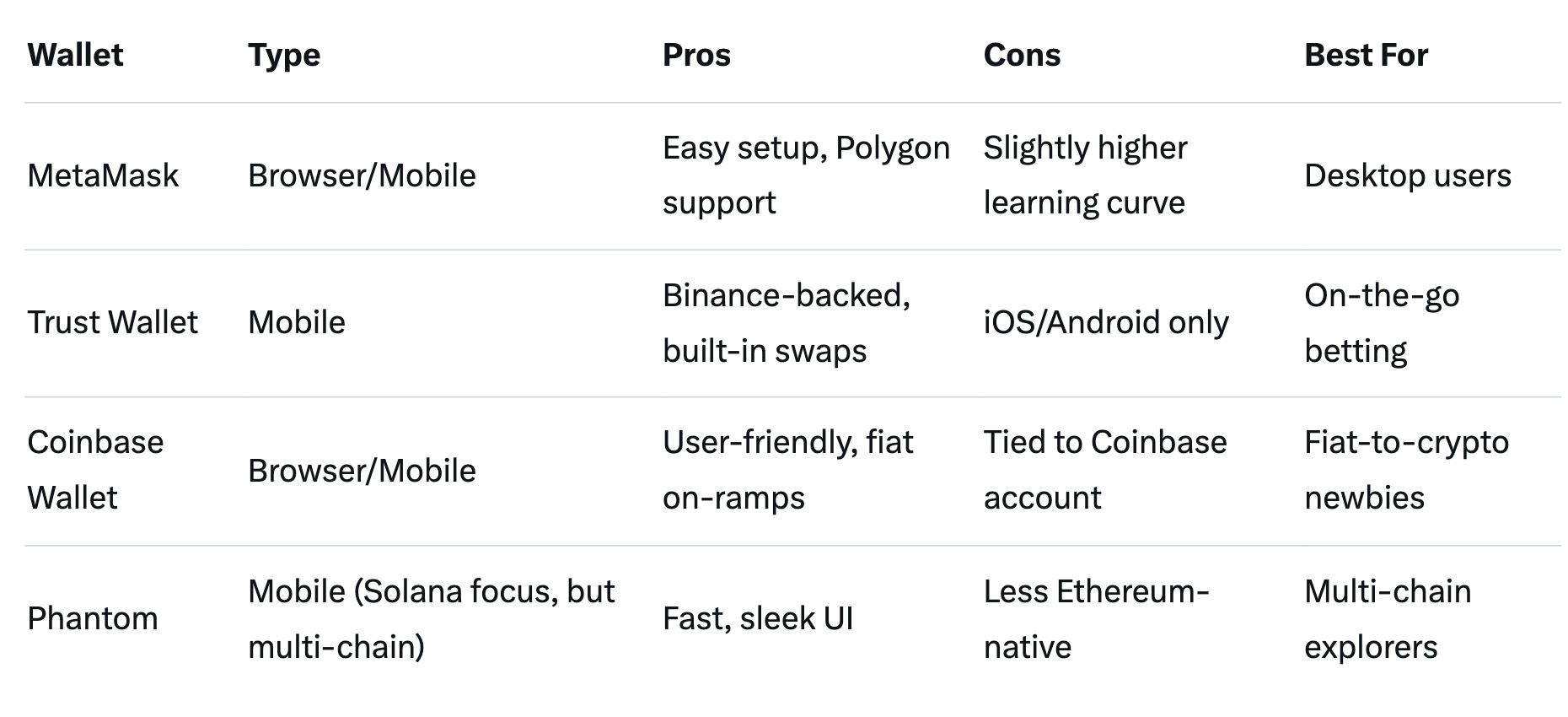
Start with MetaMask or the email option: after setup, fund your account with USDC, as described below.
Security 101:
- Use hardware wallets (e.g., Ledger) for large sums.
- Avoid phishing: only connect to the official site. In June 2026, Polymarket reported a $2.94 million frontend phishing incident and said it would reimburse affected users.
- Enable biometric locks and two-factor authentication where available.
Depositing Funds: Funding Your Polymarket Wallet
Trading requires USDC. Polymarket settles on Polygon and has reportedly standardized its on-platform collateral on pUSD, which USDC deposits convert into automatically. Minimum deposits are small, around $3 in recent guides.
Step-by-Step Deposit
- Acquire USDC: Buy on a centralized exchange (CEX) like Coinbase or Binance. Polymarket's deposit screen has also offered card payments (via MoonPay), exchange connections, and PayPal in some regions, so check what is available to you.
- Swap if Needed: Holding BTC or ETH instead? A swap service like baltex.io can convert it to USDC. Baltex advertises low fees shown before you confirm, no account for standard swaps, and an average completion time under 5 minutes. It can request KYC if a transaction trips its risk checks. Its Crypto Bridge also covers Polygon and other L2 and EVM chains.
- Send on the Right Network: Polymarket's deposit page lists the supported tokens and networks. USDC on Polygon is the most direct route, and some chains such as Ethereum and Base are also accepted. Check the screen and match the network exactly, because a wrong-network transfer can be lost.
- Confirm on Polymarket: Copy your deposit address from the Deposit page, send the funds, and wait for them to appear.
Withdrawals mirror this: request USDC back to your wallet or exchange. Polymarket itself charges no deposit or withdrawal fee, though your exchange, card provider, or bridge may.
Pro Tip: Start with $20 to $50 to test the process before depositing more.
Understanding Market Types on Polymarket
Polymarket categorizes events for easy navigation. In 2026, sports lead by volume, with politics and crypto close behind.
Core Market Types
- Binary Markets: Yes/No outcomes. E.g., "Will Team A win the final?" Shares: Yes ($0.40) or No ($0.60).
- Multi-Outcome Markets: 3+ choices. E.g., "Who will win the 2026-27 NBA MVP?" with a share price for each candidate.
- Scalar-Style Markets: Range predictions, often built from several bins. E.g., "Ethereum price on Dec 31, 2026?" with a market per price range.
- Sports Markets: Moneylines, spreads, totals, and player props, often with high volume.
- Politics & Crypto: Elections, policy decisions, and token events.
Browse via categories such as Politics, Crypto, and Sports. Each market shows volume, liquidity, fee information, and the resolution date and rules.
Liquidity matters: high-volume markets trade smoothly, while thin ones may have wide spreads.
For examples, check current popular markets on Polymarket.
Placing Your First Bet: A Step-by-Step Walkthrough
Steps to Bet
- Connect and Navigate: Signed in? Search or browse to the market.
- Analyze Odds: "Yes" at $0.55 means a 55% implied probability. Charts show historical prices.
- Choose Side: Buy "Yes" shares if you think the event will happen. Enter an amount: $10 buys about 18 shares ($10 / $0.55).
- Confirm Trade: Review the price impact and the fee shown for that market, then confirm.
- Hold or Trade: Sell any time if the odds shift. If news moves "Yes" from $0.55 to $0.65, your shares are worth more; if it falls to $0.45, they are worth less.
Payout: If Yes wins, each share redeems for $1 USDC. Your roughly 18 shares become about $18, a gain of about $8, before fees. If No wins, they expire worthless.
Tools: Use limit orders to set your price and avoid taker fees. The mobile app mirrors the web version.
Common Mistake: Ignoring the resolution rules. Read the fine print on exactly what counts and when, because wording is what decides disputed markets.
Fees and Costs: What You'll Pay on Polymarket
Polymarket used to charge no trading fees. That changed in 2026, when it rolled out taker fees in stages: high-frequency crypto markets in January, select sports in February, and most other categories from March 30, 2026.
Breakdown
- Taker Fees: Charged when you take liquidity (market orders). The fee equals shares × rate × price × (1 − price), so it peaks at a 50¢ price and shrinks toward the extremes. As of October 2026, rates run about 0.07 for crypto (max $1.75 per 100 shares), 0.05 for economics, culture, weather, and newer sports markets ($1.25), 0.04 for politics, finance, tech, and mentions ($1.00), and 0.03 for NFL and college football game markets ($0.75). Geopolitics and world-events markets are fee-free. Each market has its own schedule, and some older markets carry older rates, so check the market page.
- Maker Fees: None. Limit orders that add liquidity pay $0 and can earn rebates.
- Gas Fees: Small on Polygon, and often covered by Polymarket for deposits.
- Deposit and Withdrawal: No Polymarket fee, though exchanges, card providers, and bridges may charge theirs.
- Fees on Winnings: None.
- Swaps via Baltex.io: Low fees shown before you confirm, plus network costs.
Worked example: $10 buys about 18.18 shares at 55¢. On a market with a 0.05 taker rate, the fee is about 18.18 × 0.05 × 0.55 × 0.45 = $0.22. Polymarket US has its own, separate fee schedule.
Spreads also matter. The gap between the buy and sell price can cost more than the fee in thin markets.
Risks of Betting on Polymarket: What Beginners Should Know
Prediction markets aren't get-rich-quick schemes, and crypto adds extra layers of risk.
Top Risks
- Market Risk: A wrong prediction means a loss. Diversify and size positions carefully.
- Liquidity Risk: Illiquid markets make exits hard, so stick to high-volume ones.
- Oracle and Rules Risk: Disputes are no longer rare. A Wall Street Journal analysis reported that Polymarket had more than 1,150 disputed markets in 2026 by May, already above its 2025 total. In June 2026, a market on whether Strategy would sell Bitcoin by May 31 resolved "No" after two dispute rounds, even though Strategy later disclosed selling 32 BTC. Read the rules closely.
- Crypto and Security Risks: Hacks, phishing, wrong-network transfers, and bridge failures. Use hardware wallets and official links only.
- Regulatory Risk: The international platform is geoblocked in the US and restricted elsewhere, and more than a dozen US state regulators have taken action against prediction markets. Do not use VPNs to bypass restrictions.
- Emotional Risk: FOMO leads to over-betting, so set limits.
Mitigate: Start with $20 to $50, research events, prefer limit orders, and never bet money you need.
Outcome Resolution: How Winners Get Paid
Resolution is the part of Polymarket where trust matters most. Blockchain settlement is transparent, but the question of what actually happened is decided by an oracle.
Process
- Event End: The market closes (e.g., after the final whistle).
- Proposal: Someone proposes an outcome to UMA's optimistic oracle, using public data (e.g., official scores or filings).
- Challenge Window: If nobody challenges, the proposal stands. If it is challenged, the proposal can be challenged a second time, and then the question goes to a vote by UMA token holders, which runs for roughly two days.
- Payout: Smart contracts redeem winning shares for $1 USDC each. Claim via the "Redeem" button.
Undisputed markets resolve quickly, often within hours. Disputes are different: the vote is weighted by token holdings, and the WSJ analysis found that in most disputed markets more than half of the votes came from the ten largest wallets. Polymarket cannot override the vote, and alternatives such as Hyperliquid's outcome markets use different resolution designs.
Funds stay in your wallet or account after payout, and you can withdraw any time.
Polymarket vs. Other Prediction Platforms: Which is Right for You?
Polymarket is crypto-native, but competitors cater to different needs. Here's a 2026 comparison:
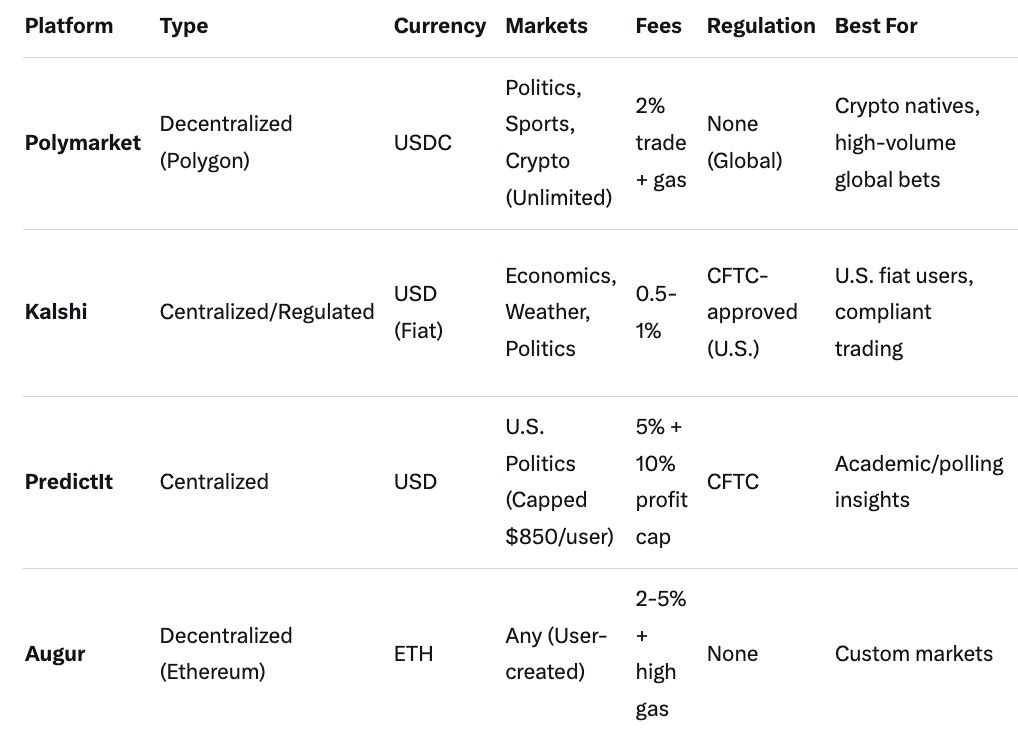
Verdict: Kalshi currently leads in total volume ($31.5 billion in June 2026 versus about $10.3 billion for Polymarket's international platform) and is fully regulated in the US, with fiat deposits and KYC. Polymarket offers crypto-native access, broader market variety outside the US, and its own regulated Polymarket US app. Newer venues such as Rothera, Limitless, and Hyperliquid's outcome markets are also entering the field. Confirm each platform's current availability and fee schedule before you deposit.
For swaps to fund any crypto-based platform, baltex.io can help with the conversion step.
FAQ: Common Polymarket Questions for Beginners
What is the minimum bet on Polymarket?
Deposits can start around $3, and each market has its own minimum order size. $10 or more is a practical starting point.
Is Polymarket legal in the U.S.?
The international site is geoblocked for US users, and using a VPN to access it is not safe. Polymarket US is a separate CFTC-regulated platform that requires full KYC, and some states restrict or challenge prediction markets, so availability varies by state.
How do I cash out winnings?
Redeem shares after resolution, then withdraw USDC to your wallet or exchange and sell for fiat if you wish.
Can I bet on sports like NFL?
Yes. Sports is the largest category by volume, though sports fees and availability vary by platform and region.
What's the difference between buying and trading shares?
Buy and hold for the payout at resolution, or trade to profit from price swings before the event ends.
How accurate are Polymarket predictions?
Prediction-market prices are often a useful signal, but they are not guarantees, and thin or disputed markets can be unreliable. We could not verify a single accuracy figure, so treat any such claim with caution.
Conclusion: Your First Bet Awaits—Bet Smart, Stay Informed
Polymarket makes forecasting accessible, blending crypto's open access with real-world stakes. From quick onboarding to on-chain payouts, it is beginner-friendly on the surface, but fees, oracle disputes, and legal restrictions are real. Remember: research events, read the resolution rules, manage risk, and use tools like baltex.io for the funding step.
Start small: pick a high-volume market with clear rules and a size you can afford to lose. Questions? Drop a comment or connect on X (@baltexio).
Happy betting, and bet responsibly.
Related reading: Best Ways to Buy Bitcoin in 2026: Complete Beginner Tutorial.
For more on this, see our guide on Can XRP Decouple From Bitcoin? Decoupling Scenarios for 2026.