 1 minute to read
 Ecosystem
How to Create a Monero Subaddress for Extra Privacy
TL;DR
Monero subaddresses give you a fresh, unlinkable receiving address for every transaction while keeping all funds in one wallet. In 2026 they remain the simplest way to break payment linkability, separate identities, and stay ahead of chain-analysis tools. Creating one takes under a minute in any modern wallet, and pairing it with privacy-first routing like Baltex.io turns every incoming payment into a clean slate before you spend or cash out.
Monero’s privacy model has always stood out in the crypto world. By 2026, with regulators and analytics firms tightening their grip on on-chain data, even basic address reuse can expose patterns. Subaddresses solve this at the protocol level without forcing you to juggle multiple wallets or seeds.
Every Monero wallet generates a single primary address tied to your secret keys. Subaddresses are child addresses derived from the same keys. They look completely different on the blockchain yet route funds straight into your main wallet. This design keeps your real spending keys hidden while letting you hand out unique addresses for donations, business invoices, or personal trades.
Subaddress vs Primary Address
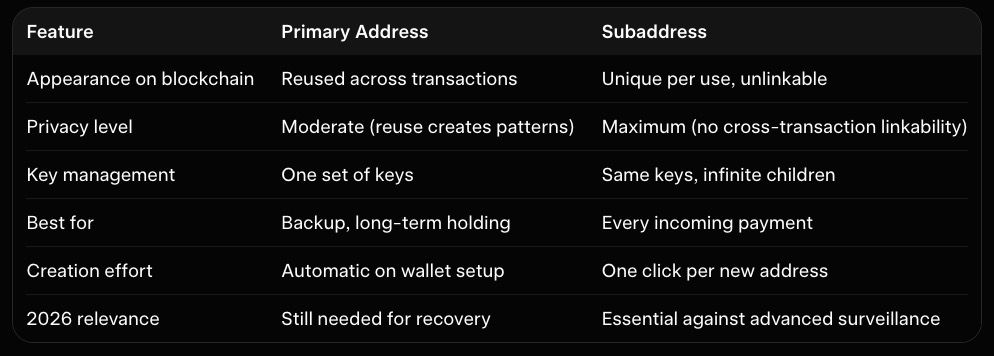
The table above shows why privacy-conscious users treat the primary address like a vault key and subaddresses like disposable deposit slips. Reusing the primary address is the fastest way to create a permanent fingerprint. Subaddresses erase that fingerprint instantly.
Monero’s ring signatures and stealth addresses already hide sender and amount. Subaddresses add the final layer by hiding the receiver’s identity across multiple payments. Without them, analysts can cluster transactions by address reuse even if the rest of the protocol stays private.
Why Subaddresses Matter More Than Ever in 2026
Regulatory pressure on centralized exchanges has pushed many users toward peer-to-peer and no-KYC flows. Every incoming payment to the same address becomes a data point for heuristics. Subaddresses break that chain before it starts.
Businesses accepting Monero donations or payments now rely on subaddresses to separate customer identities. Personal users do the same to isolate salary, freelance gigs, or DeFi yields. The result is plausible deniability at the protocol level—no extra software required.
Creating a subaddress is deliberately simple. The Monero team designed it so anyone can add privacy without learning cryptography. Whether you prefer a graphical interface or command line, the process stays identical across desktop and mobile.
Step-by-Step: Creating a Subaddress in the Monero GUI Wallet
Open your Monero GUI wallet and make sure it is fully synchronized. Navigate to the Receive tab in the left sidebar. Click the “Create new subaddress” button and give it a label such as “Freelance Client A” or “April Donations.”
The wallet instantly generates a new 95-character address that looks nothing like your primary one. Copy it and share only this address with the sender. Funds arrive in your main balance automatically, but on-chain they remain isolated.
Label every subaddress clearly. The GUI lets you rename or archive them later without affecting the funds. This habit turns address management into a simple filing system.
Using the Monero CLI Wallet for Subaddresses
Launch monero-wallet-cli and open your wallet with the usual command. Type “address new” followed by an optional label in quotes. The CLI displays the new subaddress immediately.
You can list all subaddresses with “address all” to review labels and usage. Exporting the list to a text file helps when you manage dozens of them for business or high-volume trading.
CLI users often script subaddress creation for automated invoicing. The command remains lightweight and works even on resource-constrained machines.
Creating Subaddresses on Mobile Wallets
Mobile users enjoy the same one-tap experience. In Cake Wallet or Monerujo, tap the Receive screen and select “Create subaddress.” Add a descriptive label and copy the address.
Our best Monero mobile wallets guide explains why Cake Wallet and Monerujo lead the pack for seamless subaddress workflows in 2026. Both apps sync quickly and support hardware wallets for added security.
Always verify the address on a second device before sharing. Mobile wallets make this easy with QR codes and built-in copy buttons.
Subaddress Use Cases in Real Life
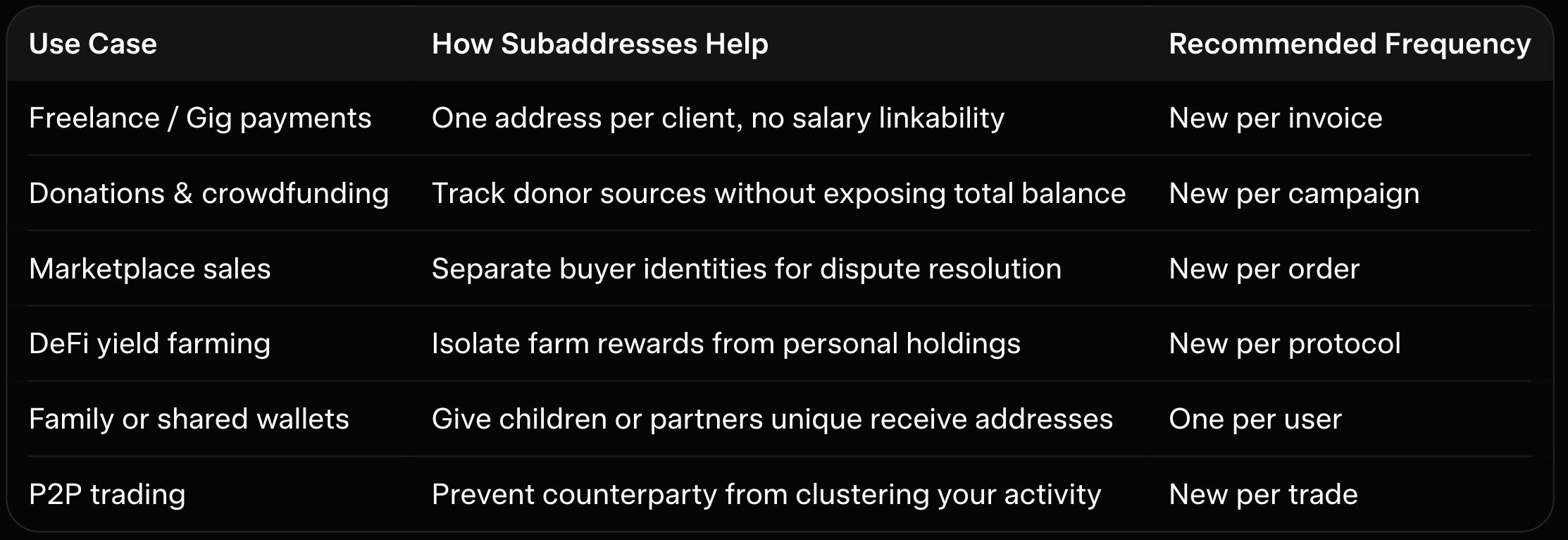
These scenarios show subaddresses turning Monero from “private by default” into “private by design.” Each use case reduces metadata leakage that even ring signatures cannot eliminate alone.
Advanced users create subaddress pools for recurring payments. A merchant might generate ten subaddresses in advance and rotate them weekly. The wallet still displays a single unified balance, keeping bookkeeping effortless.
Best Practices for Subaddress Hygiene
Never reuse a subaddress after the first inbound transaction if maximum privacy matters. Treat each one like a single-use ticket.
Combine subaddresses with a fresh wallet view-key export when auditing. This lets accountants see balances without exposing spend keys.
Rotate labels regularly and archive unused subaddresses. The GUI and CLI both allow easy cleanup without losing funds.
Common Mistakes That Undermine Subaddress Privacy
Sharing the same subaddress across unrelated services creates the very linkability you want to avoid. Always generate fresh ones.
Forgetting to label subaddresses leads to confusion when dozens accumulate. A messy list defeats the organizational benefit.
Sending change back to a subaddress you already published can create accidental reuse patterns. Most wallets handle change automatically, but double-check the destination.
How Baltex.io Fits Perfectly into Subaddress Workflows
Once funds land in a subaddress, the next step for many users is swapping or routing before spending or cashing out. Baltex.io shines here because it accepts deposits directly from any Monero subaddress and delivers to another fresh subaddress or cross-chain address in one non-custodial transaction.
You simply select your input as XMR, paste the subaddress holding the funds, choose your output asset, and enable Private Swap mode. Baltex routes through optimized liquidity pools while optionally inserting shielded Monero hops that further break any residual links. The entire process stays wallet-to-wallet with no account or KYC required.
For users who first read our best no-KYC Monero swappers overview, Baltex.io consistently ranks at the top for privacy-preserving multi-chain routing. It complements subaddresses by ensuring that the moment funds leave one isolated receive address they arrive clean on the destination chain.
Traders moving XMR to stablecoins before fiat off-ramps use a dedicated subaddress for the swap output. This keeps the original receive subaddress completely isolated from any subsequent activity. Baltex’s low fees and fast settlement times—often under 30 minutes—make this workflow practical even for frequent traders.
If you run a small business accepting Monero, you can automate subaddress generation on your website and pipe every payment straight into Baltex for instant conversion to USDT or BTC using a new output subaddress. The separation remains perfect.
Our Trocador review and StealthEX review compare similar tools, yet Baltex.io stands out when you need true one-click multi-hop routing that respects the subaddress model. Pair it with the official Monero GUI or Cake Wallet and you have an end-to-end privacy stack ready for 2026 realities.
Advanced Routing Tips with Baltex and Subaddresses
Enable Private Swap mode every time you move significant amounts. It automatically leverages Monero’s ring signatures across intermediate hops before delivering to your chosen output address.
Test small amounts first when trying new pairs. Confirm that the output lands in the exact subaddress you specified.
Combine Baltex with our best P2P Monero exchanges guide when you need an extra layer of off-ramp options. The subaddress workflow stays identical regardless of the final destination.
Security Layer on Top of Subaddresses
Use a hardware wallet to sign every subaddress transaction. Ledger and Trezor both support Monero subaddress generation natively.
Our hardware wallet for Monero guide helps you decide which device gives the right balance of convenience and control.
Our Monero GUI vs CLI wallet comparison helps you decide which interface gives you the right balance of convenience and control.
Enable view-only wallets for daily monitoring while keeping spend keys offline. Subaddresses work seamlessly in view-only mode.
Conclusion
Subaddresses remain one of Monero’s most powerful yet under-appreciated privacy tools in 2026. They require almost zero effort while delivering massive unlinkability gains. Combine them with disciplined labeling, regular rotation, and privacy-first routing through Baltex.io and you create a workflow that survives even sophisticated chain analysis.
Start today by opening your wallet, generating your first dedicated subaddress, and testing a small receive transaction. Once you see how cleanly funds arrive without any cross-linkage, you will never want to hand out your primary address again.
For deeper wallet strategies, explore our best Monero desktop wallets guide or the Cake Wallet review. When you are ready to move those freshly received funds onward, our best no-KYC Monero swappers overview shows why Baltex.io belongs in every serious privacy stack.
For more on this, see our guide on SimpleSwap Review 2026: Pros, Cons, and Monero Exchange Fees.
We cover this in more detail in Aztec Network: Best for Programmable Private Smart Contracts.
Related reading: XMR.to Alternatives: How to Pay Bitcoin Invoices with Monero.
You can read our full breakdown in Zcash (ZEC) vs Monero (XMR): Which Privacy Coin Wins in 2026.