 2 minutes to read
 Ecosystem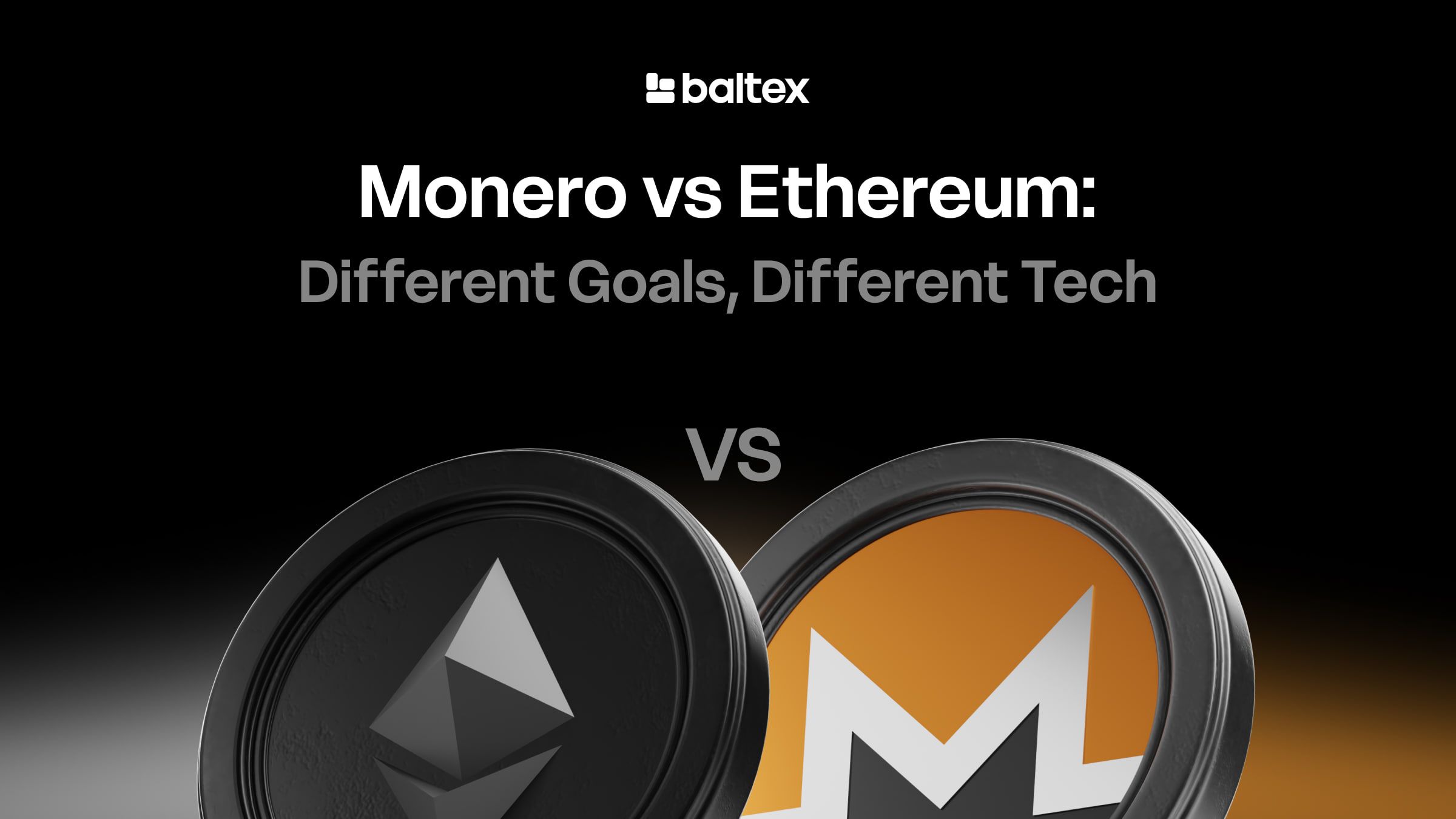
Monero vs Ethereum: Different Goals, Different Tech
TL;DR
Monero and Ethereum pursue entirely different missions in 2026. Monero is built as private digital cash with mandatory unlinkability on every transaction while Ethereum powers programmable applications through smart contracts and Layer 2 scaling. Monero wins for absolute privacy and fungibility but lacks programmability. Ethereum dominates DeFi, NFTs, and complex dApps yet remains transparent by default unless users move to privacy-focused L2s. Baltex.io lets you route between the two chains in one non-custodial step to combine Ethereum liquidity with Monero privacy exactly when needed.
Monero and Ethereum represent opposite ends of the crypto spectrum in 2026. One focuses on financial privacy as its sole purpose. The other treats privacy as an optional feature while prioritizing global programmability and adoption.
The practical differences become obvious the moment you send a transaction or build an application. Monero hides everything automatically. Ethereum shows everything publicly unless you take extra steps on specific Layer 2 networks.
Feature Comparison

The table captures the fundamental mismatch in goals. Monero never compromises privacy for features. Ethereum never compromises programmability for privacy.
Monero’s FCMP++ upgrade in early 2026 expanded anonymity sets to the entire chain, making statistical attacks nearly impossible. Ethereum relies on zero-knowledge proofs on Layer 2 rollups for selective privacy but keeps the base layer fully transparent. This architectural choice defines every user experience on each network.
Core Design Goals
Monero was created specifically to function as untraceable digital cash. Every decision prioritizes hiding sender, receiver, and amount without user intervention. The result is a coin that works the same for beginners and advanced users.
Ethereum was designed as a world computer for decentralized applications. Smart contracts and composability drive its entire roadmap. Privacy appears only as an add-on feature on certain Layer 2 solutions rather than a protocol-wide guarantee.
Privacy Models in Real-World Use
Monero enforces privacy on every single transaction through ring signatures, stealth addresses, and RingCT. The 2026 FCMP++ upgrade pushed anonymity sets to millions of outputs across the full chain. Users never need to remember to activate privacy mode.
Ethereum transactions remain publicly visible on the base layer and most Layer 2s. Users must deliberately move to privacy-oriented rollups or use mixing tools for any meaningful hiding. The optional nature means many users still leak metadata through everyday activity.
Smart Contract Capabilities
Monero has no native smart contracts and deliberately avoids them to maintain simplicity and privacy. The protocol focuses exclusively on private value transfer without executable code. This design keeps the network lightweight and resistant to exploits.
Ethereum powers the majority of DeFi, NFTs, and governance systems through its Turing-complete virtual machine. Developers build complex applications that interact seamlessly with each other. The trade-off is that every contract execution is visible on-chain unless wrapped in zero-knowledge layers.
Scalability Approaches
Monero scales directly on-chain through dynamic block sizing that automatically adjusts to demand. The network processes thousands of private transactions daily without congestion or Layer 2 complexity. Recent upgrades reduced transaction sizes further while preserving full privacy.
Ethereum achieved massive scalability through Layer 2 rollups and danksharding improvements following the Pectra upgrade. Billions of users can interact cheaply on L2s while the base layer remains secure. The architecture favors high-throughput applications over native privacy.
Fees and Cost Predictability
Monero maintains consistently low and predictable fees thanks to its adaptive block mechanism. Even during high activity the cost rarely exceeds ten cents. This stability makes frequent private transfers practical for remittances or daily spending.
Ethereum fees vary dramatically between Layer 1 and Layer 2 networks. L2s deliver sub-cent transactions for most users while the base layer stays more expensive during congestion. Our best no-KYC Monero swappers overview highlights how predictable Monero fees encourage seamless routing to and from Ethereum ecosystems.
Ecosystem Adoption in 2026
Ethereum dominates decentralized finance, NFT marketplaces, and institutional applications with trillions in total value locked across its Layer 2 networks. Developers and enterprises choose it for its mature tooling and massive liquidity. The ecosystem rewards composability over privacy.
Monero leads in privacy-sensitive niches including donations, certain marketplaces, and personal wealth protection. Its smaller but dedicated community values fungibility above everything else. Many users hold both assets and route between them depending on the specific need.
Use Cases

This table shows how the two networks serve completely different audiences in practice. Ethereum powers programmable finance at scale. Monero protects private value transfer without compromise.
Developers building trading bots or lending protocols naturally choose Ethereum for its smart contract ecosystem. Privacy-focused individuals who want to send money without leaving a permanent public record choose Monero. Our best Monero desktop wallets guide helps users secure holdings on the privacy side while many Ethereum users rely on hardware wallets for dApp interactions.
Real-World Trade-Offs
Ethereum users enjoy vast liquidity and endless application possibilities but must accept public transaction histories or move to specialized privacy Layer 2s. The network’s transparency enables powerful tools yet creates permanent financial footprints. Monero users sacrifice programmability for ironclad privacy that works automatically every time.
Many sophisticated holders keep both assets in their portfolios. They use Ethereum for yield-generating strategies and Monero for private spending or wealth preservation. The complementary nature makes routing between them a daily reality for serious users.
How Baltex.io Enables Routing Between ETH and XMR
When users need Ethereum liquidity for DeFi yields or NFT purchases but want Monero privacy for sensitive transfers they face a common dilemma. Baltex.io solves it by accepting direct deposits from either coin and delivering clean outputs on the destination chain in one non-custodial transaction. You select ETH to XMR or XMR to ETH, send from your wallet, and enable Private Swap mode for extra shielded hops that enhance privacy during the move.
The platform works seamlessly whether you route from Ethereum Layer 2 or base layer into Monero subaddresses. Funds arrive ready for immediate use with no accounts or KYC required. For readers of our Trocador review and StealthEX review, Baltex.io stands out for true one-click routing that respects both networks’ strengths.
Traders move Ethereum holdings into Monero before high-privacy donations and back again for DeFi opportunities. The workflow completes in minutes and integrates with any wallet including mobile options. Our best P2P Monero exchanges guide adds extra off-ramp choices that pair naturally with this cross-chain flow.
Businesses accepting Ethereum payments route excess inflows through Baltex.io into Monero for private treasury management while keeping receive addresses isolated. The non-custodial design ensures full key control throughout. Our Cake Wallet review shows how mobile users execute these routes effortlessly.
Advanced Routing Tips with Baltex.io
Use fresh subaddresses on Monero and standard Ethereum addresses before sending to Baltex.io for clean separation. Test small amounts first to confirm output destinations and timing. Combine with hardware wallets for larger moves to keep long-term keys offline.
Our hardware wallet for Monero guide and Monero wallet security best practices help users layer extra protection on top of these routed transactions. Our Monero GUI vs CLI wallet comparison and best Monero mobile wallets guide guide wallet choice for efficient routing.
Conclusion
Monero and Ethereum serve fundamentally different purposes in 2026 and both thrive because of those differences. Monero delivers the privacy that Ethereum cannot guarantee by default while Ethereum powers the programmable applications that Monero deliberately avoids. The two networks complement each other perfectly when users route value between them as needs change.
Evaluate your own priorities around privacy, programmability, and liquidity before deciding allocation. Many investors keep exposure to both ecosystems and use non-custodial bridges for seamless movement. When the moment arrives to shift value across chains, our best no-KYC Monero swappers overview shows exactly why Baltex.io belongs in every serious portfolio.
For deeper wallet and security strategies explore our best Monero desktop wallets guide, the Cake Wallet review, or the hardware wallet for Monero guide. Monero protects what Ethereum builds and routing between them gives you the best of both worlds without compromise.
We cover this in more detail in SimpleSwap Review 2026: Pros, Cons, and Monero Exchange Fees.
For more on this, see our guide on Across Protocol Review: The Cheapest Bridge for Ethereum L2s.
You can read our full breakdown in XMR.to Alternatives: How to Pay Bitcoin Invoices with Monero.
We cover this in more detail in Zcash (ZEC) vs Monero (XMR): Which Privacy Coin Wins in 2026.