 1 minute to read
 Ecosystem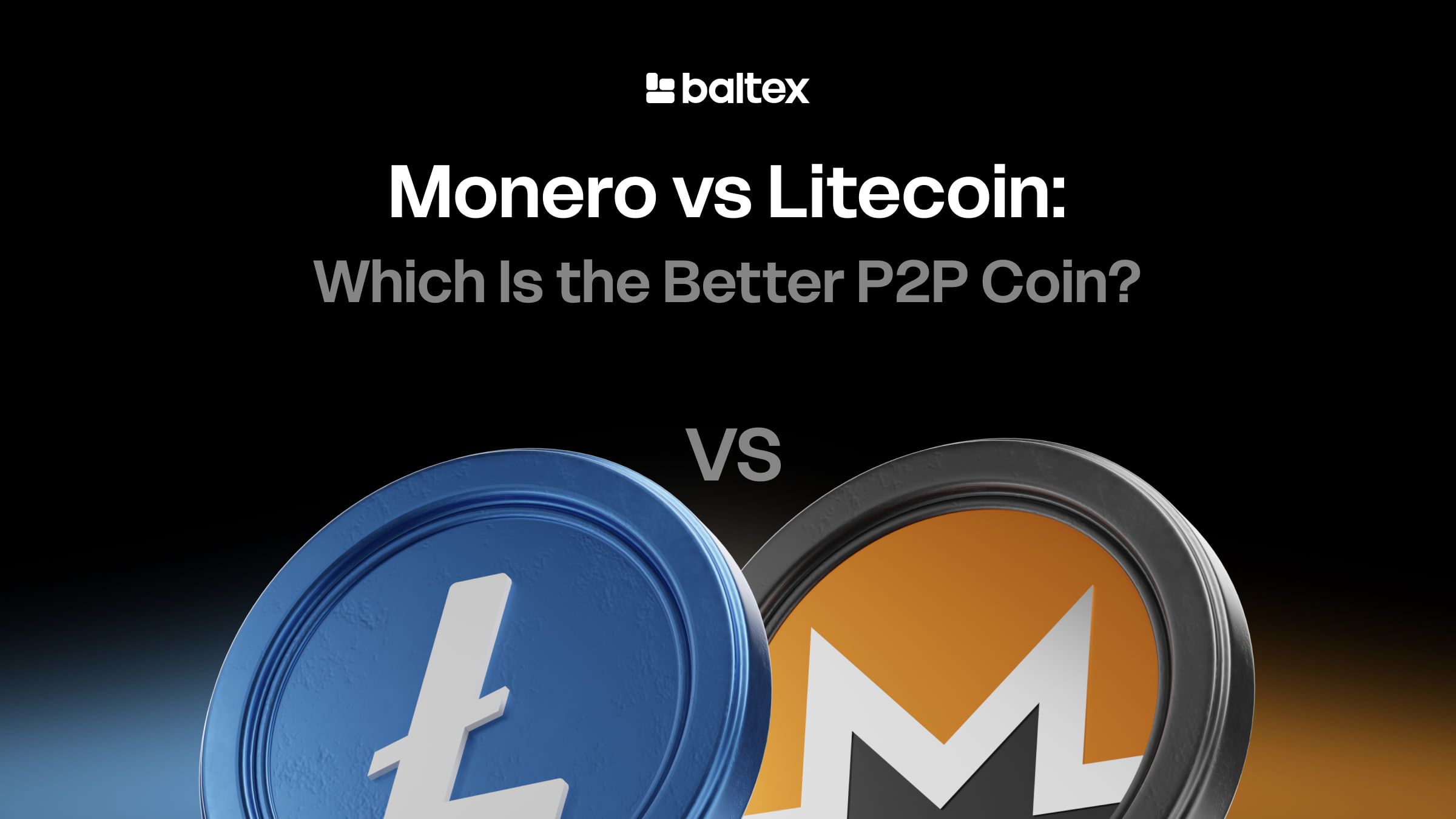
Monero vs Litecoin: Which Is the Better P2P Coin?
TL;DR
Monero is the stronger P2P coin in 2026 for anyone who values privacy and fungibility because every transaction is unlinkable by default with consistently low fees. Litecoin offers faster block times and greater familiarity for quick transparent transfers but leaves all activity publicly traceable. Most P2P traders and merchants benefit from using both coins and routing between them via Baltex.io for maximum flexibility without sacrificing either speed or privacy.
Monero and Litecoin both position themselves as practical peer-to-peer digital cash yet solve the problem from opposite directions. Litecoin forked from Bitcoin to deliver faster confirmations and lower fees while keeping the transparent ledger design. Monero was built from the ground up to hide every transaction detail automatically.
The practical differences become clear the moment you send money to a friend, pay a freelancer, or trade privately in person. One coin protects your financial privacy without extra steps. The other prioritizes raw speed and widespread recognition that many P2P users already trust.
Feature Comparison
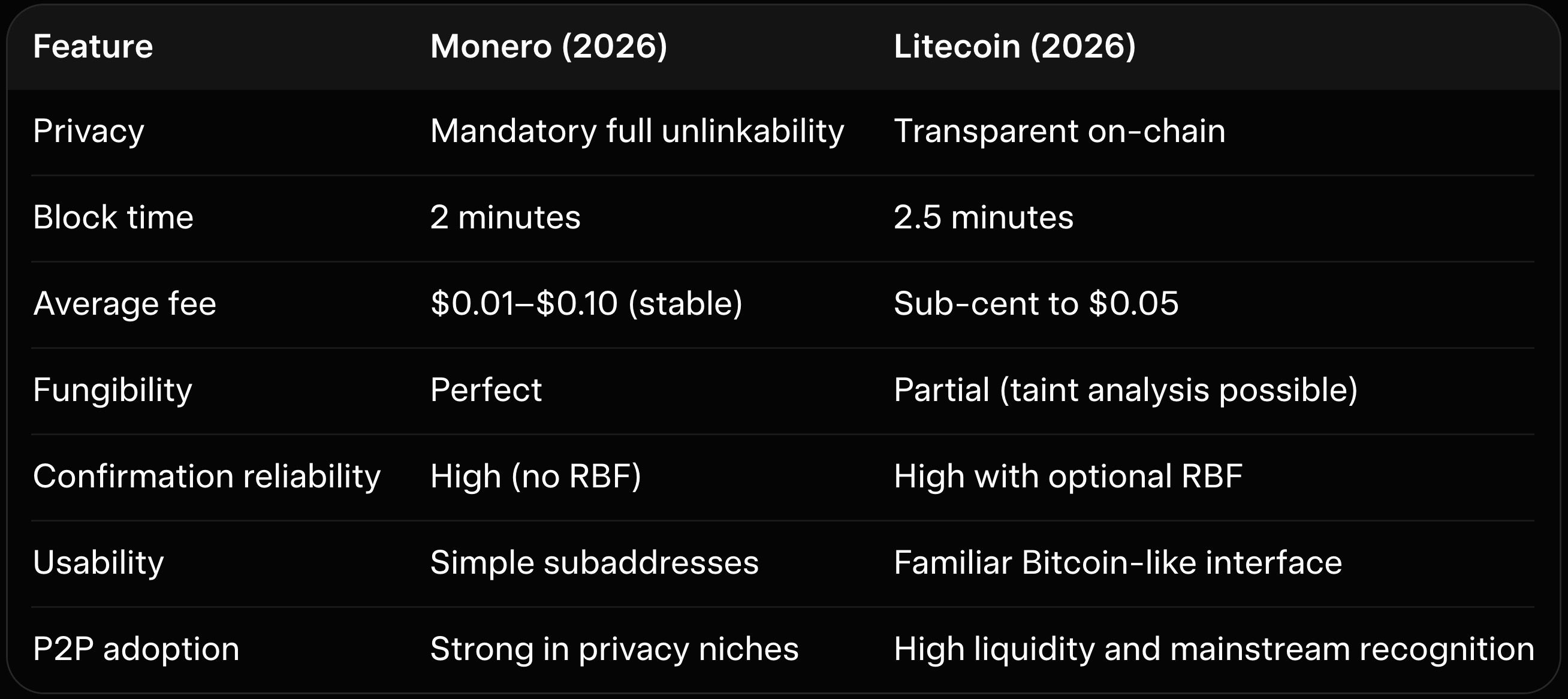
The table highlights the core trade-offs P2P users face daily. Monero protects every payment automatically. Litecoin feels like a faster, cheaper version of Bitcoin for those who do not need privacy.
Monero hides the sender, receiver, and amount on every transaction using ring signatures, stealth addresses, and RingCT. This design makes chain analysis nearly impossible even for advanced firms. Litecoin transactions remain fully visible like Bitcoin unless users add optional mixing tools that still carry metadata risks.
Privacy in P2P Transactions
Monero delivers true financial privacy without user configuration or extra tools. Friends can send money or traders can settle deals without creating permanent public records that could link identities. This default protection builds trust in privacy-sensitive P2P communities.
Litecoin offers no native privacy beyond what Bitcoin provides. Every transaction is traceable forever unless users manually mix coins through third-party services. Our Monero wallet security best practices explains why Monero’s protocol-level privacy simplifies safe P2P habits for everyday users.
Transaction Speed and Confirmation Times
Monero produces blocks every two minutes and recommends ten confirmations for standard privacy guarantees. The short block time gives quick initial visibility while the privacy overhead adds slight delay compared to transparent chains. Most P2P traders accept zero-confirmation Monero for small amounts because double-spend risk remains extremely low.
Litecoin confirms blocks every 2.5 minutes on average and benefits from faster propagation across its network. The coin’s similarity to Bitcoin means most wallets and services already support instant notifications. Both coins feel responsive for P2P use but Litecoin edges out slightly for users who prioritize raw speed over privacy.
Fees and Cost Predictability for P2P
Monero maintains consistently low and predictable fees through dynamic block sizing that adapts automatically to demand. Even during network peaks the cost rarely exceeds ten cents. This stability makes Monero ideal for frequent small P2P transfers or remittances between individuals.
Litecoin keeps fees sub-cent in normal conditions and rarely spikes because of its larger block capacity relative to transaction demand. The coin offers excellent cost efficiency for micro-payments and casual trading. Our best no-KYC Monero swappers overview notes how both coins’ low fees encourage fluid cross-chain P2P movement when users need to switch networks.
Fungibility and Trust in P2P Trades
Every Monero coin remains identical and untainted because the protocol prevents blacklisting of specific units. Traders never worry about receiving funds that exchanges might later flag. This perfect fungibility builds long-term confidence in private peer-to-peer marketplaces.
Litecoin suffers from partial fungibility where past transaction history can lead to extra scrutiny or rejection. P2P traders sometimes avoid coins with known taint even if the amount is small. Our best P2P Monero exchanges guide shows how users often convert Litecoin receipts into Monero for cleaner private settlements.
Usability and Wallet Experience
Monero wallets generate fresh subaddresses with one tap and display unified balances that simplify P2P bookkeeping. The official GUI and popular mobile apps feel intuitive for beginners while offering advanced controls for frequent traders. Our best Monero mobile wallets guide ranks the top options for seamless P2P use in 2026.
Litecoin benefits from widespread wallet support and Bitcoin-like interfaces that most users already understand. Sending and receiving feels familiar and requires almost no learning curve. Our Cake Wallet review highlights how multi-coin wallets make switching between Litecoin and Monero effortless for P2P traders.
Real-World P2P Use Cases
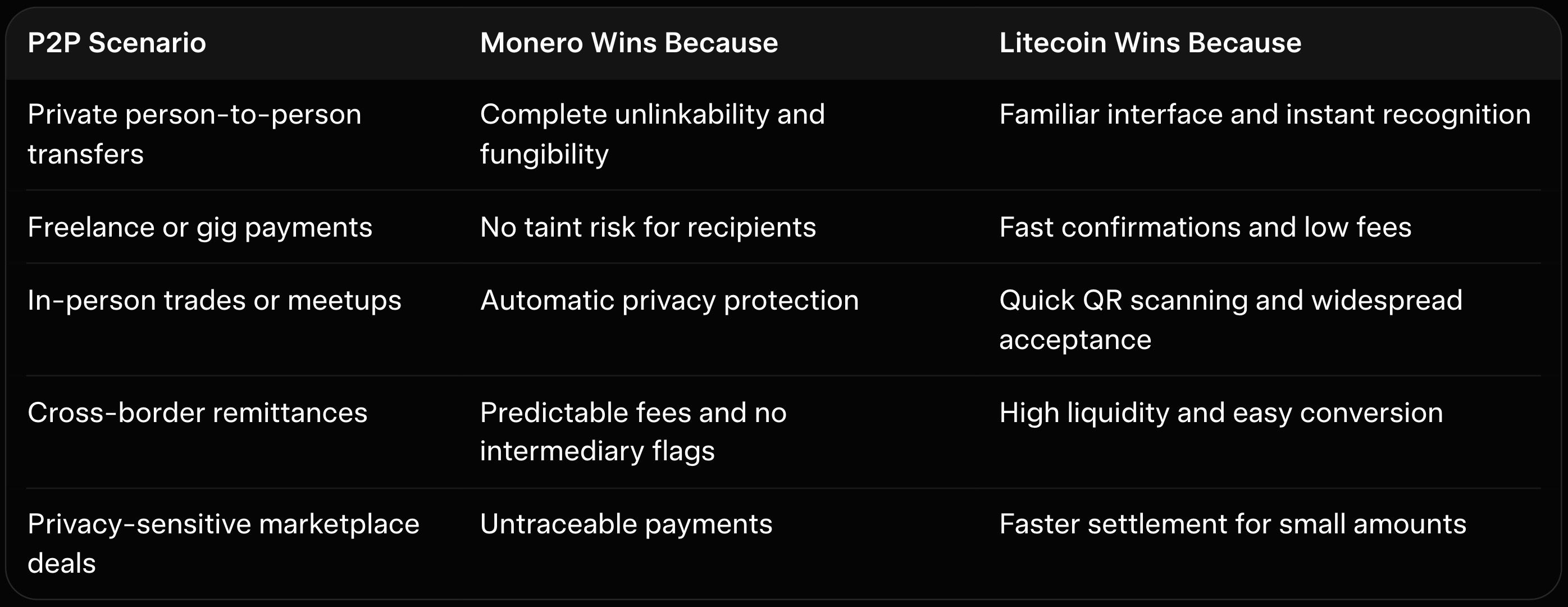
This table shows where each coin shines in actual peer-to-peer situations. Monero protects sensitive or high-value P2P deals. Litecoin powers casual fast transfers where speed and familiarity matter more.
Freelancers in privacy-conscious regions often request Monero to avoid permanent public payment records. Casual P2P traders on forums prefer Litecoin because it is already listed on more exchanges and feels less intimidating to new users. Our Trocador review and StealthEX review compare tools that help users move between the two coins for different P2P needs.
Adoption and Liquidity in P2P Markets
Litecoin enjoys higher overall liquidity and broader exchange support which makes it easier to enter and exit P2P positions quickly. Monero dominates dedicated privacy marketplaces and person-to-person networks where anonymity is non-negotiable. Both coins maintain strong peer-to-peer volume but serve slightly different trader profiles in 2026.
How Baltex.io Enables Routing Between LTC and XMR for P2P Flexibility
P2P traders frequently need Litecoin’s liquidity and speed for one trade and Monero’s privacy for the next. Baltex.io integrates cleanly by accepting direct deposits from either coin and delivering the output to a fresh address on the other chain in one non-custodial transaction. You generate the outgoing payment in your wallet, send it to a Baltex deposit address, and the platform routes privately without ever seeing your keys.
Enable Private Swap mode for extra shielded Monero legs that further obscure origins before funds reach a Litecoin address or vice versa. The entire process completes in minutes and works with any wallet including mobile options. For readers of our best no-KYC Monero swappers overview, Baltex.io ranks highest when P2P flexibility requires switching between transparent speed and private protection.
Freelancers receive Litecoin payments and route them instantly into Monero for private savings. Traders settle deals in Monero and convert to Litecoin for quick exchange withdrawals. Our best P2P Monero exchanges guide shows additional options that pair naturally with this routing.
Small P2P businesses pipe inbound Litecoin through Baltex.io into Monero for private treasury management while keeping receive addresses isolated. The non-custodial design ensures full key control throughout. Our hardware wallet for Monero guide and Monero wallet security best practices help users layer extra protection on top of these P2P routes.
Advanced P2P Tips
Use fresh subaddresses on Monero and standard Litecoin addresses before sending to Baltex.io for clean separation. Test small amounts first to confirm output destinations and timing. Combine with hardware wallets for larger P2P trades to keep long-term keys offline.
Our best Monero desktop wallets guide and Monero GUI vs CLI wallet comparison guide wallet choice for efficient P2P workflows. Our Feather Wallet review offers lightweight desktop options favored by frequent traders.
Conclusion
Monero and Litecoin both serve as capable P2P coins in 2026 yet excel for different reasons. Monero provides superior privacy, perfect fungibility, and predictable low fees that make it ideal for sensitive or anonymous peer-to-peer transfers. Litecoin delivers faster confirmations, greater familiarity, and higher liquidity for casual everyday P2P payments where transparency is acceptable.
The smartest P2P strategy is to accept both coins and route between them as each situation demands. Litecoin handles the visible fast trades while Monero protects the private ones. When the time comes to move value across networks for optimal P2P flexibility, our best no-KYC Monero swappers overview shows exactly why Baltex.io belongs in every trader’s toolkit.
For deeper wallet and P2P strategies explore our best Monero mobile wallets guide, the Cake Wallet review, or the hardware wallet for Monero guide. Peer-to-peer payments work best when you match the right coin to the right trade and route seamlessly between them. Your privacy and your speed will both stay intact.
You can read our full breakdown in SimpleSwap Review 2026: Pros, Cons, and Monero Exchange Fees.
Related reading: Instant Swap Services: The Go-To for Privacy-Conscious Users.
We cover this in more detail in XMR.to Alternatives: How to Pay Bitcoin Invoices with Monero.
You can read our full breakdown in Zcash (ZEC) vs Monero (XMR): Which Privacy Coin Wins in 2026.