 3 minutes to read
 Ecosystem
Monero vs Zcash: Optional vs Mandatory Privacy
TL;DR
Monero’s mandatory privacy model hides every transaction by default in 2026 while Zcash’s optional shielded transactions require users to actively choose privacy. This single design difference creates dramatically different anonymity sets, traceability risks, and real-world behaviors. Monero protects all users automatically but faces stricter regulatory pressure. Zcash offers flexibility and better liquidity yet leaves many transactions fully visible. Baltex.io lets you route between XMR and ZEC seamlessly so you can combine mandatory privacy with optional flexibility whenever you need it.
The privacy coin debate in 2026 centers on one fundamental question. Should privacy be mandatory for every user or optional for those who want it? Monero and Zcash represent the two clearest answers to that question.
Monero enforces privacy at the protocol level so every sender, receiver, and amount stays hidden without any extra steps. Zcash gives users a choice between transparent addresses and shielded ones using zk-SNARKs. The practical consequences of this choice affect anonymity sets, usability, fees, and daily financial life more than most users realize.
Privacy Model Comparison
The table shows why mandatory privacy changes everything in practice. Monero eliminates user error and accidental leaks. Zcash’s optional model creates a two-tier system where privacy depends entirely on individual choices.
Monero uses ring signatures, stealth addresses, and RingCT to make every transaction unlinkable by design. The 2026 FCMP++ upgrade expanded anonymity sets to the entire chain so statistical attacks become nearly impossible. No user ever has to remember to activate privacy.
Zcash relies on zero-knowledge proofs in its shielded pools for strong privacy when users deliberately choose it. Transparent transactions remain fully visible on the blockchain and form the majority of activity for many holders. The optional nature means beginners often leak metadata without realizing it.
Anonymity Sets and Real Protection
Monero’s anonymity set includes every output on the entire blockchain because privacy is mandatory. This creates massive mixing that protects even the smallest transactions. Recent protocol upgrades pushed effective anonymity to millions of possible outputs for every spend.
Zcash’s anonymity set is limited to the shielded pool which represents roughly 59 percent of total supply in 2026. While shielded transactions are cryptographically strong the smaller pool makes statistical analysis easier over time. Users who frequently switch between transparent and shielded modes further reduce their own privacy.
Traceability Risks in Practice
Monero transactions cannot be traced even by sophisticated chain analysis firms because no public metadata exists. The mandatory design removes any possibility of accidental exposure through address reuse or transparent flows. This gives users genuine plausible deniability in real-world scenarios.
Zcash transparent transactions are as traceable as Bitcoin and many users still default to them for lower fees or easier exchange deposits. Even shielded transactions can be linked if users reveal view keys or move funds in and out of transparent addresses. The optional model creates ongoing traceability risks that Monero simply does not have.
Usability Trade-Offs
Monero wallets generate fresh subaddresses automatically and display a single unified balance so users never have to think about privacy settings. The experience feels identical for beginners and experts because privacy is baked into the protocol. Our best Monero mobile wallets guide shows how simple the workflow remains across devices.
Zcash wallets improved with unified addresses that simplify shielded usage but users still must remember to select privacy mode for each transaction. Transparent addresses remain the default in many interfaces which leads to frequent mistakes. Our Cake Wallet review highlights how multi-coin wallets handle both coins but Zcash requires more conscious decisions.
Fees and Economic Implications
Monero maintains consistently low and predictable fees through dynamic block sizing that adapts to demand. The cost stays under ten cents for typical private transactions even during network peaks. This stability encourages frequent use without users worrying about privacy premiums.
Zcash transparent transactions stay very cheap but shielded ones cost more due to larger zero-knowledge proofs. Many users choose transparent mode purely to save fees which defeats the privacy goal. Our best no-KYC Monero swappers overview notes how predictable Monero fees make routing to and from Zcash more practical for cost-conscious users.
Real-World Outcomes
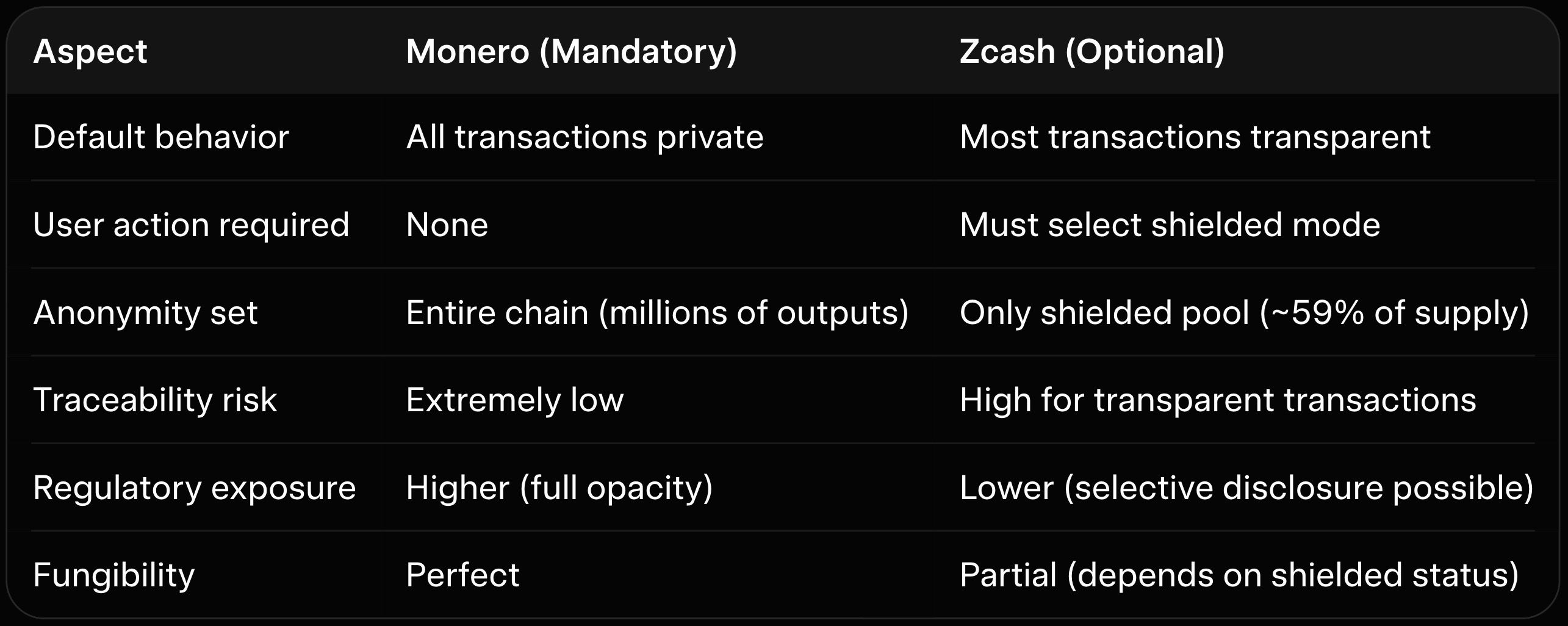
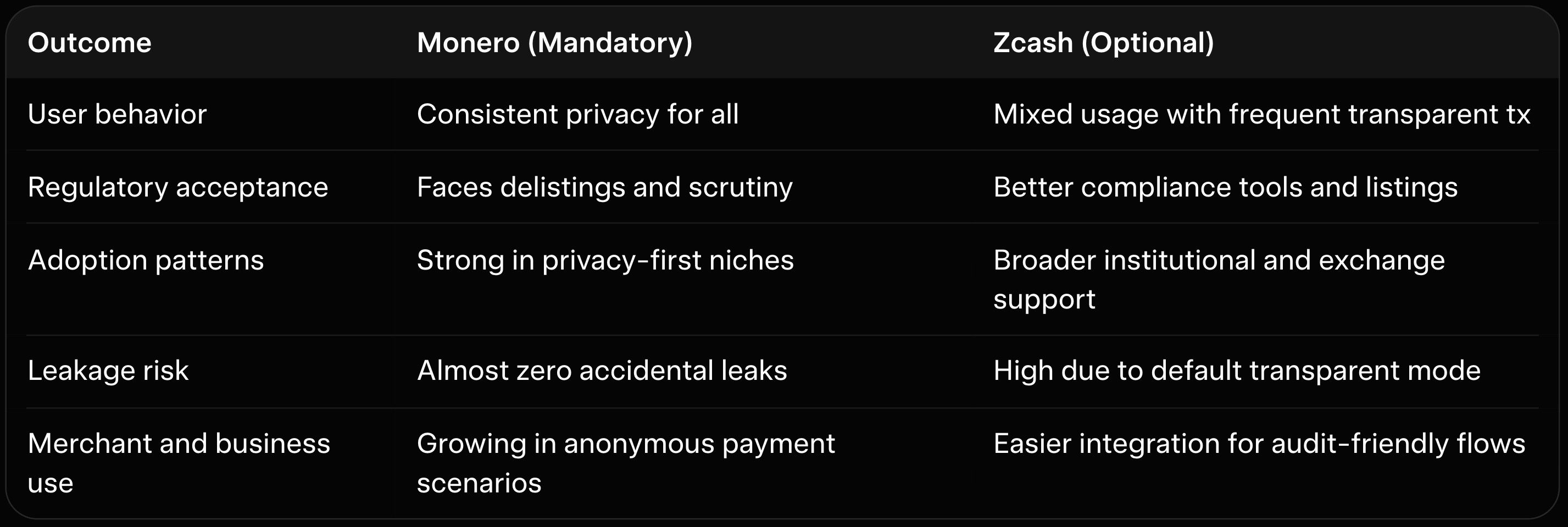
This table summarizes the practical consequences of each model in 2026. Monero creates a uniform privacy environment that protects everyone equally. Zcash offers flexibility that many users and institutions prefer but at the cost of fragmented protection.
Monero users never have to learn privacy best practices because the protocol enforces them automatically. The result is higher overall network privacy and fewer mistakes. Zcash users must actively manage shielded versus transparent flows which leads to inconsistent protection across the ecosystem.
How Baltex.io Enables Routing Between XMR, ZEC, and Other Assets
Users often hold both Monero and Zcash because each model serves different needs at different times. Baltex.io integrates cleanly by accepting direct deposits from either coin and delivering clean outputs on the destination chain in one non-custodial transaction. You select XMR to ZEC or ZEC to BTC, send from your wallet, and enable Private Swap mode for extra shielded hops that preserve privacy during the move.
The platform treats mandatory and optional privacy coins as first-class assets without forcing extra steps or KYC. Funds arrive at fresh addresses ready for immediate use whether you need stronger unlinkability or better liquidity. For readers of our Trocador review and StealthEX review, Baltex.io stands out when routing between different privacy philosophies.
Traders move Zcash holdings into Monero for high-privacy transfers and back again when liquidity or compliance matters more. The workflow completes in minutes and works with any wallet including mobile options. Our best P2P Monero exchanges guide shows additional off-ramp choices that pair naturally with this cross-coin routing.
Businesses or individuals accepting Zcash payments route excess inflows through Baltex.io into Monero for stronger privacy while keeping receive addresses isolated. The non-custodial design ensures keys never leave your control. Our hardware wallet for Monero guide and Monero wallet security best practices help users layer extra protection on top of these routed transactions.
Advanced Routing Tips with Baltex.io
Use fresh subaddresses on Monero and shielded addresses on Zcash before sending to Baltex.io for clean separation. Test small amounts first to confirm output destinations and timing. Combine with hardware wallets for larger moves to keep long-term keys offline.
Our best Monero desktop wallets guide and Monero GUI vs CLI wallet comparison guide wallet choice for efficient routing workflows. Our Feather Wallet review offers lightweight options favored by frequent cross-coin users.
FAQ Which privacy model is stronger in 2026? Monero’s mandatory privacy provides consistently stronger unlinkability because every transaction is protected by default. Zcash’s optional model is powerful when used but leaves many transactions fully visible.
Why does the optional model create more risk? Users often default to transparent transactions for convenience or lower fees which reduces overall anonymity sets and increases traceability. Monero eliminates this choice entirely.
Is Zcash easier to use than Monero? Zcash offers more flexibility with transparent options and selective disclosure that simplify compliance. Monero stays simpler for users who never want to think about privacy settings.
Do fees differ significantly between the two? Monero keeps fees low and predictable on every transaction. Zcash transparent fees stay cheap but shielded ones cost more due to proof complexity.
Can institutions use either coin effectively? Zcash appeals more because of auditability features while Monero suits users who reject any traceability. Both see niche institutional interest in privacy tech.
How does Baltex.io handle XMR and ZEC swaps? It accepts deposits from either coin and routes privately to other assets without custody or KYC in one fast transaction.
Which coin faces more regulatory pressure? Monero encounters stricter delisting pressure due to mandatory privacy while Zcash navigates compliance more successfully.
Conclusion
Monero’s mandatory privacy and Zcash’s optional privacy represent two valid but fundamentally different approaches to financial confidentiality in 2026. Monero protects every user automatically and eliminates accidental leaks while Zcash gives flexibility that many users and institutions prefer at the cost of fragmented protection. The choice ultimately depends on whether you want ironclad default privacy or the ability to toggle between privacy and transparency as needed.
Start by evaluating your own priorities around traceability, liquidity, and compliance before deciding allocation. Many privacy-conscious holders keep both coins and route between them as situations demand. When the time comes to move value across chains or into other assets, our best no-KYC Monero swappers overview shows exactly why Baltex.io belongs in every privacy-coin workflow.
For deeper wallet and security strategies explore our best Monero mobile wallets guide, the Cake Wallet review, or the hardware wallet for Monero guide. Privacy remains a personal choice and both models deliver real value when matched to the right use case. Your funds stay yours to control with the right tools and routing options ahead.
For more on this, see our guide on SimpleSwap Review 2026: Pros, Cons, and Monero Exchange Fees.
We cover this in more detail in Aztec Network: Best for Programmable Private Smart Contracts.
We cover this in more detail in XMR.to Alternatives: How to Pay Bitcoin Invoices with Monero.
Related reading: Zcash (ZEC) vs Monero (XMR): Which Privacy Coin Wins in 2026.