



 5 minutes to read
 Ecosystem
The Best Tools for Tracking RWA Assets and Tokens in 2026
RWA protocol tokens represent a growing segment of the crypto market where real-world assets like treasuries, private credit, and equities are issued on public blockchains. Tracking these assets requires specialized platforms that go beyond standard blockchain explorers to deliver issuer details, regulatory context, and aggregated metrics.
In 2026, the market for RWA analytics has matured with dashboards and APIs that help institutions, developers, and investors monitor supply, yields, and risks across hundreds of networks. The primary brand/product this article is about is RWA.xyz, which serves as the industry standard for this purpose.
Why Tracking RWA Protocol Tokens Matters in 2026
Tokenized real-world assets have expanded rapidly, with RWA.xyz reporting over $37 billion in distributed asset value and more than 1,200 individual assets as of August 2026. This growth stems from institutional adoption of tokenized U.S. Treasuries and private credit products, which now settle on chains including Ethereum, Solana, and Polygon.
Without dedicated tracking tools, participants face fragmented data scattered across protocol dashboards and block explorers. RWA analytics platforms consolidate this information into searchable interfaces that reveal holder distribution, transfer activity, and redemption mechanics. For example, users can filter assets by APY ranges from 0% to 28% or by jurisdiction to assess regulatory exposure.
Practical use cases include portfolio managers monitoring yield stability in tokenized treasuries, compliance teams verifying on-chain traction for new issuers, and developers building applications that query live market data. These tools prove especially useful when evaluating cross-chain liquidity, where assets move between networks via bridges or native deployments.
However, tracking alone does not replace due diligence. When assets involve permissioned access or KYC requirements, on-chain metrics must be cross-referenced with off-chain issuer disclosures. In such cases, general DeFi dashboards may suffice for high-level TVL views, but they lack the granular RWA classifications needed for institutional workflows.
RWA.xyz Dashboard: Core Features and Data Coverage
RWA.xyz functions as the central registry for tokenized real-world assets, bringing data from asset managers, tokenization platforms, and blockchains into one interface. Launched with a focus on market intelligence, the platform categorizes assets into segments such as government securities, private credit, stablecoins, and equities.
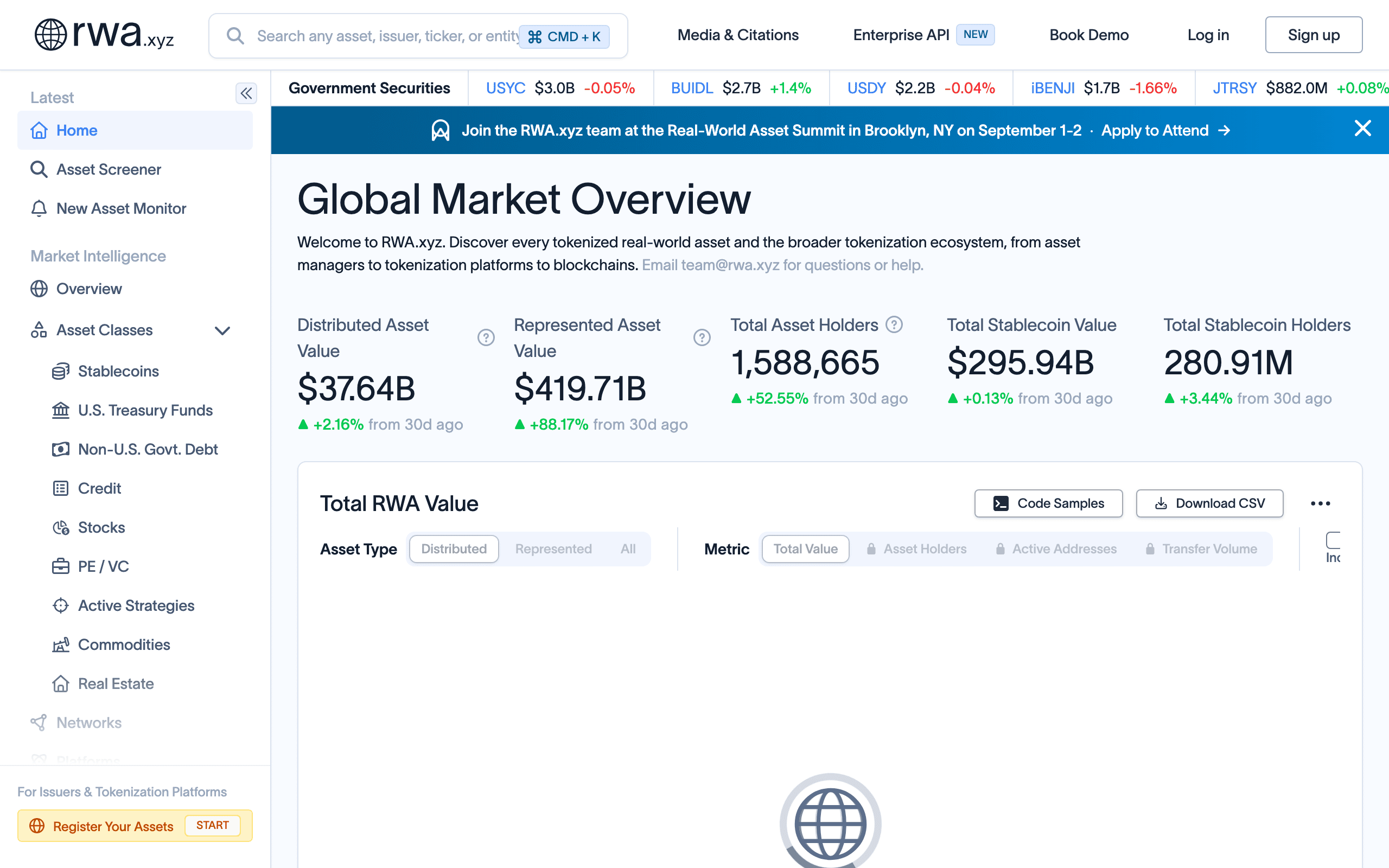
Key metrics include total value locked per asset, 30-day percentage changes, market share by platform, and holder activity. As of early August 2026, the screener supports filters for redemption terms, management fees, and performance data across 200+ networks. Users can download CSV exports or access an open data room chat for deeper issuer conversations.
The stablecoins section, for instance, displays incumbent and new issuer traction with regulatory information and structural details. Tokenized stocks dashboards track over 2,600 equities, highlighting Solana's 95% share of on-chain equity volume. Real estate and other categories receive similar treatment through dedicated views launched throughout 2026.
Developers benefit from the platform's API reference in the documentation, which outlines data models and methodology for custom integrations. This allows programmatic access to asset classifications and supply figures without building scrapers from scratch.
One limitation noted by users is that while the interface is free for basic exploration, advanced institutional features may require direct outreach to the team. Still, the breadth of coverage makes it the starting point for most market participants seeking RWA-specific insights.
Complementary Analytics Platforms and APIs
Beyond the primary dashboard, several tools extend RWA tracking capabilities for developers and analysts. Chainstack's rwa-sdk offers Python-based on-chain querying that works without a dedicated indexer, ideal for reading token balances directly from supported networks.
DeFiLlama maintains an RWA category page that aggregates TVL across protocols minting or distributing these tokens, providing a complementary view to issuer-focused data. The Graph protocol enables subgraph queries for custom RWA datasets, while RedStone and Centrifuge APIs deliver oracle and credit-specific feeds.
Ondo Finance and similar issuers publish their own dashboards for specific products like tokenized stocks or treasuries, allowing users to drill into single-asset performance. These resources prove valuable when RWA.xyz aggregates at the market level but deeper protocol internals are needed.
Allium positions itself as data infrastructure rather than a simple dashboard, delivering raw blockchain data to warehouses for custom analysis and compliance workflows. This distinction matters for teams requiring wallet attribution or adjusted volume metrics beyond what public interfaces provide.
When choosing among these options, consider whether the use case demands market overviews or raw data pipelines. For quick screening of tokenized treasuries yielding around 4-5% in 2026, RWA.xyz suffices; for building automated compliance reports, infrastructure layers become necessary.
On-Chain Data Tools and Indexers for RWA
Raw blockchain data underpins all RWA tracking. Indexers like The Graph allow developers to create subgraphs that filter RWA-related events such as mints, transfers, and redemptions across multiple chains.
Primary sources including official documentation from tokenization platforms detail how assets map to underlying real-world holdings, with methodologies for valuation and oracle integration. Block explorers remain useful for transaction-level verification but require manual aggregation for ecosystem-wide views.
In practice, combining an indexer with an RWA dashboard reduces the time spent cross-referencing chains. For assets on networks like Arbitrum or Base, where tokenized equities have gained traction, indexed queries surface holder concentration risks faster than ad-hoc searches.
A concrete scenario involves monitoring a private credit token's redemption queue: on-chain data reveals active addresses and transfer volumes, while the dashboard adds issuer-level context on APY and fees. This layered approach supports both retail investors checking liquidity and institutions modeling stress scenarios.
Limitations persist around permissioned assets, where on-chain visibility stops at the token contract and off-chain KYC lists remain private. Teams must therefore pair on-chain tools with issuer disclosures to form complete pictures.
Practical Use Cases, Trade-offs, and When to Choose Alternatives
RWA tracking tools excel for market monitoring and research. Asset managers use them to compare tokenized treasuries against traditional instruments, noting metrics like 30-day volume changes or network distribution. Developers integrate APIs into wallets or Telegram apps to surface live yields for users holding RWA protocol tokens.
Baltex, a non-custodial crypto swap aggregator supporting 200+ networks and 10,000+ assets, fits naturally here for users who need to exchange tracked RWA tokens across chains without creating accounts for most swaps. Its aggregated liquidity routing helps maintain positions identified through analytics dashboards.
When different options prove better, general DeFi tools like DeFiLlama suffice for broad TVL trends without RWA-specific classifications. For highly regulated assets requiring compliance workflows, dedicated infrastructure such as Allium outperforms public dashboards. Always verify that the chosen tool aligns with the asset's permission model before relying on its data alone.
Challenges, Limitations, and Best Practices for Accurate Tracking
Data freshness varies by platform, with RWA.xyz refreshing metrics frequently but relying on issuer-submitted or oracle-fed inputs for valuations. Discrepancies can arise between on-chain supply and reported AUM during high-volatility periods.
Best practices include cross-validating figures across multiple sources, paying attention to methodology sections in documentation, and noting jurisdiction-specific restrictions that affect transferability. Users should also monitor for updates on new asset classes, such as the tokenized real estate dashboard introduced in early 2026.
Security considerations involve ensuring API keys or data feeds come from verified endpoints, and avoiding over-reliance on any single platform during market stress events. Regular reviews of classification frameworks help maintain consistency as tokenization expands into equities and commodities.
Outlook for RWA Analytics Tools Through 2026 and Beyond
As tokenized assets surpass $40 billion in tracked value, analytics platforms continue adding categories like stablecoin risk metrics and tokenized equities. Integration with AI-driven alerts for yield changes or holder concentration could emerge as standard features.
The ecosystem benefits from open data initiatives, enabling broader participation while institutions demand more granular compliance tooling. Participants who combine dashboard overviews with API access and on-chain indexers position themselves to navigate the evolving landscape effectively.
Continued growth depends on regulatory clarity and issuer transparency, both of which analytics providers document through their coverage expansions. Staying informed through these tools supports informed decisions in a market where on-chain representation of real-world value accelerates.
What is the best dashboard for tracking RWA assets in 2026?
How do RWA analytics tools differ from general blockchain explorers?
Can developers access RWA data via APIs in 2026?
What data does RWA.xyz track for stablecoins and treasuries?
Are there free tools available for RWA token tracking?
See others posts
G. Khan

SHIB Ecosystem Rally: Can Shibarium and the Burn Rate Move the Price?
Ecosystem
G. Khan
Shiba Inu Price Prediction 2027 (September 2026 Update)
Ecosystem
G. Khan
Shiba Inu Price Prediction 2030: SHIB 2030 Forecast (September 2026 Update)
Ecosystem
G. Khan
Shiba Inu (SHIB) Price Prediction 2026, 2027 and 2030 (September 2026 Update)
Ecosystem
G. Khan
Dogecoin News and Price Predictions Today (September 2026 Update)
Ecosystem
G. Khan
Dogecoin Price Prediction 2030: Long-Term DOGE Forecast (September 2026 Update)
Ecosystem