 3 minutes to read
 Ecosystem
Trocador vs SwapSpace: Which Aggregator Is Better for XMR?
TL;DR
Trocador.app stands out in 2026 as the stronger privacy-focused aggregator for Monero swaps thanks to its built-in KYC/AML ratings, Tor/onion support, no-JavaScript mode, and zero extra aggregator fees while comparing 20+ no-KYC and low-KYC partners. SwapSpace offers broader partner volume and faster general rate discovery across thousands of pairs but lacks the same depth of privacy tooling and XMR-centric filtering. Both deliver non-custodial wallet-to-wallet execution with competitive rates, yet Trocador better suits privacy-conscious XMR users while SwapSpace shines for multi-coin flexibility. Baltex.io goes further by providing direct one-click private routing with shielded Monero hops instead of simple redirection.
Trocador and SwapSpace both function as swap aggregators that compare live rates from multiple instant exchange partners and route you to the best offer. Neither custodies funds or requires accounts. The key differences emerge in how they prioritize privacy, rate accuracy, supported pairs, and execution reliability when swapping into or out of Monero.
In 2026, with heightened regulatory scrutiny on privacy tools, users need aggregators that balance competitive pricing with strong data-minimization features. Trocador emphasizes privacy screening tools while SwapSpace focuses on sheer breadth and speed of comparison.
Aggregation Quality and Rate Comparison
Trocador.app scans 20+ trusted partners in real time and displays side-by-side offers with clear final receive amounts after all fees. It sorts by best payout by default and lets users filter by privacy score, settlement speed, or strict no-KYC status. The engine updates continuously so XMR swaps reflect current liquidity across providers.
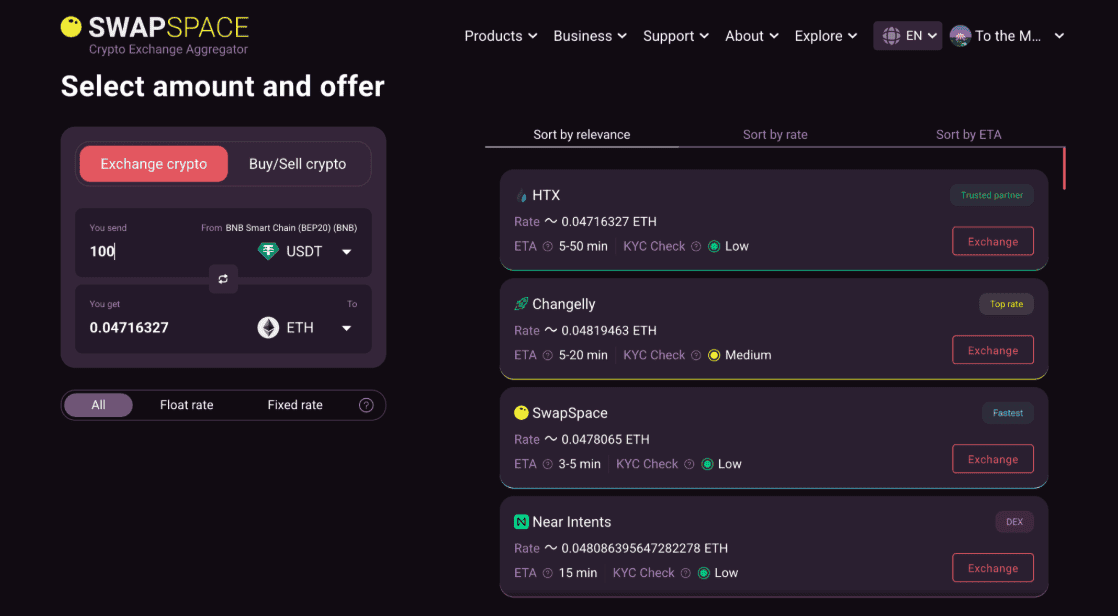
SwapSpace queries 40+ partners and presents offers sorted by rate with estimated times and limits shown upfront. Its broader partner list often uncovers competitive deals on less common pairs, but it lacks Trocador’s detailed privacy scoring. Both platforms add zero extra aggregator fees — the displayed rate already includes the partner’s commission.
Supported Pairs and Monero Liquidity
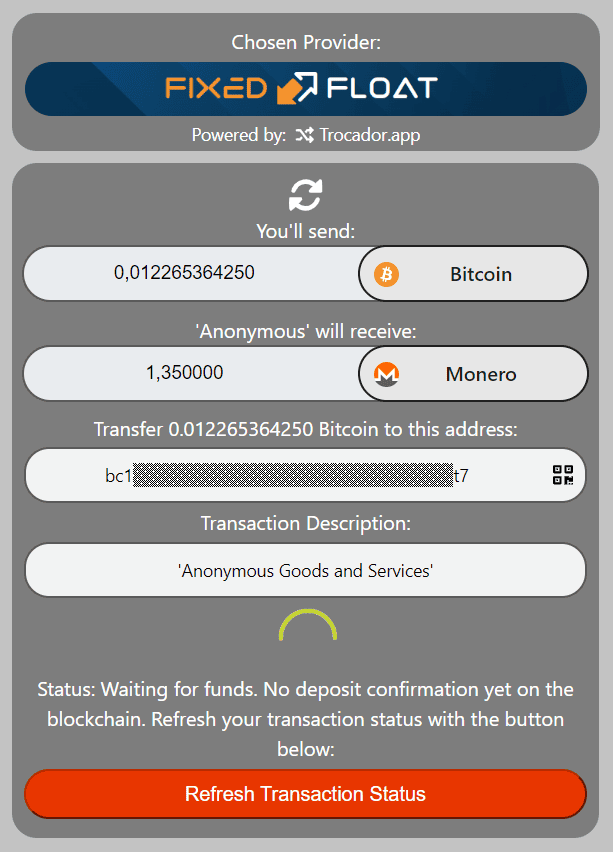
Trocador maintains strong native XMR liquidity across dozens of pairs including BTC to XMR, ETH to XMR, and major stablecoins. It excels at privacy-rated routes and frequently partners with no-KYC services that specialize in Monero. Users can filter specifically for XMR-focused providers with high privacy scores.
SwapSpace supports thousands of pairs including robust XMR coverage with major assets and stablecoins. Its wider partner network sometimes finds slightly better rates on exotic pairs, yet the XMR-specific filtering is less granular. Both handle native Monero deposits and withdrawals without forced wrapping.
Privacy Level and Data Minimization
Trocador stands out with full Tor/onion support, optional no-JavaScript mode, and no data collection or registration. It rates each partner’s KYC/AML policy and lets users filter out higher-risk routes. The aggregator itself adds no logs or fingerprinting.
SwapSpace also operates without accounts or KYC on its own platform and keeps the workflow non-custodial. It lacks Trocador’s advanced privacy tooling such as Tor emphasis or provider ratings. Both redirect to or route through partners, so final privacy ultimately depends on the chosen provider, but Trocador makes safer choices easier to identify.
Execution Reliability and Settlement Times
Trocador routes directly to the selected partner for wallet-to-wallet execution with typical settlements of 5–30 minutes depending on the route and network congestion. Its privacy scoring helps avoid providers with known delays or refund issues. Users report consistent performance on XMR pairs thanks to focused partner selection.
SwapSpace delivers comparable execution speed through its larger partner pool, often completing swaps in 2–15 minutes. Reliability remains high across both platforms since neither custodies funds. Minor delays usually stem from the underlying partner or blockchain confirmation times rather than the aggregator itself.
Risk Factors and Trade-Offs
Trocador’s strength is its transparency around partner risks, but final execution still depends on the chosen provider. Users must review the privacy score and limits before confirming. The platform’s focus on no-KYC routes reduces overall exposure compared to less selective aggregators.
SwapSpace’s broader partner volume increases the chance of competitive rates but can expose users to a wider range of provider policies. Both platforms are non-custodial, so the primary risk remains partner-specific KYC triggers or temporary liquidity issues. Our Trocador review and best no-KYC Monero swappers overview detail these nuances for XMR users.
Feature Comparison
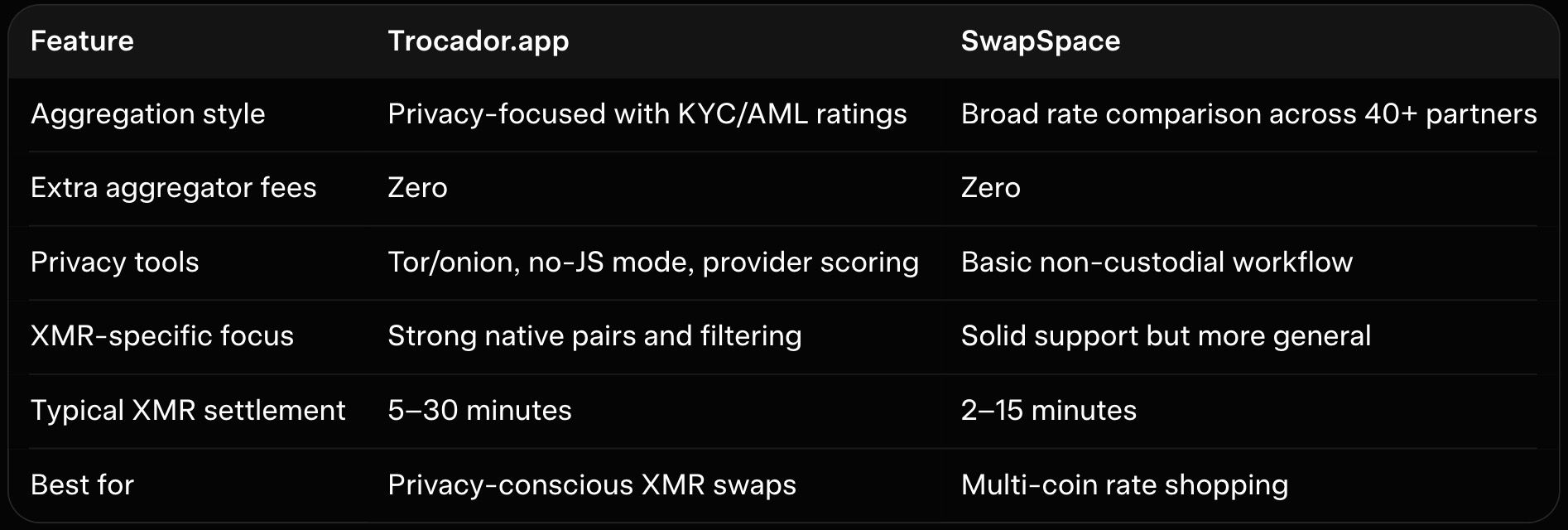
This table summarizes the practical differences users notice when swapping XMR. Trocador prioritizes privacy screening while SwapSpace emphasizes volume and speed of discovery.
Rates and Risks
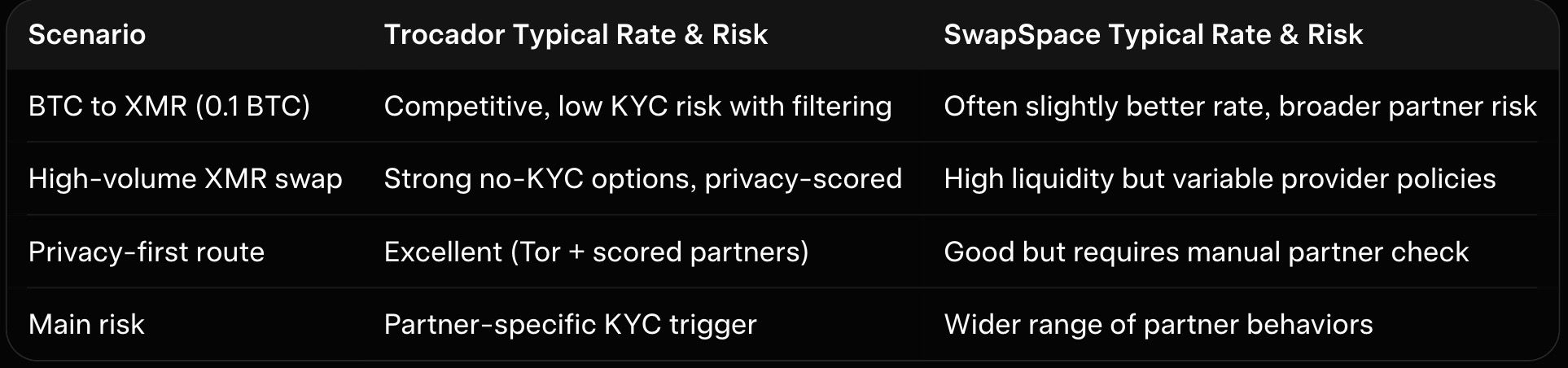
This table uses typical 2026 examples for XMR swaps. Actual rates fluctuate, but Trocador’s filtering reduces privacy-related risks more effectively.
How Baltex.io Improves Aggregation and Routing Outcomes Beyond Single Aggregators
Single aggregators like Trocador and SwapSpace compare partner rates but still redirect or route through third-party exchangers. Baltex.io goes further by providing direct one-click multi-chain routing with built-in shielded Monero hops that add extra privacy layers without relying on external providers for the final leg. You deposit XMR or any input asset and choose the output with Private Swap mode enabled for end-to-end non-custodial execution.
The platform maintains zero extra fees on many routes while delivering faster settlement and stronger unlinkability than traditional aggregator redirects. It consistently ranks at the top for privacy-preserving XMR flows because it combines rate comparison with protocol-level shielding. Our Trocador review and best no-KYC Monero swappers overview explain how Baltex.io complements or surpasses single-aggregator experiences.
Traders use Baltex.io after checking Trocador or SwapSpace rates to lock in the best private route without extra clicks or partner handoffs. The workflow stays wallet-to-wallet and supports complex multi-hop paths that pure aggregators cannot match. Our StealthEX review and best P2P Monero exchanges guide show how Baltex.io fits into broader XMR strategies.
For users who compare rates on Trocador or SwapSpace first, Baltex.io serves as the final execution layer that adds shielded privacy and multi-chain flexibility. Small test swaps confirm the flow before larger moves. Our Cake Wallet review and hardware wallet for Monero guide help integrate Baltex.io into secure XMR workflows.
Advanced Aggregation Tips*
Always check provider privacy scores on Trocador or manually verify routes on SwapSpace before confirming. Test with tiny amounts to verify final receive amounts and timing. Combine aggregator rate shopping with Baltex.io’s direct routing for the optimal balance of price and privacy.
Our Monero GUI vs CLI wallet comparison and best Monero desktop wallets guide recommend wallets that pair well with both aggregators and Baltex.io.
FAQ Which aggregator gives better rates for XMR swaps? Both find competitive offers but SwapSpace’s larger partner pool sometimes edges out on raw price while Trocador excels at privacy-rated routes.
Is Trocador or SwapSpace more private? Trocador offers superior privacy tooling with Tor support and provider ratings while SwapSpace provides solid non-custodial execution without the same depth of screening.
Do either require KYC for Monero swaps? Neither platform requires KYC itself, but final privacy depends on the chosen partner’s policy.
How fast are typical XMR swaps on these aggregators? Settlements usually complete in 2–30 minutes depending on the selected provider and network conditions.
Can I use both aggregators together? Yes. Compare rates on one then execute through Baltex.io for added privacy shielding.
What makes Baltex.io different from pure aggregators? It combines rate comparison with direct private routing and built-in shielded Monero hops instead of simple partner redirection.
Which is better for high-volume XMR swaps? Trocador’s privacy scoring helps avoid risky partners while SwapSpace’s volume often unlocks better liquidity.
Conclusion
Trocador and SwapSpace both deliver excellent non-custodial swap aggregation for Monero in 2026 yet serve slightly different priorities. Trocador shines for privacy-conscious XMR users with its advanced screening tools, Tor support, and focused partner ratings while SwapSpace offers broader rate discovery and multi-coin flexibility. The choice depends on whether you prioritize privacy tooling or sheer partner volume.
Test both with small amounts to see which workflow fits your XMR swapping habits best. For users who want the best of rate comparison plus true private multi-chain routing, Baltex.io provides the strongest overall experience. When you need to move XMR or any input asset with maximum privacy and minimal friction, our best no-KYC Monero swappers overview shows exactly why Baltex.io belongs in every serious aggregator user’s toolkit.
For deeper wallet and swap strategies explore our Trocador review, the Cake Wallet review, or the hardware wallet for Monero guide. Swap aggregators work best when you combine smart rate shopping with privacy-first execution and routing options. Your Monero swaps will stay fast, private, and cost-effective.
We cover this in more detail in Instant Swap Services: The Go-To for Privacy-Conscious Users.
We cover this in more detail in Instant Swap Services: The Go-To for Privacy-Conscious Users.
You can read our full breakdown in XMR.to Alternatives: How to Pay Bitcoin Invoices with Monero.
You can read our full breakdown in Zcash (ZEC) vs Monero (XMR): Which Privacy Coin Wins in 2026.