



 2 minutes to read
 Ecosystem
The Future of Zero-Knowledge Bridges: What to Expect in 2027
TLDR By 2027, zero-knowledge bridges will dominate cross-chain transfers by using ZK proofs to verify transactions without revealing data, delivering native assets in seconds with zero slippage, near-zero TVL risk, and fees under 0.1% all-in. They will outperform classic bridges in security (no pooled liquidity exploits) and speed (sub-minute finality) while matching or beating cross-chain swaps on capital efficiency. Expect widespread adoption for Ethereum L2s, Solana, and new chains, with privacy-preserving ZK routes for Monero and other assets. For practical multi-chain swaps today without waiting for full ZK maturity or classic bridge exposure, baltex.io already aggregates routes with shielded hops—see our what-is-crypto-bridge-cross-chain-transfers-guide and best-crypto-bridge-swaps-2025-instant-transfers-low-gas guides. Overall, ZK bridges will make cross-chain movement safer, faster, and cheaper—start testing native routes now.
Crypto users and DeFi participants in 2026 are already seeing the limits of traditional bridges: long challenge periods, pooled liquidity risks, and high gas costs. Zero-knowledge (ZK) bridges address these by using mathematical proofs to verify transfers without exposing underlying data or locking massive TVL. By 2027, ZK technology is projected to reshape asset movement, making cross-chain transfers nearly as seamless as on-chain ones while preserving privacy and reducing capital inefficiency. This guide explores ZK bridge architecture, expected developments, improvements in security, speed, and capital efficiency, and comparisons with classic bridges and cross-chain swaps. It shows why ZK is the future and how tools like aggregators can bridge the gap today.
How Zero-Knowledge Bridge Architecture Works
ZK bridges use zero-knowledge proofs to let the destination chain verify that a transaction on the source chain is valid without seeing the details. The process starts with a user locking assets on the source chain. A prover generates a succinct ZK proof that the lock is correct and the corresponding mint on the destination is authorized. The destination chain’s smart contract verifies this proof instantly, minting native assets. In 2027, expect ZK-SNARKs and ZK-STARKs to dominate, enabling sub-second verification and native delivery without wrapped tokens. As explained in our what-is-crypto-bridge-cross-chain-transfers-guide and top-crypto-bridges-in-2025-which-are-safe-which-to-avoid, this architecture eliminates the need for large liquidity pools or long challenge periods.
Expected Developments by 2027
By 2027, ZK bridges will integrate with more chains, including Ethereum L2s, Solana, Sui, and new EVM-compatible networks. Expect full native asset support for ETH, USDC, and major tokens, with ZK proofs handling complex multi-hop routes in one transaction. Capital efficiency will improve as bridges move from TVL-heavy models to proof-based verification, reducing locked funds by 90% or more. Privacy features will expand, allowing shielded ZK routes for assets like Monero. Speed will reach sub-minute finality, and fees will drop below 0.1% all-in through optimized proof generation. As explained in our best-crypto-bridge-swaps-2025-instant-transfers-low-gas and rise-of-crypto-aggregators-one-app-to-rule-every-exchange, these developments will make cross-chain movement feel like a single-chain transaction.
Improvements in Security, Speed, and Capital Efficiency
ZK proofs dramatically improve security by eliminating pooled liquidity risks—no single contract holds billions that can be drained. Verification is mathematical and trustless, reducing validator or guardian compromises. Speed improves because proofs are verified instantly, bypassing long challenge periods. Capital efficiency rises as bridges no longer need massive TVL; proofs replace locked funds. In 2027, expect ZK bridges to handle $1M+ transfers with minimal slippage and fees under 0.1%. As explained in our what-are-the-risks-of-cryptocurrency-top-dangers-how-to-avoid and top-crypto-bridges-in-2025-which-are-safe-which-to-avoid, ZK bridges reduce exploit surfaces while maintaining privacy.
Comparing ZK Bridges with Classic Bridges and Cross-Chain Swap Routing
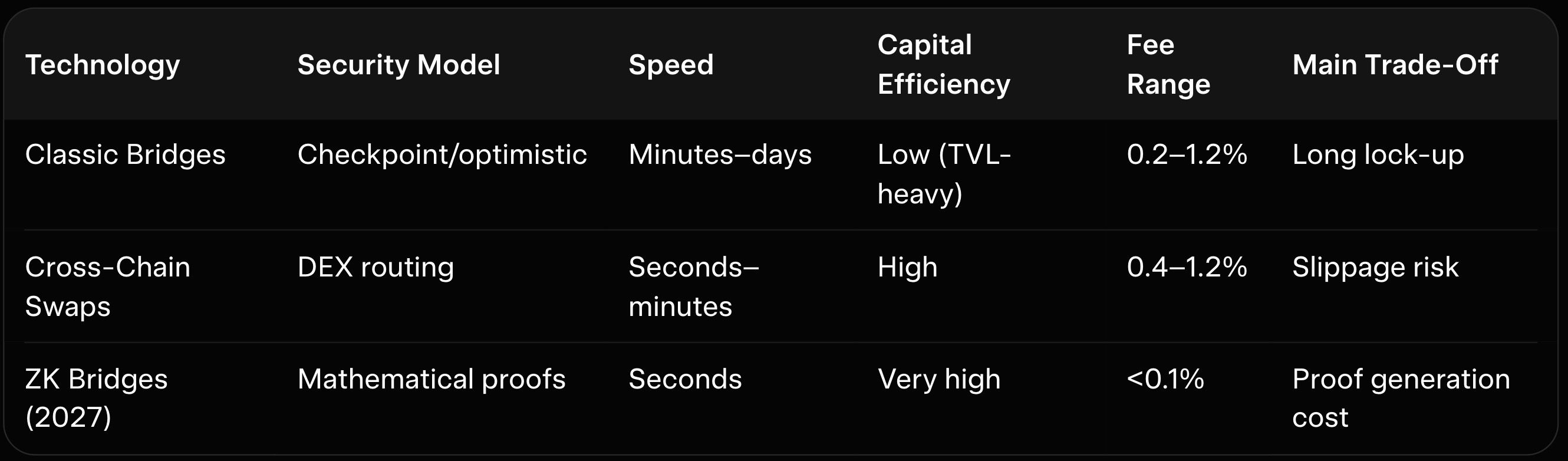
Classic bridges rely on locked liquidity or optimistic verification, creating TVL risks and longer finality. Cross-chain swaps use DEX routing for speed but add slippage and smart-contract exposure. ZK bridges combine the best: native delivery, sub-minute speed, and mathematical security without pools. For large ETH moves, ZK is safer than classic bridges and more efficient than swaps. For frequent stablecoin trades, ZK matches swap speed with better security. As explained in our cross-chain-swaps-swap-crypto-between-blockchains-instantly and best-crypto-bridge-swaps-2025-instant-transfers-low-gas, ZK bridges will become the standard for secure, efficient transfers.
Here is the technology comparison table:
Here is a fees and limits projection table (2026–2027 averages):
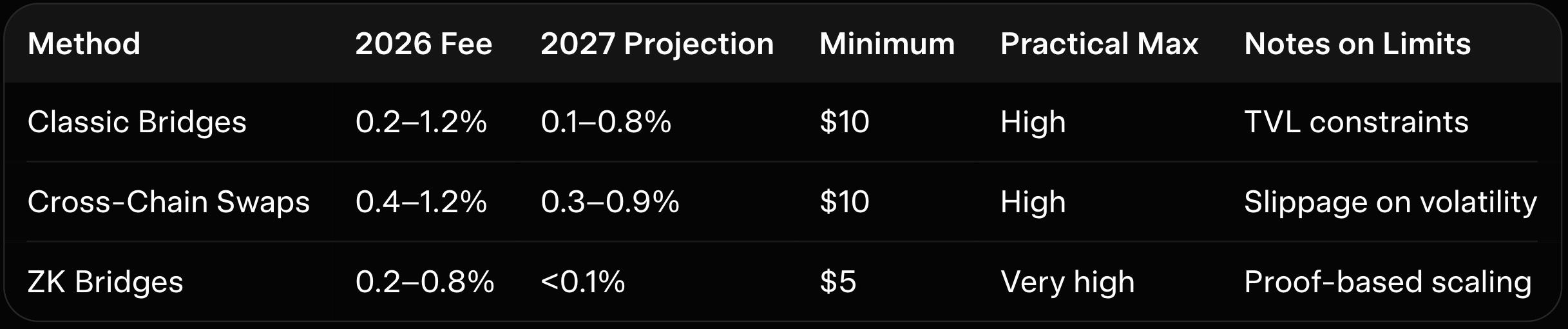
These projections reflect current trends—always verify live rates.
Real Use Cases and Cost Efficiency
For large ETH transfers to L2s for staking, ZK bridges will offer native delivery with minimal fees and no TVL risk. For frequent stablecoin moves between chains, ZK will match swap speed with better security. In arbitrage or liquidity provision, ZK routing will reduce costs by 50%+ compared to classic bridges. Wrapped tokens will fade as native ZK support grows. As explained in our best-crypto-swaps-2025-fast-cheap-non-custodial and top-5-crypto-bridges-benefits-how-to-use, ZK will make cross-chain moves seamless.
How baltex.io Enables Multi-Chain Swaps Today Without Waiting for ZK Bridge Maturity
ZK bridges are still maturing in 2026, but baltex.io already delivers similar benefits through intelligent multi-chain routing that scans dozens of bridges and DEXs internally. It executes optimal paths in one wallet-to-wallet transaction without classic bridge exposure or heavy reliance on wrapped assets. Private Swap mode can insert shielded hops for privacy. Settlements complete in 8–35 minutes, fees stay low at ~0.4–0.8%, and there are virtually no limits. Supporting over 10,000 tokens across 200+ networks, baltex.io provides practical ZK-like efficiency today.
Users moving assets today benefit enormously—especially when pairing with tools covered in our best-tools-for-cross-chain-swaps and rise-of-crypto-aggregators-one-app-to-rule-every-exchange. Use classic bridges for simple moves and switch to baltex.io when you want ZK-like optimization without waiting for full maturity.
Conclusion
Zero-knowledge bridges will transform cross-chain transfers by 2027, offering native assets, sub-minute speed, near-zero risk, and ultra-low fees through mathematical proofs. They will outperform classic bridges in security and capital efficiency while matching or beating swaps on usability. By understanding the architecture and trade-offs, users can prepare for seamless interoperability. Tools like baltex.io already provide practical benefits today, bridging the gap until full ZK adoption.
Always test small, use hardware wallets, and monitor audits. Explore more strategies in our what-is-crypto-bridge-cross-chain-transfers-guide, best-crypto-bridge-swaps-2025-instant-transfers-low-gas, and what-are-the-risks-of-cryptocurrency-top-dangers-how-to-avoid guides to stay ahead in the evolving landscape.
What will ZK bridges change by 2027? 
How do ZK bridges compare to classic ones?
Are ZK bridges safer than swaps?
Is baltex.io a good alternative today?
See others posts

G. Khan

Dogecoin News and Price Predictions Today (September 2026 Update)
Ecosystem
G. Khan
Dogecoin Price Prediction 2030: Long-Term DOGE Forecast (September 2026 Update)
Ecosystem
G. Khan
Dogecoin Price Prediction 2027
Ecosystem
G. Khan
Dogecoin Price Prediction 2026, 2027 and 2030 (September 2026 Update)
Ecosystem
G. Khan
Solana Price Prediction 2030 (September 2026 Update)
Ecosystem
G. Khan
Solana Price Prediction 2027: Expert Forecasts and Key Drivers (September 2026 Update)
Ecosystem