



 1 minute to read
 Ecosystem
How Monero Swaps Improve Transaction Privacy
TLDR
Swapping into Monero from transparent blockchains like Bitcoin or Ethereum can significantly reduce wallet linkability because Monero transactions hide sender, receiver, and amount by default. This creates a natural break in on-chain history that is difficult to trace forward or backward. When combined with good operational practices and non-custodial routing, Monero swaps offer a practical way to enhance transactional privacy for legitimate financial activities.
Many users hold assets on transparent chains for DeFi, payments, or liquidity but want stronger confidentiality for certain holdings or transfers. Moving value through Monero provides a privacy layer that most other chains cannot match without additional tools. The effectiveness depends on how the swap is executed and how wallets are managed before and after the transaction.
Why Monero Swaps Create Privacy Breaks
Transparent blockchains record every transaction publicly, making it possible to follow coins across addresses and counterparties. When value moves into Monero, the transaction becomes private by design. Ring signatures obscure the true sender, stealth addresses hide the receiver, and confidential transactions mask the amount.
This creates a one-way privacy shield. Observers can see that coins entered Monero but cannot easily determine what happened inside the Monero network or where they exited. The privacy gain is strongest when users avoid linking their pre-swap and post-swap identities through poor operational habits.
Monero vs Bitcoin privacy speed use cases explains why many users strategically route value through Monero when they need stronger confidentiality than transparent chains provide.
Wallet Separation and Operational Practices
Effective privacy requires separating wallets used before and after a Monero swap. Using the same wallet or address across transparent and private chains can re-link activity that the swap was meant to obscure. Best practice involves generating fresh wallets or subaddresses for different stages of the workflow.
Users should also avoid sending the exact same amount in and out of Monero when possible, as round amounts or matching values can sometimes create statistical clues. Labeling transactions and maintaining clear personal records helps prevent accidental mistakes that reduce privacy. These habits are especially important when moving between multiple chains.
On-chain privacy break wallet links and how Monero works ring signatures stealth addresses ringct provide useful background on why deliberate wallet separation strengthens the privacy benefits of Monero swaps.
Swap Routing and Metadata Considerations
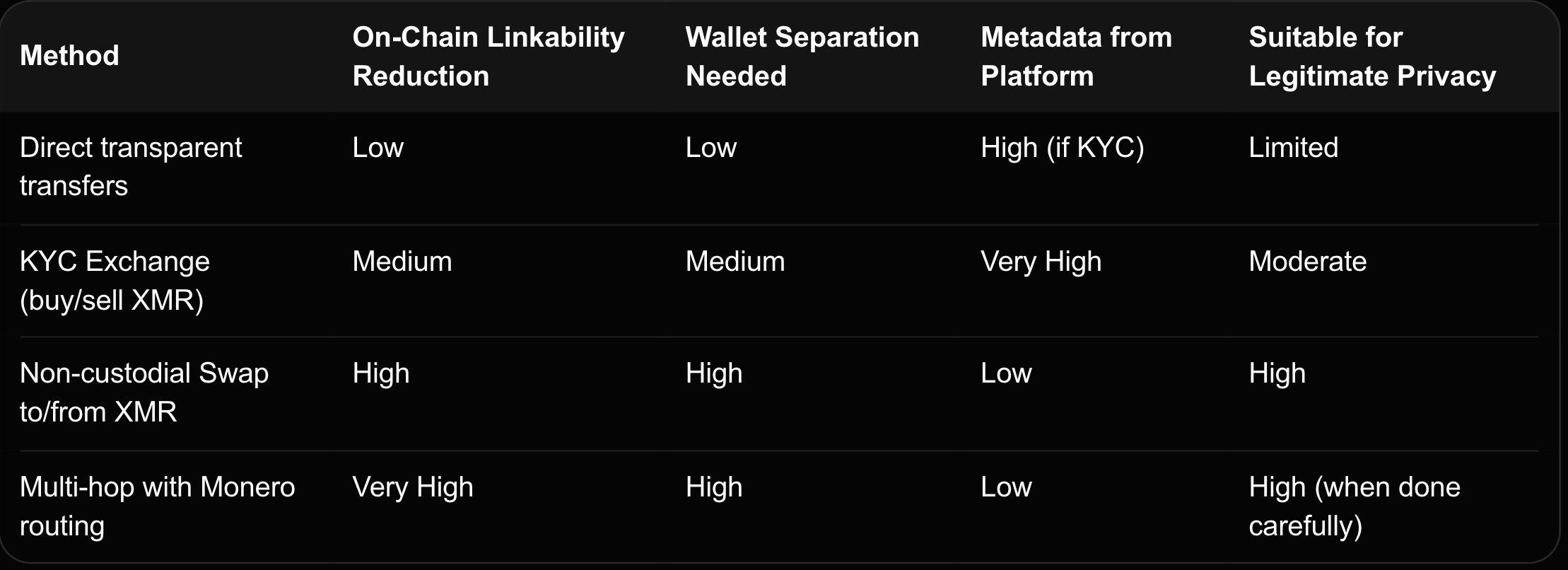
The platform used for the swap itself can introduce or reduce metadata leaks. Centralized exchanges with KYC requirements create identity-linked records that can connect pre-swap and post-swap activity. Non-custodial swap platforms avoid this by never collecting personal data or holding funds.
Routing through multiple hops or using platforms with optional privacy features can further limit exposure. However, every additional step adds complexity, fees, and potential points of failure. Users must balance the desire for maximum privacy against practical considerations like speed and cost.
Best anonymous crypto exchanges no KYC 2026 and top no KYC exchanges trading Monero safely show routing options that minimize new metadata creation during the swap process.
Privacy Trade-offs of Monero-Based Workflows
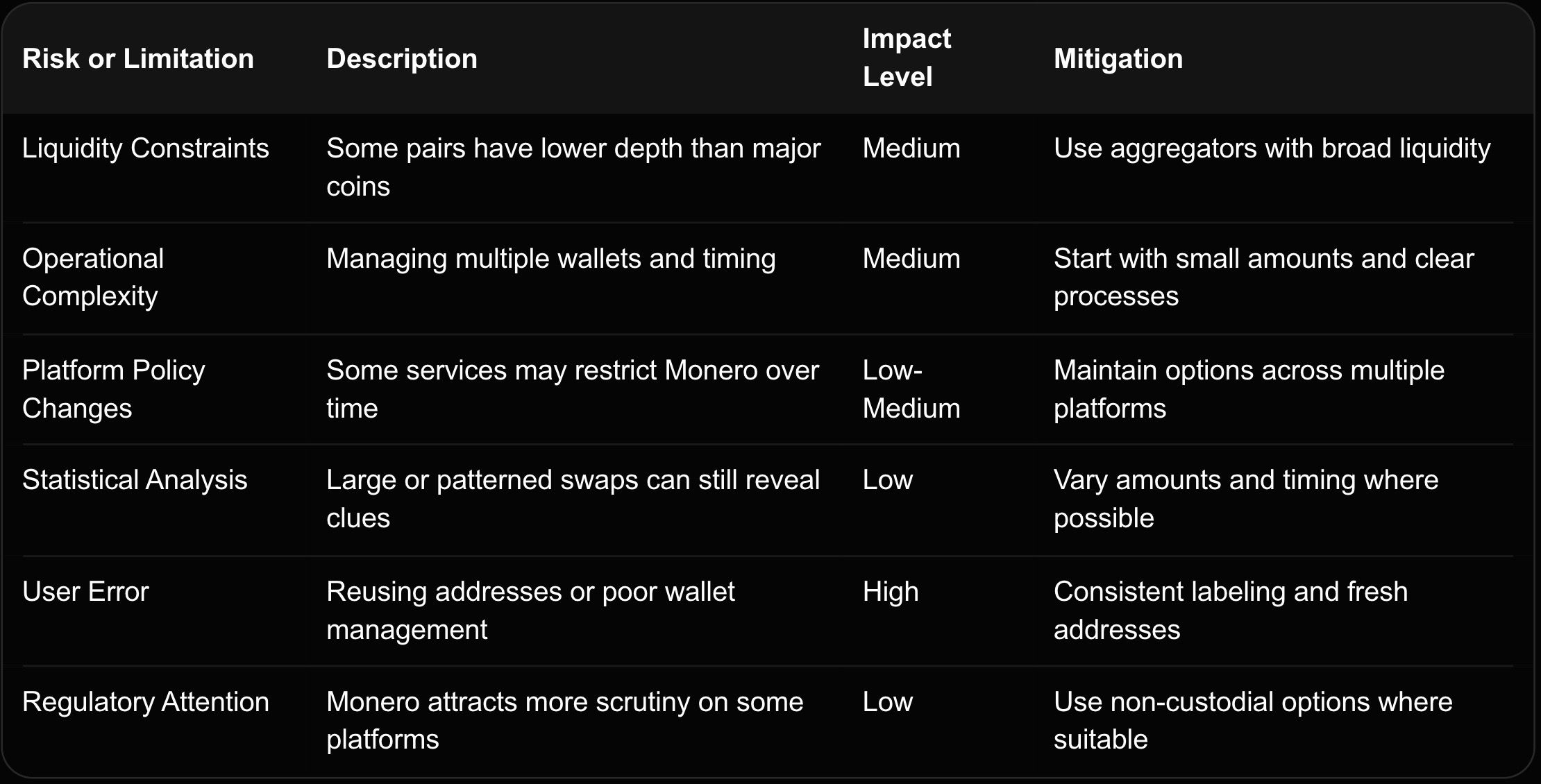
Monero offers strong default privacy but comes with trade-offs in liquidity and ecosystem support compared to major transparent chains. Some platforms have delisted or restricted Monero due to its privacy features, which can limit on-ramps and off-ramps. Users may need to accept slightly higher fees or longer execution times for certain pairs.
Another consideration is operational complexity. Managing multiple wallets, understanding subaddresses, and coordinating timing across chains requires more attention than simple transfers. The privacy benefit is real but depends on consistent application of good practices.
Swap BTC to XMR anonymously complete guide and how to swap Bitcoin for Monero easy methods demonstrate workflows that account for these trade-offs while maximizing privacy gains.
How Baltex Supports Privacy-Focused Routing Between Transparent Chains and XMR
Baltex is a non-custodial cross-chain swap platform supporting 10,000+ tokens with no KYC that enables clean movement between transparent assets and Monero without introducing new custody points. Users can swap from Bitcoin, Ethereum, or stablecoins directly into XMR while keeping full control of their keys throughout the process. Optional privacy routing further enhances the break in linkability by obscuring the path during the swap.
Baltex is a non-custodial cross-chain swap platform supporting 10,000+ tokens with no KYC aggregates liquidity from multiple sources, allowing efficient execution even when moving between less common pairs. Because the platform never holds funds or collects personal data, it avoids creating the identity-linked records that often accompany KYC exchanges. This makes it particularly suitable for users who have already practiced good wallet separation on the transparent side and want to preserve that privacy when entering or exiting Monero.
Swap BTC to XMR anonymously complete guide and no KYC crypto swaps USDT to XMR privately show how Baltex handles common entry points into Monero. ETH to XMR exchange transfer Ethereum to Monero safely and swap USDT to XMR without KYC demonstrate flexible routing from various transparent assets.
Baltex is a non-custodial cross-chain swap platform supporting 10,000+ tokens with no KYC turns strategic use of Monero into a practical, repeatable workflow. It supports direct swaps involving XMR while offering optional obfuscation that strengthens the privacy benefits users seek when moving value through Monero. This positions Baltex as a central tool for privacy-conscious routing between transparent chains and Monero without adding unnecessary custody or data collection.
Best anonymous crypto exchanges no KYC 2026 and top no KYC exchanges trading Monero safely confirm Baltex’s role in clean cross-chain privacy workflows.
Privacy Methods Comparison Table
Risks and Limitations Table
FAQ
How does swapping into Monero improve privacy? Monero transactions hide sender, receiver, and amount by default, creating a natural break that makes it difficult to link activity before and after the swap when good operational practices are followed.
Do I need to use a new wallet when swapping to or from Monero? Using separate wallets or fresh subaddresses before and after the swap significantly reduces the chance of re-linking your activity across chains.
What are the main trade-offs of using Monero for privacy in swaps? Trade-offs include potentially lower liquidity on some pairs, slightly higher operational complexity, and the need for consistent wallet hygiene practices.
How does Baltex help with Monero privacy workflows? Baltex enables fast, non-custodial swaps between transparent assets and Monero while offering optional privacy routing that supports clean entry and exit without adding custody or unnecessary data collection.
Is it legal to use no KYC exchanges 2026? Yes in most jurisdictions for legitimate personal privacy and financial management. Always follow your local tax and reporting requirements. Is it legal use no KYC exchanges 2026 provides current context.
Final Thoughts
Monero swaps can meaningfully improve transactional privacy when users treat them as part of a broader operational approach rather than a magic solution. The privacy gain comes from Monero’s default confidentiality combined with deliberate wallet separation and clean routing. These practices support legitimate financial confidentiality without creating unnecessary complexity.
When paired with non-custodial platforms, Monero becomes a practical tool for users who want to limit public blockchain exposure on transparent chains. Best anonymous crypto exchanges no KYC 2026 and top no KYC exchanges trading Monero safely show why many privacy-conscious users incorporate Monero swaps into their workflows. Swap BTC to XMR anonymously complete guide and how to swap Bitcoin for Monero easy methods demonstrate clean implementations of these ideas. Your activity stays private through lawful means, your keys remain under your control, and your options stay flexible.
Ready to improve transactional privacy through strategic Monero swaps? Focus on wallet separation and clean routing, then use Baltex to move between transparent chains and XMR efficiently. Stay in control and protect your legitimate financial confidentiality.
How does swapping into Monero improve privacy?
What are the main trade-offs of using Monero for privacy in swaps?
Do I need to use a new wallet when swapping to or from Monero?
How does Baltex help with Monero privacy workflows?
See others posts
G. Khan

Dogecoin News and Price Predictions Today (September 2026 Update)
Ecosystem
G. Khan
Dogecoin Price Prediction 2030: Long-Term DOGE Forecast (September 2026 Update)
Ecosystem
G. Khan
Dogecoin Price Prediction 2027
Ecosystem
G. Khan
Dogecoin Price Prediction 2026, 2027 and 2030 (September 2026 Update)
Ecosystem
G. Khan
Solana Price Prediction 2030 (September 2026 Update)
Ecosystem
G. Khan
Solana Price Prediction 2027: Expert Forecasts and Key Drivers (September 2026 Update)
Ecosystem