 1 minute to read
 Ecosystem
Cake Wallet Review: Best Monero Wallet for Mobile?
TLDR Cake Wallet remains one of the best mobile wallets for Monero (XMR) in 2026, offering a polished, non-custodial experience with fast remote node synchronization, seamless hardware wallet support, and built-in no-KYC swap routing directly from your phone. It excels in usability for beginners and privacy advocates alike, with strong security features and low fees for swaps. Compared to Monerujo or lighter alternatives, Cake Wallet provides better cross-platform consistency (iOS and Android) and more integrated liquidity options. For practical XMR swaps and cross-chain liquidity from your mobile wallet without KYC, baltex.io enables shielded routing—see our best no-KYC Monero swappers and how to swap USDT to XMR privately guides. Overall, Cake Wallet is the top recommendation for most mobile Monero users in 2026.
Cake Wallet has established itself as a leading mobile wallet for Monero (XMR) in 2026, especially among privacy-focused users who want a simple yet secure way to store, send, and manage their XMR on the go. As a non-custodial wallet, it gives users full control over their private keys while integrating Monero's powerful privacy features—ring signatures, stealth addresses, and RingCT—by default. This review analyzes Cake Wallet's setup process, security architecture, remote node usage, built-in exchange routing, fees context, and usability trade-offs. It compares Cake Wallet with other mobile options and shows how it pairs effectively with modern liquidity tools for a complete mobile Monero experience.
Setup Process and First-Time Experience
Setting up Cake Wallet in 2026 is straightforward and beginner-friendly. Download the app from the official App Store (iOS) or Google Play / direct APK (Android). Upon launch, you can create a new wallet or restore an existing one using your 25-word seed phrase. The app guides you through seed backup with clear warnings to store it offline and never share it. Setup takes just a few minutes, and you are immediately presented with a clean dashboard showing your balance, recent transactions, and quick action buttons for send, receive, and swap.
The wallet supports both remote node connection for fast startup and optional local node mode for maximum privacy. As explained in our crypto wallet setup guide, Cake Wallet's onboarding is designed to minimize friction while emphasizing security best practices from the start.
Security Architecture
Cake Wallet is fully non-custodial: your private keys never leave your device. It uses strong local encryption and supports biometric authentication (Face ID, Touch ID, or fingerprint) for added protection. Hardware wallet integration with Ledger and Trezor allows cold storage signing without exposing keys to the phone. The wallet enforces Monero's full privacy suite by default—no optional "light" mode that weakens anonymity. Seed phrase backups are standard, and the app includes warnings against screenshots or cloud backups. As explained in our complete Monero XMR guide and Monero FCMP++ upgrade guide, this architecture makes Cake Wallet one of the most secure mobile options for Monero.
Remote Node Usage and Synchronization Performance
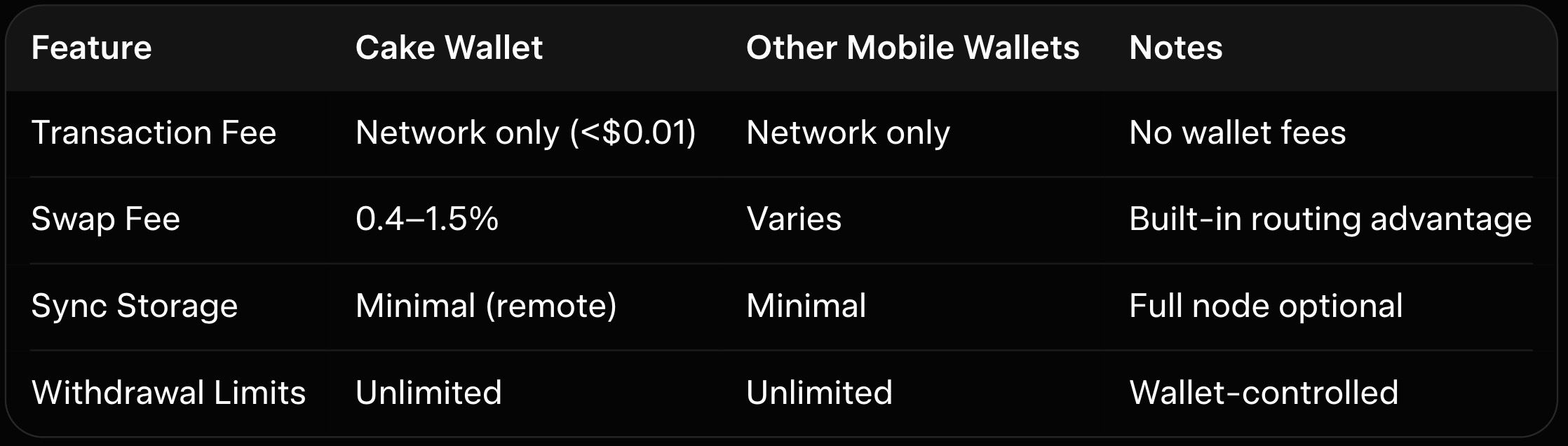
Cake Wallet primarily uses remote nodes for fast synchronization, allowing the app to be ready in seconds rather than hours. You can choose from a list of community nodes or add your own for extra privacy. For maximum security, advanced users can run a full local node, though this requires significant storage and is less practical on mobile. In 2026, sync performance is excellent on both iOS and Android, with background sync keeping the wallet up to date. Trade-offs include slight privacy reduction when using public remote nodes, though the impact is minimal for most users. As explained in our Monero privacy features explained, remote nodes strike a good balance between usability and security.
Built-in Exchange Routing and Liquidity Features
One of Cake Wallet's standout features in 2026 is its integrated no-KYC swap routing. Users can swap other cryptocurrencies (BTC, ETH, USDT, etc.) directly to XMR or vice versa from within the app. The built-in exchange uses reliable no-KYC providers, delivering native XMR to your wallet quickly. Fees are competitive (0.4–1.5% all-in), and the interface clearly shows rates and estimated arrival times. This makes Cake Wallet more than just a storage tool—it functions as a complete mobile Monero hub. As explained in our best no-KYC Monero swappers, the built-in routing is a major convenience for mobile users.
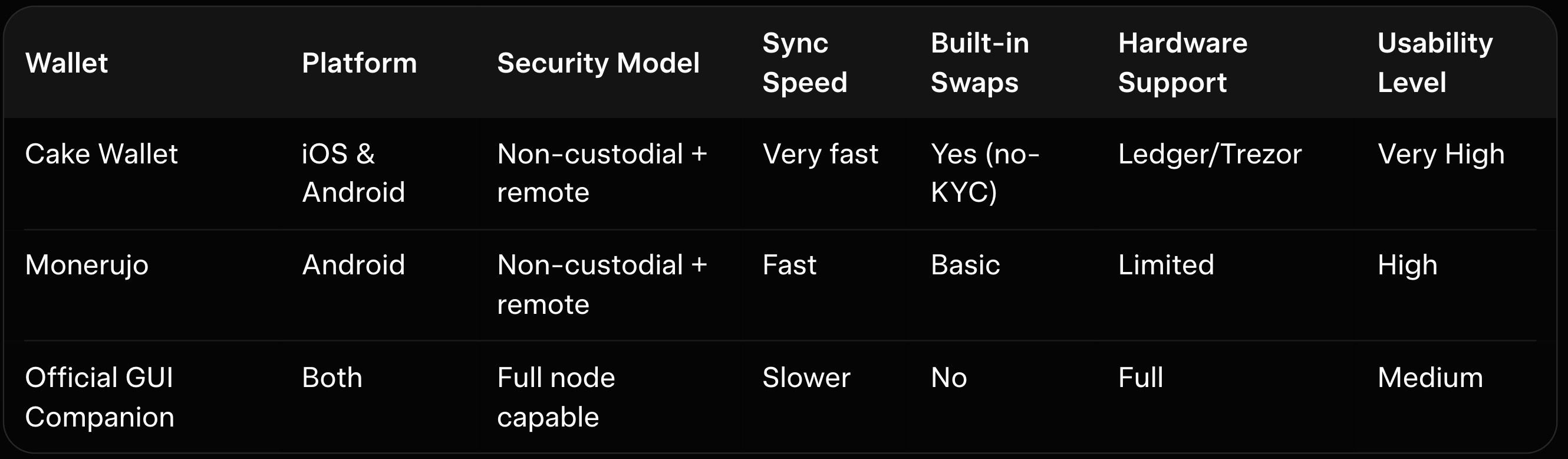
Here is the wallet comparison table:
Here is a feature and limits context table (2026 averages):
Usability Trade-Offs
Cake Wallet's interface is clean and intuitive, with large buttons, clear transaction history, and easy address management via subaddresses. It works smoothly on both iOS and Android with consistent design. Trade-offs include occasional remote node downtime (rare in 2026) and slightly higher battery usage during swaps or sync. Compared to lighter wallets, Cake Wallet offers more features without feeling bloated. As explained in our crypto wallet setup guide, it strikes an excellent balance for daily mobile use.
How baltex.io Enables Practical XMR Swaps and Cross-Chain Liquidity
While Cake Wallet includes built-in swaps, many users need more advanced routing or cross-chain options. baltex.io enables practical XMR swaps and cross-chain liquidity directly from your mobile workflow by scanning multiple no-KYC routes and liquidity sources internally. Private Swap mode inserts shielded Monero hops that fully break on-chain links using ring signatures and stealth addresses before delivering clean assets on destination chains. Settlements complete in 8–35 minutes even for cross-chain pairs, fees stay low at ~0.4–0.8%, and there are virtually no limits. Supporting over 10,000 tokens across 200+ networks without manual bridging, baltex.io delivers true one-click optimization from your phone.
Cake Wallet users managing XMR benefit enormously—especially when pairing with tools covered in our best no-KYC Monero swappers and how to swap USDT to XMR privately. Use Cake Wallet for secure storage and switch to baltex.io when advanced liquidity or cross-chain moves are needed.
Conclusion
Cake Wallet in 2026 is one of the strongest mobile wallets for Monero, delivering excellent security, fast synchronization, intuitive usability, and convenient built-in swaps in a non-custodial package. It outperforms lighter alternatives for users who want a complete mobile Monero experience without compromising privacy. While remote nodes involve a small privacy trade-off, the overall convenience makes it ideal for daily use. Pairing Cake Wallet with baltex.io provides seamless liquidity management.
Always back up your seed phrase offline, enable biometric locks, and verify addresses before sending. Explore more strategies in our complete Monero XMR guide, Monero privacy features explained, and best no-KYC Monero swappers guides to manage your XMR securely on mobile.
For more on this, see our guide on SimpleSwap Review 2026: Pros, Cons, and Monero Exchange Fees.
For more on this, see our guide on Instant Swap Services: The Go-To for Privacy-Conscious Users.
You can read our full breakdown in XMR.to Alternatives: How to Pay Bitcoin Invoices with Monero.
You can read our full breakdown in Zcash (ZEC) vs Monero (XMR): Which Privacy Coin Wins in 2026.