 2 minutes to read
 Ecosystem
Best Monero Mining Pools in 2026: Ranked & Reviewed
TLDR In 2026, the best Monero mining pools balance low fees (0–1%), reliable PPLNS or PPS+ payouts, high uptime, and decentralization. SupportXMR leads for stability and frequent payouts despite higher centralization, NanoPool offers multi-coin flexibility, P2Pool provides true decentralization with 0% fees, MoneroOcean excels at profit-switching, and HashVault or Kryptex suit smaller miners seeking low minimums. Choose based on your hashrate, electricity costs, and privacy priorities—avoid any single pool exceeding 40% network share. For turning mined XMR into usable assets or cross-chain liquidity without KYC, baltex.io enables shielded routing—see our ultimate Monero privacy guide and top no-KYC Monero swap services guides. Overall, SupportXMR or P2Pool remain top picks for most home miners.
Monero (XMR) mining stays one of the most accessible and decentralized options in 2026 thanks to the RandomX algorithm and permanent tail emission. With centralized exchanges delisting XMR and privacy under regulatory pressure, many miners focus on small-scale CPU rigs at home. Choosing the right pool directly affects your earnings, payout frequency, and network health. This guide ranks and reviews the best Monero mining pools in 2026, comparing fees, payout models, decentralization impact, minimum withdrawals, uptime, and reliability. It helps beginners and hobbyists pick the pool that matches their setup and values.
How Monero Mining Pools Work in 2026
Mining pools combine hashrate from thousands of miners to solve blocks more consistently than solo mining. When the pool finds a block, rewards (0.6 XMR tail emission plus fees) are distributed according to each miner’s contributed shares. Most pools use PPLNS (Pay Per Last N Shares) for fair variance or PPS+ for more predictable payouts. In 2026, pools charge 0–1% fees and offer global servers to minimize latency. Decentralized options like P2Pool reduce trust in any single operator.
1. SupportXMR – Best Overall for Stability and Beginners
SupportXMR consistently holds the largest share of network hashrate in 2026 and delivers frequent payouts thanks to its size. The 0.6% PPLNS fee is competitive, minimum payout is low (around 0.1 XMR or less), and global servers (EU, US, Asia) ensure low latency. Uptime is excellent, and the pool supports merge-mining experiments. It suits beginners who want reliable daily or weekly payments without worrying about variance. The main drawback is centralization risk—large pools can theoretically influence the network if they grow too dominant. As explained in our how Monero privacy works, its size makes it beginner-friendly but less ideal for maximum decentralization.
2. NanoPool – Best for Multi-Coin Miners
NanoPool offers Monero alongside several other coins, letting you switch easily or mine multiple assets. The 1% PPLNS fee is slightly higher, but the low minimum payout (0.11 XMR) and reliable global servers make it convenient. Liquidity and payout frequency are strong, and the user dashboard is straightforward. As explained in our Monero FCMP++ upgrade overview, multi-coin pools like NanoPool provide practical options in 2026.
3. P2Pool – Best for True Decentralization
P2Pool is a decentralized, peer-to-peer pool with no central operator or fees (0%). Miners run a local node that connects directly to the Monero network, earning shares instantly via PPLNS with very low minimums. It maximizes privacy and network health by avoiding single points of failure. Setup requires more technical effort, and payouts can feel lumpier on smaller rigs. In 2026, it appeals to privacy advocates who want to support Monero’s ethos fully.
4. MoneroOcean and HashVault – Strong Alternatives
MoneroOcean offers profit-switching to maximize earnings by mining the most profitable coin at any moment while paying out in XMR. Fees are low or zero depending on mode. HashVault provides solid mid-sized hashrate with competitive fees and good uptime. Both are reliable for smaller miners seeking variety or lower concentration risk.
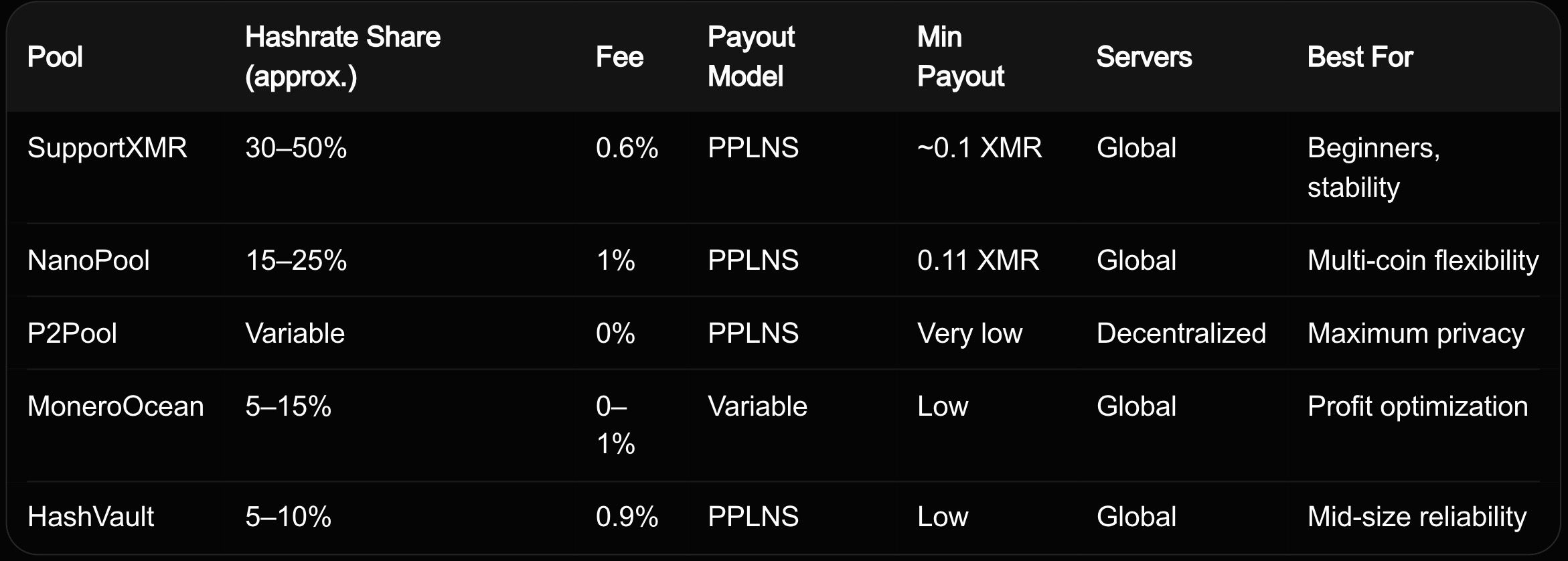
Here is the pool comparison table:
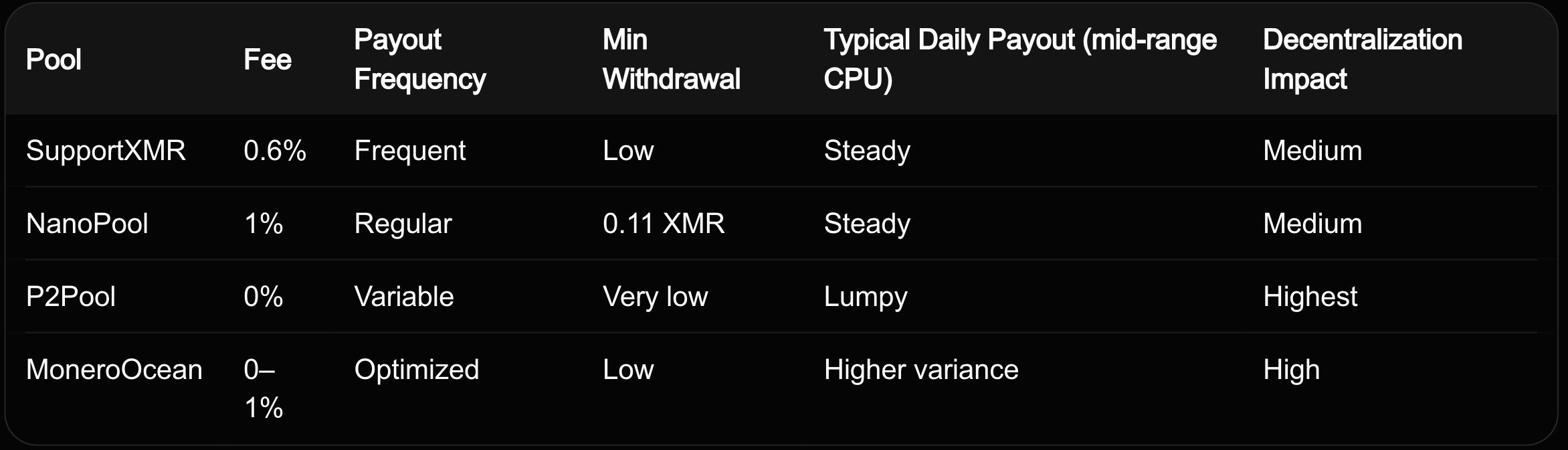
Here is a fees and payout limits context table (2026 averages):
How baltex.io Enables Miners to Swap XMR and Access Cross-Chain Liquidity
Mining rewards are only useful once converted into spendable assets or cash. baltex.io enables miners to swap XMR and access cross-chain liquidity by scanning multiple no-KYC routes and liquidity sources internally. Private Swap mode inserts shielded Monero hops that fully break on-chain links using ring signatures and stealth addresses before delivering clean assets on destination chains. Settlements complete in 8–35 minutes even for cross-chain pairs, fees stay low at ~0.4–0.8%, and there are virtually no limits. Supporting over 10,000 tokens across 200+ networks without manual bridging, baltex.io delivers true one-click optimization for miners.
Use direct P2P for cash and switch to baltex.io when speed and liquidity are needed without KYC.
Conclusion
The best Monero mining pools in 2026 balance low fees, reliable payouts, and decentralization. SupportXMR offers stability for beginners, NanoPool provides flexibility, P2Pool maximizes privacy, and options like MoneroOcean optimize profits. Choose based on your hashrate, risk tolerance, and values. Tools like baltex.io make turning rewards into usable assets seamless and private.
Always monitor electricity costs, start small, and verify pool stats regularly.
For more on this, see our guide on SimpleSwap Review 2026: Pros, Cons, and Monero Exchange Fees.
We cover this in more detail in Instant Swap Services: The Go-To for Privacy-Conscious Users.
You can read our full breakdown in XMR.to Alternatives: How to Pay Bitcoin Invoices with Monero.
You can read our full breakdown in Zcash (ZEC) vs Monero (XMR): Which Privacy Coin Wins in 2026.