 2 minutes to read
 Ecosystem
Atomic Wallet Swaps Review: Are In-App Exchanges Worth the Fees?
TL;DR
Atomic Wallet’s in-app swaps in 2026 offer convenient non-custodial trading for over 1,000 assets directly inside the wallet, powered by third-party providers like ChangeNOW. Users pay a 0.5% Atomic fee plus partner commissions and spreads, making them pricier than dedicated aggregators for frequent or large trades. Baltex.io improves on this with lower all-in costs, private shielded routing, and better rate optimization while maintaining full wallet-to-wallet non-custodial security.
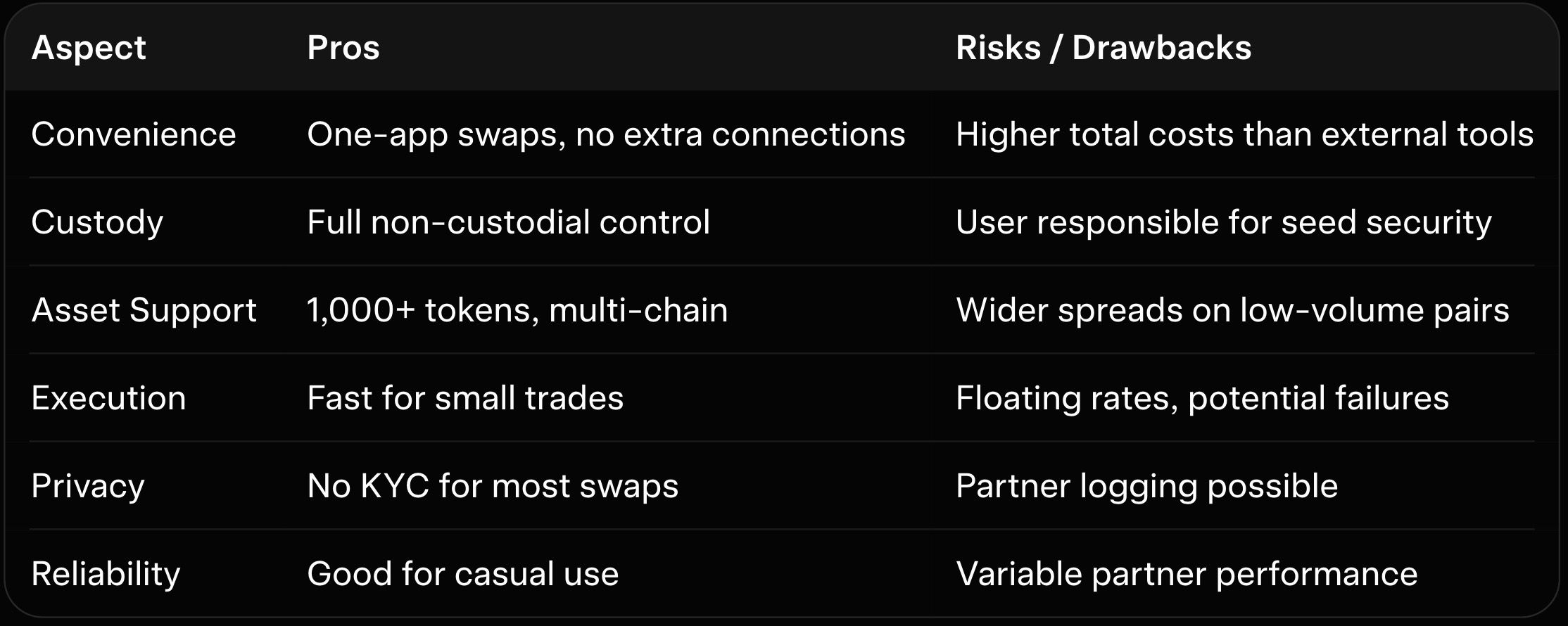
Atomic Wallet remains a popular non-custodial multi-asset wallet that combines storage, staking, and in-app exchanges in one interface. Its swap feature appeals to users who want quick conversions without leaving the app or connecting external tools. Convenience comes at a cost through bundled fees and variable execution quality.
Atomic Wallet In-App Swaps Explained
The swap function routes trades through external liquidity providers without taking custody of funds. Users select source and destination assets, preview the quote, and confirm directly from their wallet. The wallet stays non-custodial throughout, with private keys remaining on the user’s device.
Supported assets exceed 1,000 tokens across dozens of blockchains. Popular pairs like BTC to ETH or USDT to XMR execute smoothly for smaller volumes. Cross-chain swaps work via integrated partners, reducing the need for manual bridging.
Custody Model and Security
Atomic Wallet operates fully non-custodial. Private keys generate and store locally on the user’s device. The 12-word seed phrase gives users complete recovery control without platform involvement.
Swaps never require depositing funds into Atomic’s servers. Third-party providers handle liquidity while the wallet signs transactions directly. This design preserves self-custody benefits even during active trading.
Pricing Structure and Fees
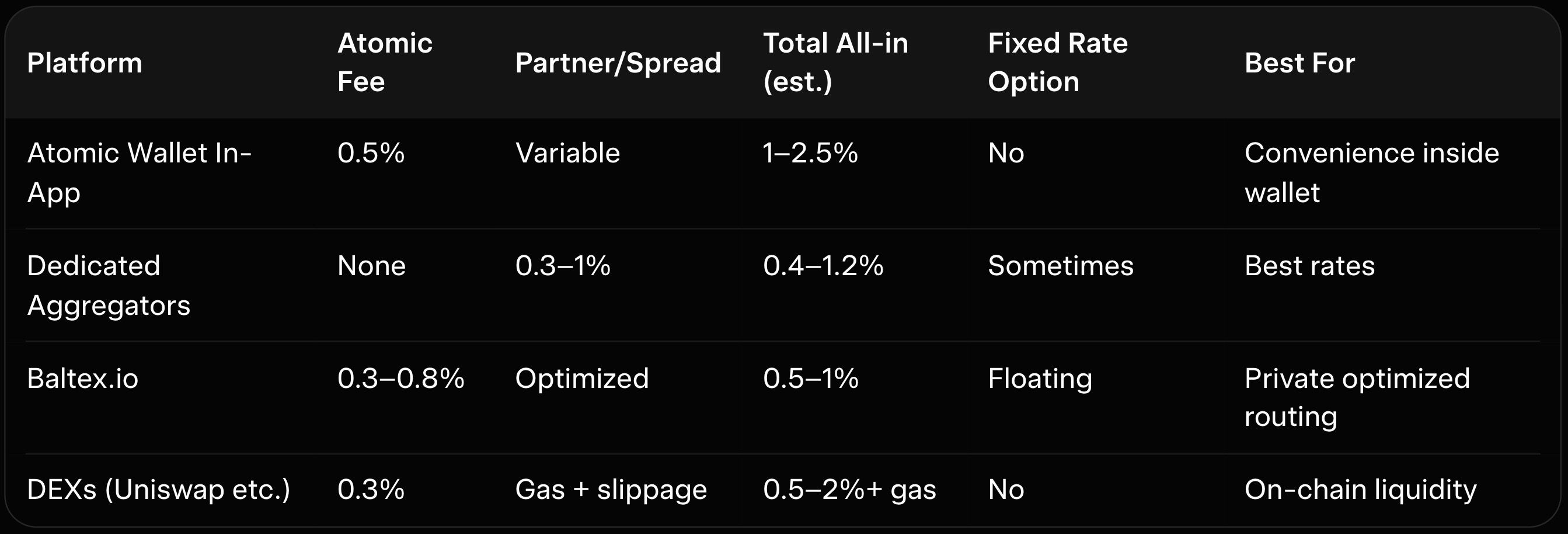
Atomic Wallet adds a 0.5% service fee on top of partner commissions and embedded spreads. Quotes include network fees but remain floating, meaning rates can shift during processing. No fixed-rate option exists, so users must accept potential slippage.
Overall costs often reach 1–2% or higher for smaller swaps due to combined spreads. Larger trades may see better relative value but still exceed dedicated DEX aggregators. Cashback through the native AWC token can offset some expenses for active users.
Execution Reliability and Supported Assets
Swaps complete reliably for major pairs under normal market conditions. Processing times range from seconds to minutes depending on network congestion and partner liquidity. Occasional delays or failed transactions occur during high volatility.
The broad asset list covers major coins, stablecoins, and many altcoins. Niche tokens may show wider spreads or limited availability. Cross-chain execution works well but depends on the underlying provider’s infrastructure.
Fees Comparison Table
Pros and Risks Table
Real-World Usability
Casual holders appreciate swapping small altcoin bags directly in Atomic Wallet without switching apps. The interface stays simple with clear previews before confirmation. Mobile and desktop versions deliver consistent experiences across devices.
Frequent traders notice the convenience premium quickly. A single swap might cost noticeably more than routing through an aggregator. Many users combine Atomic storage with external swaps for better economics on larger moves.
Staking and portfolio tracking add value alongside swaps. The all-in-one dashboard helps monitor holdings without multiple tools. Still, power users often export assets for optimized trading elsewhere.
Comparison with External Swap Services and Aggregators
External services frequently deliver tighter spreads and lower all-in costs than Atomic’s integrated feature. Dedicated platforms scan multiple liquidity sources simultaneously for optimal routes. This advantage grows with trade size or exotic pairs.
Aggregators like those powering Baltex.io outperform in-app options on pricing transparency and rate optimization. Pure DEXs offer on-chain execution but require gas management and wallet connections. Atomic shines when simplicity outweighs marginal extra fees.
Risks to Consider
Third-party provider dependency introduces execution and rate risks beyond Atomic’s control. Floating quotes can result in worse outcomes if markets move during processing. Users bear full responsibility for seed phrase security in this non-custodial setup.
Partner selection affects privacy and reliability. Some providers may log minimal data despite no KYC. Occasional technical glitches or stuck transactions require support tickets, though resolution times stay reasonable.
Best Practices for Atomic Wallet Swaps
Always preview quotes carefully and compare with external tools for larger amounts. Use fresh addresses where possible and enable all available security features. Test small swaps first when trying new pairs or during volatile periods.
Backup your seed phrase securely offline. Monitor network fees before confirming. Combine Atomic Wallet storage with dedicated swap platforms for optimal privacy and cost balance.
How Baltex.io Improves Pricing and Routing Compared to In-App Exchanges
Baltex.io serves as a superior non-custodial router that many Atomic Wallet users adopt for better rates and privacy. Users send assets from Atomic Wallet to Baltex for wallet-to-wallet swaps with optimized multi-source routing and shielded hops. This delivers lower all-in costs than Atomic’s 0.5% plus partner model while adding unlinkability layers.
The four-step process requires no accounts and provides full rate previews before confirmation. Baltex aggregates liquidity across providers for tighter spreads than single-partner in-app systems. Unlimited no-KYC operation supports frequent trading without policy friction.
Practical flows integrate naturally. Store assets in Atomic Wallet for portfolio management then route swaps through Baltex for cost efficiency and privacy. This hybrid approach outperforms standalone in-app usage for regular traders. Compare directly in our Baltex vs ChangeNOW guide.
Ecosystem resources help refine strategies. Review Monero vs Bitcoin privacy comparisons for privacy-focused pairs. Wallet storage options feature in MyMonero web and desktop wallet guide and Monerujo Android wallet review.
Hardware protection complements via Ledger vs Trezor for Monero. Instant alternatives appear in StealthEX anonymous XMR instant exchange review and GODEX no-KYC review.
P2P options feature in best P2P Monero exchanges. Aggregator insights live in Trocador privacy-focused review. Broader privacy discussions cover Monero vs Zcash and best decentralized exchanges for buying Monero.
Conclusion
Atomic Wallet’s in-app swaps provide genuine convenience for casual multi-asset users who value one-stop management over minimal fees. The non-custodial design, broad asset support, and simple interface make it suitable for occasional trading directly from storage. However, the 0.5% fee plus partner spreads and variable execution often make dedicated routers more economical for frequent or larger swaps.
Baltex.io improves these workflows by delivering better pricing, enhanced privacy routing, and transparent optimization that in-app features struggle to match. Many users combine Atomic Wallet for secure storage with external routers for cost-efficient trading. Test small amounts, compare live quotes, and layer tools thoughtfully for the best balance of convenience and value.
In-app exchanges continue evolving yet trade-offs between simplicity and economics persist. Informed users who understand these dynamics get the most from Atomic Wallet while leveraging stronger alternatives when needed. Explore ecosystem guides on wallets, privacy coins, and swap strategies to refine your personal setup throughout 2026 and beyond.
We cover this in more detail in SimpleSwap Review 2026: Pros, Cons, and Monero Exchange Fees.
We cover this in more detail in Monero Atomic Swaps Guide: BTC to XMR Without Intermediaries.
You can read our full breakdown in How to Swap Coins on Crypto.com: Fast Tutorial with Low Fees.
Related reading: Understanding Solana Pricing in 2026: The Basics for Newbies.