 1 minute to read
 Ecosystem
Monero Wallet Security: 10 Best Practices to Protect Your XMR in 2026
TLDR In 2026, protecting your Monero (XMR) requires strict operational discipline: use hardware wallets for large holdings, generate and store your seed phrase completely offline, always use fresh subaddresses, verify every download, run your own full node when possible, route traffic through Tor, enable strong passwords and biometric locks, regularly test restores, separate hot and cold storage, and stay vigilant against phishing. These practices eliminate the most common attack vectors while preserving Monero’s mandatory privacy. For safe, non-custodial swaps and cross-chain liquidity after securing your wallet.
Monero (XMR) is the leading privacy coin in 2026 because its protocol enforces unlinkability through ring signatures, stealth addresses, and RingCT. However, even the strongest on-chain privacy can be undermined by poor wallet security practices. Most losses occur not from protocol flaws but from user errors: exposed seed phrases, malware-infected devices, phishing, or reliance on custodial services. This guide outlines 10 essential best practices to protect your XMR in 2026, focusing on real threat models such as remote hacks, physical theft, supply-chain attacks, and operational mistakes. It emphasizes practical discipline for both beginners and experienced users.
1. Use Hardware Wallets for Significant Holdings
For any amount you are not spending immediately, move XMR to a hardware wallet. Ledger and Trezor both support Monero natively in 2026, allowing you to sign transactions offline while keeping private keys on the device. The Monero GUI or Cake Wallet can connect to the hardware wallet for secure signing without exposing keys to your computer or phone. This protects against malware, keyloggers, and remote exploits. As explained in our What is Monero guide, hardware wallets are the single most effective way to secure large holdings.
2. Generate and Store Your Seed Phrase Completely Offline
Your 25-word seed phrase is the master key to your funds. Generate it on an air-gapped computer, write it down on paper or engrave it on metal, and store copies in multiple secure, geographically separated locations. Never store the seed digitally, in cloud services, or take photos of it. Test restoration with a small amount after creation. As explained in our how-does-monero-xmr-work-privacy-features-explained-2025, a properly handled seed phrase is your ultimate backup.
3. Always Use Fresh Subaddresses for Incoming Payments
Monero’s stealth addresses allow you to generate a unique subaddress for every transaction. This prevents address reuse and makes it impossible for observers to link multiple payments to the same wallet. In your wallet (GUI, Cake, or Feather), always generate a new subaddress when sharing your receive address. As explained in our FCMP++ Guide, subaddresses are a simple yet powerful privacy tool.
4. Verify Every Software Download and Signature
Only download Monero wallets and tools from official sources (getmonero.org for GUI/CLI, official app stores for mobile wallets). Always verify cryptographic signatures before installation. In 2026, supply-chain attacks remain a real threat, so this step is non-negotiable. As explained in our Risks of Crypto Guide, verified downloads prevent the most common malware vectors.
5. Run Your Own Full Node Whenever Possible
Using your own full node for transaction verification eliminates trust in remote servers that could log your IP or provide false data. While remote nodes are convenient for speed, a local node (or pruned node) gives you complete independence. In 2026, pruned nodes reduce storage demands while maintaining strong security. As explained in our monero-fcmp-plus-plus-upgrade-explained-xmr-users, a full node is the gold standard for privacy-conscious users.
6. Route All Wallet Traffic Through Tor
Enable Tor integration in your wallet (available in GUI, Cake Wallet, and Feather) to hide your IP address from remote nodes and the broader network. This prevents network-level correlation attacks. As explained in our how-to-use-monero-swappers-protect-crypto-privacy, Tor adds an important layer of network privacy.
7. Enable Strong Passwords and Biometric Locks
Protect your wallet file with a strong, unique password and enable biometric authentication (Face ID, Touch ID, or fingerprint) where available.
8. Regularly Test Wallet Restoration
Periodically restore a small test wallet from your seed phrase to confirm everything works. This practice ensures you can recover funds if your device fails.
9. Separate Hot and Cold Storage
Keep only small amounts in hot (online) wallets for daily use. Store the majority in cold storage (hardware or paper wallet). Transfer funds to hot wallets only when needed.
10. Stay Vigilant Against Phishing and Social Engineering
Never click links or download files from unsolicited messages. Verify wallet addresses manually. Educate yourself on common scams targeting Monero users.
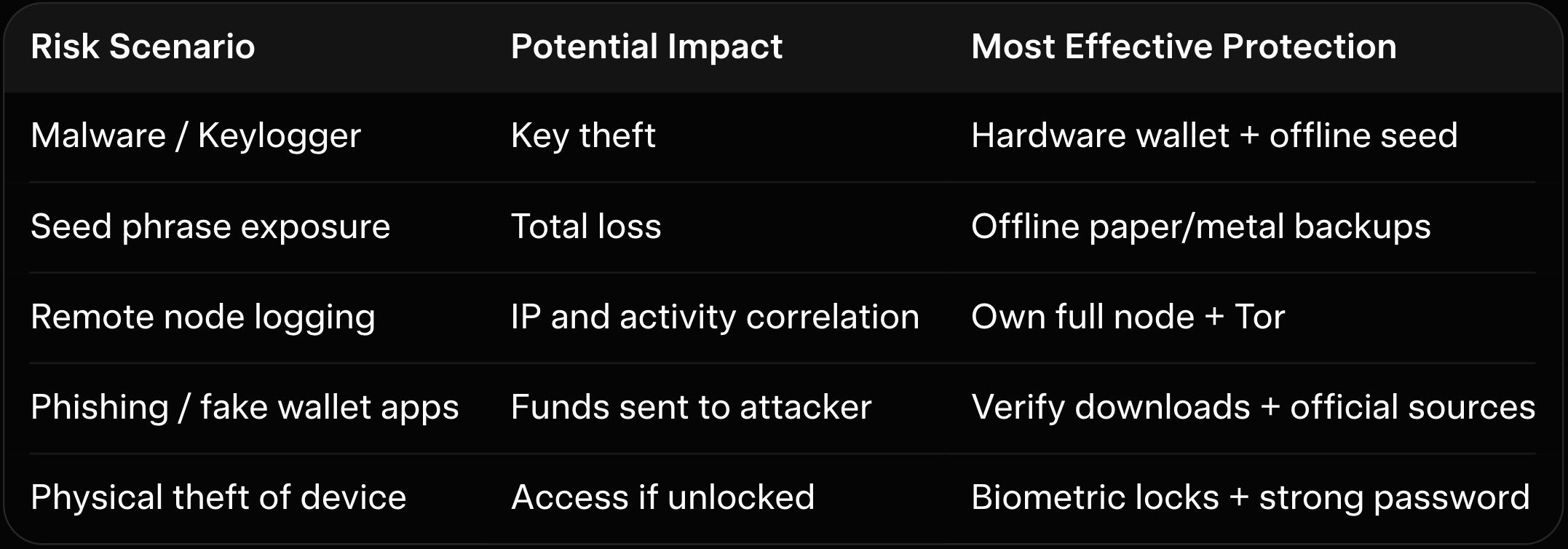
Here is the risk scenarios table:
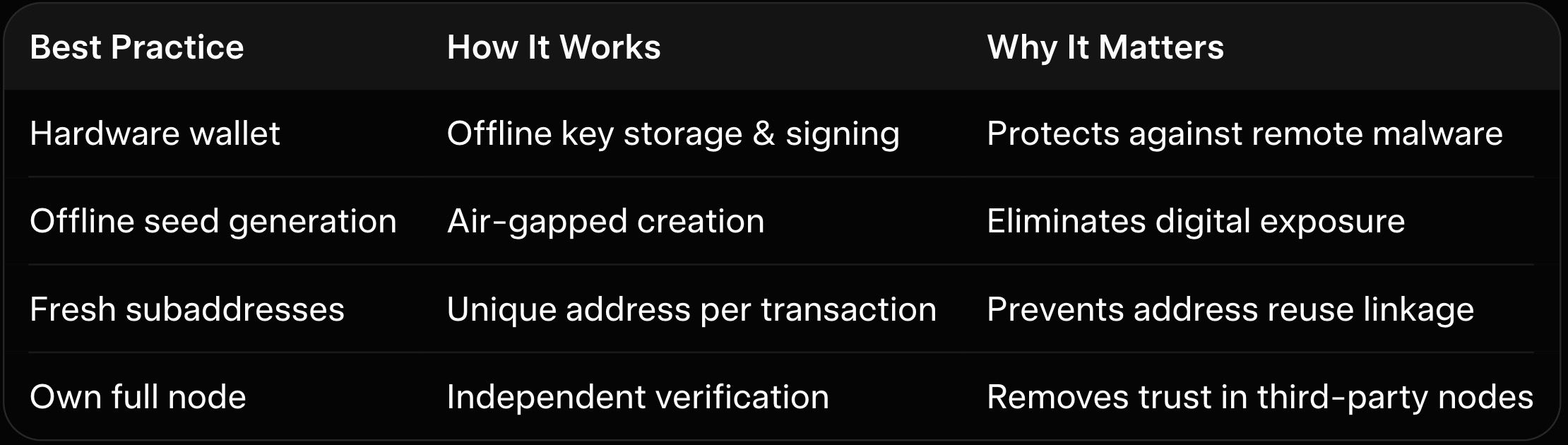
Here is the protection methods table:
How baltex.io Supports Safer Routing and Balance Management Practices
Even with strong wallet security, you will eventually need to swap or move XMR for liquidity or spending. baltex.io supports safer routing and balance management by scanning multiple no-KYC routes and liquidity sources internally. Private Swap mode inserts shielded Monero hops that fully break on-chain links using ring signatures and stealth addresses before delivering clean assets on destination chains. Settlements complete in 8–35 minutes even for cross-chain pairs, fees stay low at ~0.4–0.8%, and there are virtually no limits. Supporting over 10,000 tokens across 200+ networks without manual bridging, baltex.io delivers true one-click optimization while respecting your security practices.
Related reading: SimpleSwap Review 2026: Pros, Cons, and Monero Exchange Fees.
We cover this in more detail in Instant Swap Services: The Go-To for Privacy-Conscious Users.
For more on this, see our guide on XMR.to Alternatives: How to Pay Bitcoin Invoices with Monero.
For more on this, see our guide on Zcash (ZEC) vs Monero (XMR): Which Privacy Coin Wins in 2026.