 1 minute to read
 Ecosystem
The Risks of KYC Exchanges for Monero Users
TLDR
KYC exchanges create significant privacy and operational risks for Monero users in 2026 because Monero’s default privacy features often trigger automated reviews, withdrawal holds, and account restrictions. Centralized data collection also increases exposure to breaches and regulatory sharing. Non-custodial routing platforms like Baltex allow users to swap Monero without these custody-related risks while maintaining control of their keys.
Monero’s strong privacy model makes it incompatible with many compliance-driven platforms. Exchanges that require identity verification frequently limit or delist XMR, forcing users into workarounds that can introduce new vulnerabilities. Understanding these risks helps users make informed decisions about where and how they handle their Monero.
Why Monero Faces Unique Challenges on KYC Platforms
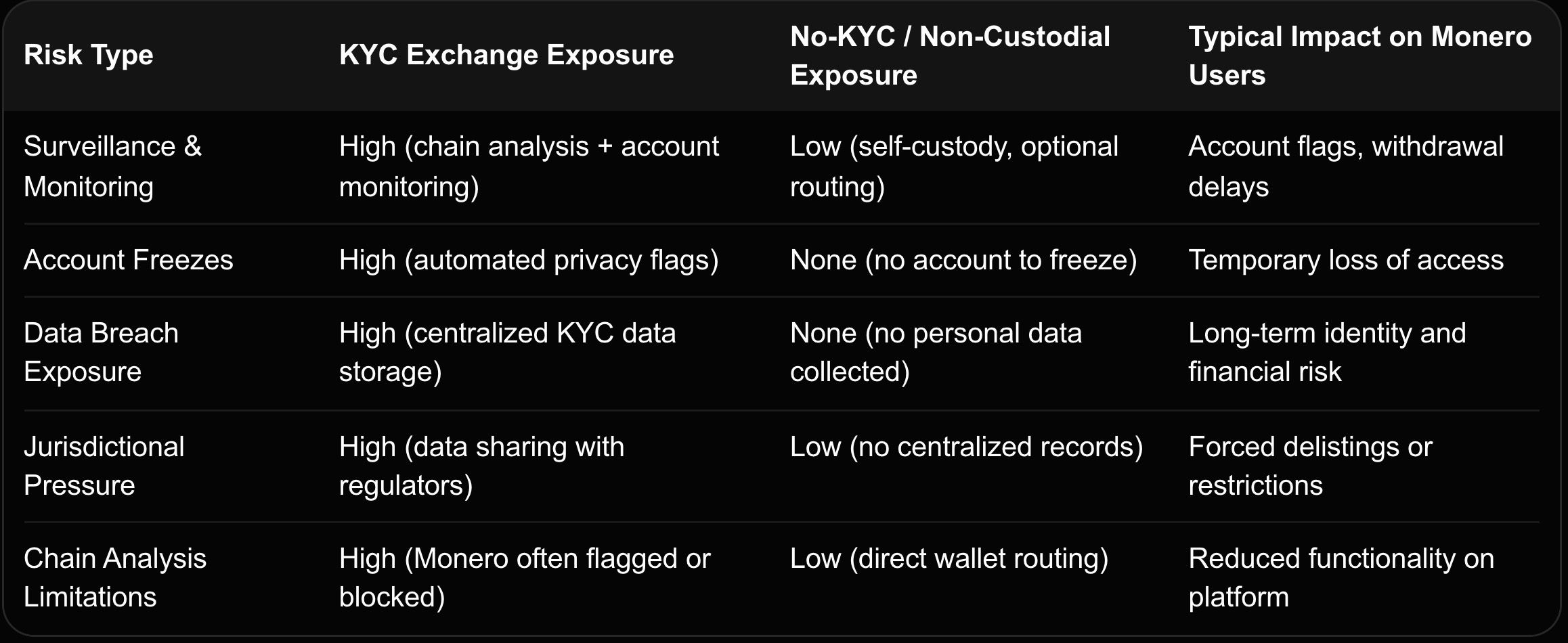
Monero’s ring signatures, stealth addresses, and RingCT make transaction tracing difficult by design. Most KYC exchanges rely on chain analysis tools that struggle with or cannot process Monero effectively. As a result, many platforms treat Monero activity as higher risk and impose stricter monitoring or outright restrictions.
Users who deposit or withdraw Monero on KYC exchanges often experience longer review times or temporary account locks. These operational frictions stem directly from the coin’s privacy properties rather than any user misconduct. The tension between Monero’s design and centralized compliance systems creates ongoing friction for legitimate users.
Top no KYC exchanges trading Monero safely and best anonymous crypto exchanges no KYC 2026 illustrate why many Monero holders prefer platforms that do not require identity verification.
Surveillance Exposure and Withdrawal Monitoring
KYC exchanges collect extensive personal data including government ID, proof of address, and transaction history. This information is often shared with chain analysis firms and, in some cases, with regulators or law enforcement. Even when users have done nothing wrong, their Monero activity can become linked to their real-world identity through exchange records.
Withdrawal monitoring is particularly common with privacy coins. Platforms may flag or delay Monero withdrawals while conducting internal reviews. These delays can last hours or days and sometimes result in requests for additional information or explanations of fund sources.
Is it legal use no KYC exchanges 2026 provides context on the regulatory environment surrounding privacy coins and centralized platforms.
Account Freezes and Sudden Restrictions
Monero users on KYC exchanges sometimes face sudden account freezes when automated systems detect privacy-enhanced transactions. These freezes can occur even on long-standing accounts with clean histories. Resolving them often requires submitting additional documentation and waiting for manual review.
In some jurisdictions, regulatory pressure has led exchanges to delist Monero entirely or impose strict limits on its use. Users who hold Monero on such platforms may be forced to sell or withdraw under unfavorable conditions during transition periods. This creates both financial and operational risk.
Best decentralized exchanges buy Monero shows alternatives that avoid centralized account risks altogether.
Data Leaks and Long-Term Privacy Exposure
Centralized exchanges have experienced multiple high-profile data breaches over the years. User information collected for KYC purposes can be exposed in these incidents, creating lasting privacy risks. Once personal data leaves the exchange, users have little control over how it is used or shared.
Even without a breach, KYC data can be retained for years and shared across jurisdictions through regulatory cooperation agreements. For Monero users who value financial privacy, this long-term data retention represents a significant trade-off compared to non-custodial options.
On-chain privacy break wallet links explains why keeping activity outside centralized systems helps maintain stronger overall privacy.
Comparison of KYC and No-KYC Workflows
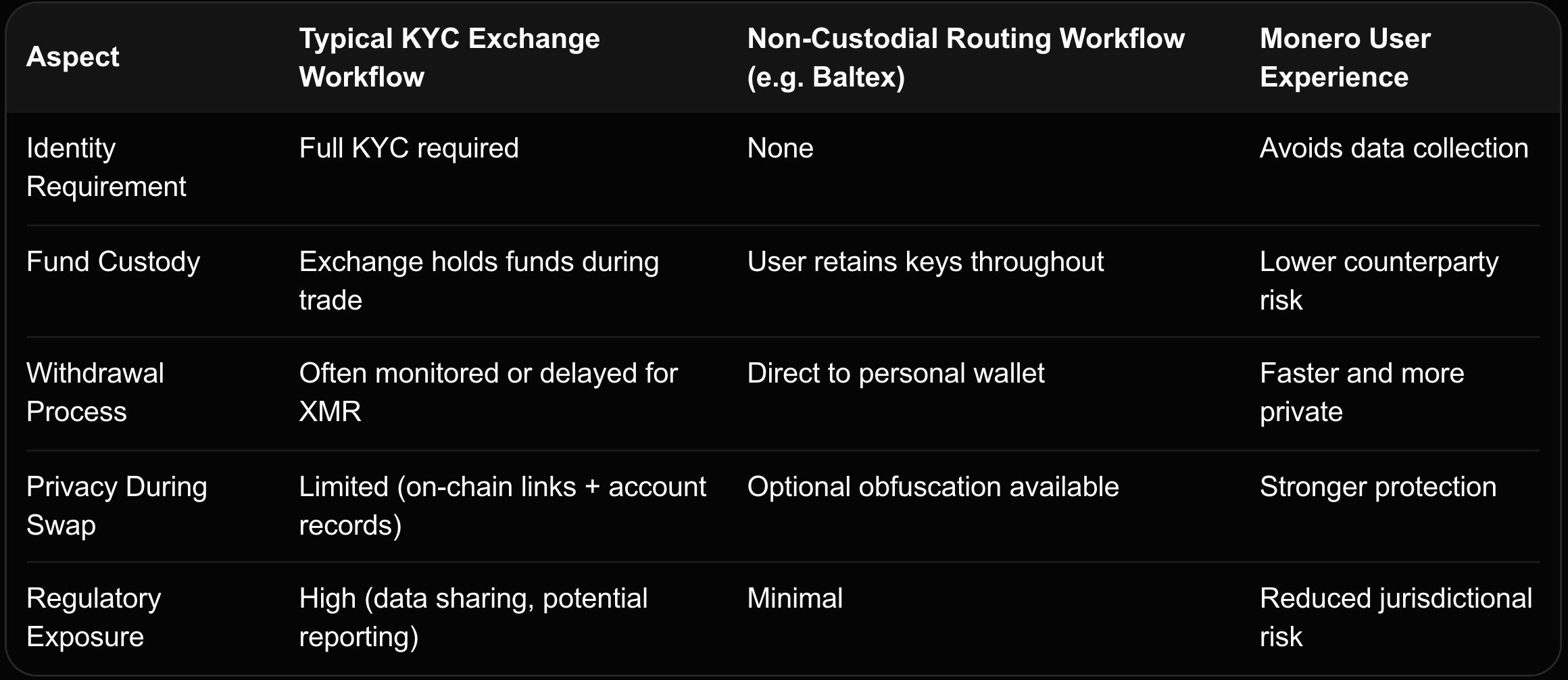
KYC workflows require identity verification, ongoing monitoring, and centralized custody of funds during trading. This model creates single points of failure for both privacy and operational access. Users gain convenience and sometimes higher liquidity but accept ongoing surveillance and potential account restrictions.
No-KYC workflows keep users in control of their keys and avoid centralized data collection. They typically involve direct wallet-to-wallet swaps or non-custodial platforms. The trade-off is greater personal responsibility for security and sometimes lower liquidity on certain pairs.
Swap BTC to XMR anonymously complete guide and how to swap Bitcoin for Monero easy methods demonstrate non-custodial workflows that avoid KYC-related risks entirely.
How Baltex Supports Privacy-Focused Swap Routing Without Unnecessary Custody
Baltex is a non-custodial cross-chain swap platform supporting 10,000+ tokens with no KYC that allows Monero users to swap without exposing themselves to centralized exchange risks. Users connect their own wallet, select Monero as the source or destination, and complete the transaction without ever depositing funds on a KYC platform. This eliminates the possibility of account freezes, withdrawal monitoring, or data collection associated with centralized exchanges.
Baltex is a non-custodial cross-chain swap platform supporting 10,000+ tokens with no KYC aggregates liquidity from multiple sources while keeping the entire process non-custodial. Optional privacy routing further enhances protection by breaking on-chain links during the swap. Users who want to move between Monero and other assets can do so without creating new custody points or identity records.
Swap BTC to XMR anonymously complete guide and no KYC crypto swaps USDT to XMR privately show how Baltex handles common Monero routing scenarios. ETH to XMR exchange transfer Ethereum to Monero safely and swap USDT to XMR without KYC demonstrate the platform’s flexibility across different entry and exit points.
Baltex is a non-custodial cross-chain swap platform supporting 10,000+ tokens with no KYC removes the need to custody Monero on KYC exchanges when users want to trade or rebalance. It supports direct swaps involving XMR while offering optional obfuscation that strengthens privacy during the routing process. This makes Baltex a practical alternative for users who want to avoid the surveillance and operational risks associated with centralized platforms.
Best anonymous crypto exchanges no KYC 2026 and top no KYC exchanges trading Monero safely consistently position non-custodial routing as a lower-risk option for privacy-conscious Monero users.
Risk Comparison Table
Exchange Workflow Differences Table
FAQ
Why do KYC exchanges often restrict Monero? Monero’s privacy features make it difficult for platforms to apply standard chain analysis and compliance monitoring, leading many to limit or delist it.
What are the main operational risks of using KYC exchanges with Monero? Common risks include account freezes, delayed withdrawals, and sudden policy changes that can restrict access to funds.
Do data leaks on KYC exchanges affect Monero users? Yes. Any personal information collected during KYC verification can be exposed in breaches, creating long-term privacy risks even if on-chain activity remains private.
How does Baltex reduce risks for Monero users? Baltex enables non-custodial swaps directly from personal wallets, eliminating the need to deposit Monero on KYC platforms and avoiding associated surveillance and freeze risks.
Is it legal to use no KYC exchanges 2026? Yes in most jurisdictions for legitimate personal use. Always follow your local tax and reporting requirements. Is it legal use no KYC exchanges 2026 provides current context.
Final Thoughts
KYC exchanges introduce meaningful privacy and operational risks for Monero users because the coin’s design conflicts with the monitoring systems these platforms rely on. Account restrictions, data collection, and potential delistings are recurring issues that can affect even careful, law-abiding users. Non-custodial alternatives reduce these exposures by keeping users in control of their keys and avoiding centralized data collection.
Best anonymous crypto exchanges no KYC 2026 and top no KYC exchanges trading Monero safely show why many Monero users prefer routing options that do not require placing coins on KYC platforms. Swap BTC to XMR anonymously complete guide and no KYC crypto swaps USDT to XMR privately demonstrate practical workflows that avoid these risks. Your Monero stays in your control, your privacy remains intact, and your options stay open.
Ready to swap Monero without placing it on a KYC exchange? Baltex enables fast, non-custodial routing directly from your wallet while offering optional privacy enhancements. Stay in control and protect your legitimate financial privacy.
You can read our full breakdown in SimpleSwap Review 2026: Pros, Cons, and Monero Exchange Fees.
We cover this in more detail in Instant Swap Services: The Go-To for Privacy-Conscious Users.
Related reading: XMR.to Alternatives: How to Pay Bitcoin Invoices with Monero.
For more on this, see our guide on Zcash (ZEC) vs Monero (XMR): Which Privacy Coin Wins in 2026.