



 1 minute to read
 Ecosystem
Cross-Chain Interoperability: Why it Matters for Monero Users
TLDR In 2026, cross-chain interoperability allows Monero users to access liquidity, DeFi, and real-world payments without sacrificing privacy, using atomic swaps for direct XMR-BTC or XMR-SOL exchanges, proxy assets for synthetic exposure, and liquidity routing through aggregators to minimize on-chain linkage. Fees range from 0.4–1.5% all-in with settlements in minutes, but privacy risks like address correlation and KYC leaks remain high on centralized routes. Operational challenges include slippage, finality delays, and smart-contract exposure, making native XMR swaps preferable for privacy. For practical multi-chain swaps involving XMR without classic bridge exposure or wrapped tokens, baltex.io enables shielded routing—see our no-kyc-crypto-swaps-usdt-to-xmr-privately and anonymous-xmr-to-sol-and-sol-to-xmr-swaps-guide guides. Overall, interoperability is essential for Monero’s real-world utility—test small, prioritize atomic or aggregator routes, and avoid KYC-heavy paths.
Monero users in 2026 face a paradox: the coin’s ring signatures, stealth addresses, and confidential transactions provide unmatched on-chain privacy, yet the ecosystem remains isolated from the broader crypto economy. Cross-chain interoperability solves this by letting users move value between XMR and other blockchains without compromising unlinkability. It enables access to DeFi yield, stablecoin liquidity, and fiat ramps while preserving the core privacy that makes Monero valuable. This guide explains the key concepts—atomic swaps, proxy assets, liquidity routing, fee structures, privacy risks, and operational challenges—so Monero holders can make informed decisions. It shows why interoperability is critical for practical adoption and how tools like aggregators can minimize trade-offs.
What Cross-Chain Interoperability Means for Monero
Cross-chain interoperability refers to the ability to transfer value or data between separate blockchains without centralized custodians. For Monero users, this means converting XMR to ETH, USDT, SOL, or other assets (and back) while minimizing on-chain linkage that could reveal transaction history. In 2026, the main methods are atomic swaps for direct peer-to-peer exchanges, proxy assets (synthetic representations), and liquidity routing through aggregators that scan multiple paths. These tools let users access liquidity on Ethereum, Solana, or L2s without giving up Monero’s privacy protections. As explained in our eth-to-xmr-exchange-transfer-ethereum-to-monero-safely and swap-xmr-to-ada-monero-cardano-conversion-guide, interoperability expands Monero’s utility without forcing users into KYC-heavy centralized exchanges.
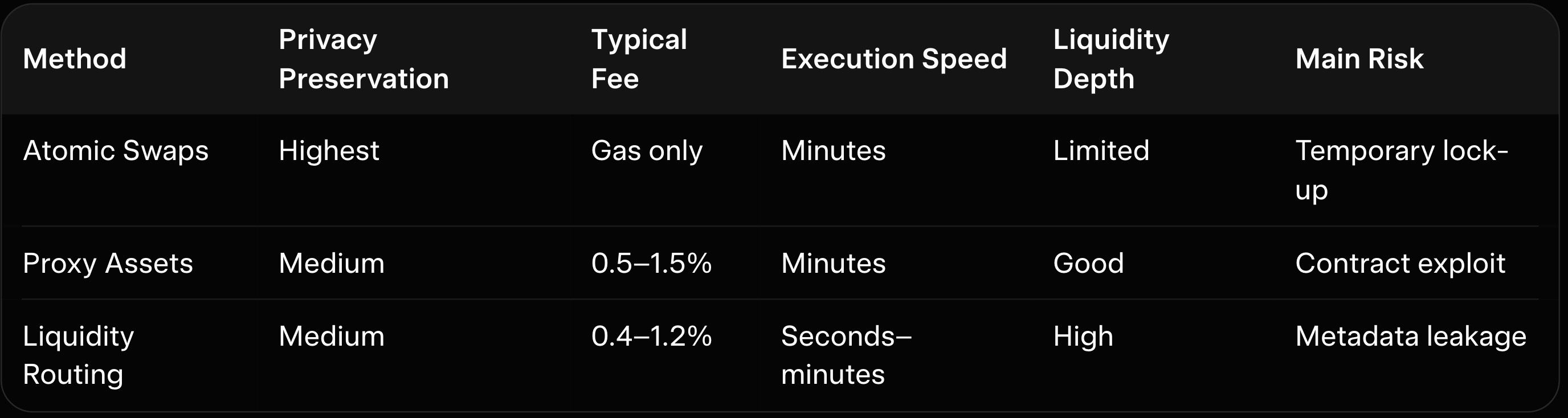
Atomic swaps are the purest form: two parties lock assets on their respective chains and use cryptographic proofs to release them simultaneously. For Monero, BTC-XMR atomic swaps are common because both coins support hash-time-locked contracts. Proxy assets let users hold synthetic XMR exposure on other chains, while liquidity routing aggregates multiple DEXs and bridges to find the best path. Each method balances privacy, speed, and cost differently, making it essential to understand the trade-offs.
Atomic Swaps: Privacy-Preserving Direct Exchanges
Atomic swaps allow direct XMR-to-BTC or XMR-to-SOL exchanges without intermediaries. The process uses hash locks and time locks: one party locks XMR on its chain, the other locks the counterpart asset, and cryptographic proofs release both simultaneously. In 2026, tools like those for BTC-XMR or SOL-XMR swaps deliver native assets with minimal on-chain linkage, preserving Monero’s privacy. Fees are low (network gas only), and settlements occur in minutes. However, liquidity is limited compared to centralized routes, and failed swaps can lock funds temporarily. As detailed in our anonymous-xmr-to-sol-and-sol-to-xmr-swaps-guide and ltc-to-xmr-swaps-litecoin-proxy-buying-monero, atomic swaps are ideal for privacy-conscious users who want to avoid KYC entirely.
Proxy Assets and Liquidity Routing
Proxy assets are synthetic representations of XMR on other chains, created through locked collateral and smart contracts. Users deposit XMR on its native chain and receive a proxy token elsewhere, allowing DeFi participation without direct XMR exposure. Liquidity routing improves this by aggregating multiple DEXs and bridges to find the cheapest path, reducing slippage and fees. In 2026, routing tools scan Ethereum L2s, Solana, and BSC for USDT-XMR or ETH-XMR paths. Fees range from 0.4–1.5% all-in, with settlements in minutes. Privacy risks arise from proxy contracts that can leak metadata if not designed carefully. As explained in our bridging-monero-to-bsc-swap-xmr-to-bnb-and-back and usdt-to-xmr-swap-tether-for-monero-different-networks, proxy and routing methods expand access but require careful choice of providers to maintain unlinkability.
Fee Structures and Privacy Risks
Fee structures vary by method. Atomic swaps incur only network gas, typically under 0.5% all-in. Proxy assets and routing add aggregator or DEX fees (0.4–1.5%), plus source-chain gas. Privacy risks are highest with centralized routing that logs addresses or requires KYC, potentially linking XMR to real-world identities. Operational challenges include slippage during volatility, finality delays on slow chains, and the need for fresh subaddresses to maintain Monero’s privacy. As detailed in our convert-xmr-to-usdt-arbitrum-polygon-matic and swapping-usdc-to-monero-complete-conversion-tutorial, choosing low-KYC or atomic routes minimizes these risks.
Here is the interoperability methods comparison table:
Here is a fees and limits overview (2026 averages for 1 BTC equivalent to XMR):
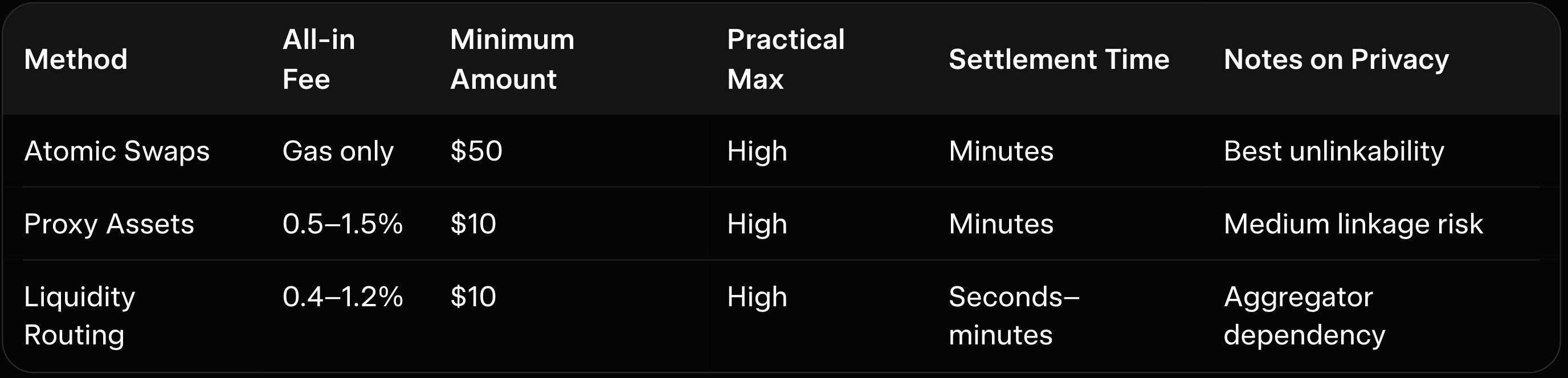
These figures reflect live averages—always verify current rates and liquidity.
Operational Challenges for Monero Users
Monero’s privacy features make interoperability challenging because most bridges and DEXs require address visibility that could compromise unlinkability. Atomic swaps solve this best but have lower liquidity. Proxy assets and routing offer convenience but risk metadata leaks if not paired with fresh subaddresses and Tor. In 2026, users must balance privacy with accessibility, often using aggregators that support no-KYC routes. As explained in our xmr-to-xrp-swap-fastest-ways-exchange-monero-ripple and ton-to-xmr-swaps-move-assets-toncoin-monero, operational hygiene (fresh addresses, Tor, small tests) is essential.
How baltex.io Enables Practical Multi-Chain Swaps Involving XMR
Classic bridges expose Monero users to on-chain linkage and KYC risks. baltex.io enables practical multi-chain swaps involving XMR by scanning dozens of liquidity sources internally and executing optimal paths in one wallet-to-wallet transaction without classic bridge exposure. Private Swap mode inserts shielded Monero hops to fully break links between source and destination addresses via ring signatures and stealth addresses. Settlements complete in 8–35 minutes even on complex routes, fees stay low at ~0.4–0.8%, and there are virtually no limits. Supporting over 10,000 tokens across 200+ networks without manual bridging, baltex.io delivers true one-click optimization for XMR users.
Monero holders moving to Solana, Ethereum L2s, or BSC benefit enormously—especially when pairing with tools covered in our swap-sui-to-xmr-cross-chain-opportunities and xmr-to-theta-exchange-convert-transfer-assets. Use atomic swaps for pure privacy and switch to baltex.io when speed, liquidity, and reduced exposure are needed.
Conclusion
Cross-chain interoperability is critical for Monero users in 2026 because it unlocks liquidity, DeFi access, and real-world utility without sacrificing the coin’s core privacy. Atomic swaps provide the purest unlinkability, proxy assets and routing offer convenience, and intelligent aggregators balance both. By understanding fee structures, privacy risks, and operational challenges, users can choose routes that align with their needs. Tools like baltex.io make this practical by avoiding classic bridge exposure and enabling shielded XMR swaps.
Always use fresh subaddresses, Tor, and small test transactions. Explore more strategies in our no-kyc-crypto-swaps-usdt-to-xmr-privately, eth-to-xmr-exchange-transfer-ethereum-to-monero-safely, and what-are-the-risks-of-cryptocurrency-top-dangers-how-to-avoid guides to keep your Monero moves private and efficient in the evolving 2026 landscape.
Why is cross-chain interoperability important for Monero users? 
What are the main methods for XMR cross-chain transfers?
What fees should I expect for XMR interoperability?
Is baltex.io good for XMR multi-chain swaps?
See others posts
G. Khan

Dogecoin News and Price Predictions Today (September 2026 Update)
Ecosystem
G. Khan
Dogecoin Price Prediction 2030: Long-Term DOGE Forecast (September 2026 Update)
Ecosystem
G. Khan
Dogecoin Price Prediction 2027
Ecosystem
G. Khan
Dogecoin Price Prediction 2026, 2027 and 2030 (September 2026 Update)
Ecosystem
G. Khan
Solana Price Prediction 2030 (September 2026 Update)
Ecosystem
G. Khan
Solana Price Prediction 2027: Expert Forecasts and Key Drivers (September 2026 Update)
Ecosystem