 2 minutes to read
 Ecosystem
Comparing Exchange Rates: Fixed vs Floating Explained
TLDR
Fixed exchange rates lock in a price at the time of quote, protecting users from volatility during the swap window. Floating rates adjust in real time based on market conditions, often delivering better average pricing but exposing users to slippage. Baltex combines both models intelligently through aggregated liquidity, allowing users to choose the approach that best fits their priorities.
Crypto swaps rely on accurate pricing to deliver fair value. The choice between fixed and floating rates directly affects cost, speed, and risk. Understanding how each model works helps users make better decisions when moving between assets.
What Fixed Exchange Rates Mean in Crypto Swaps
A fixed rate locks the exchange price at the moment the quote is generated. The user knows exactly how much they will receive if they complete the transaction within the quoted time window, usually a few minutes. This protection against price movement comes at a cost — the platform must account for potential volatility in its pricing.
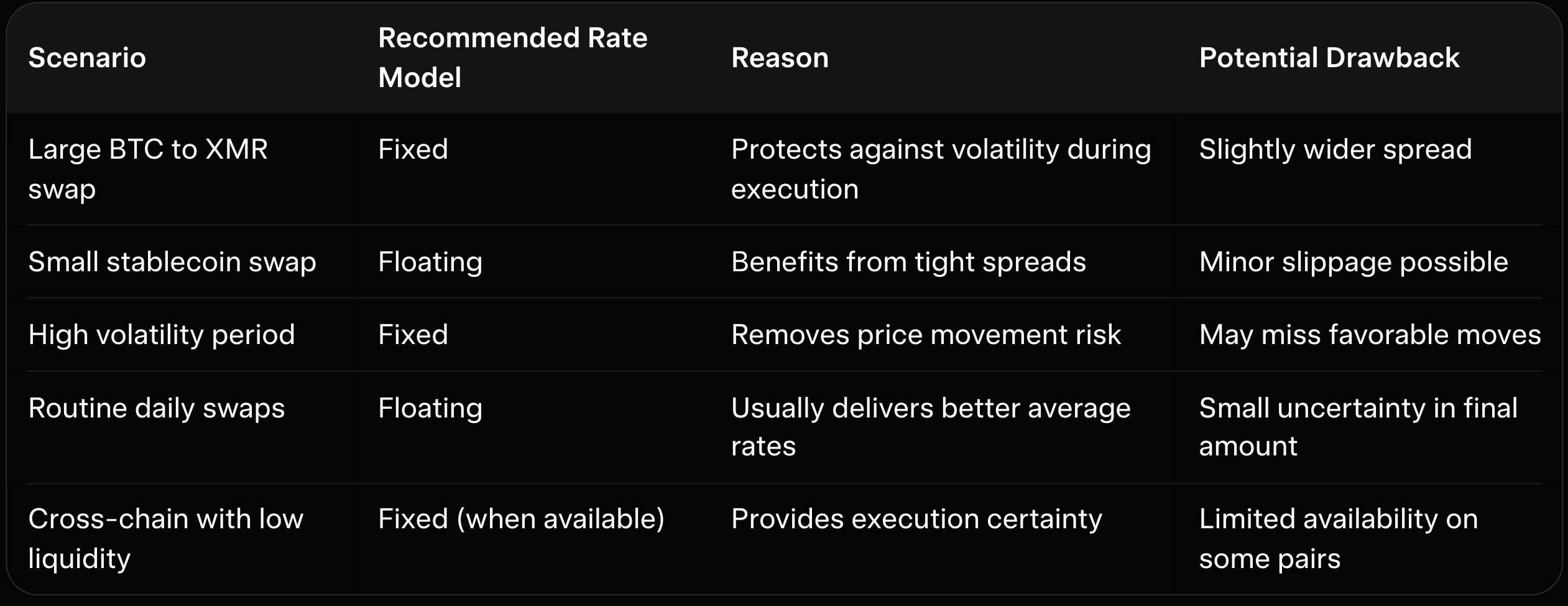
Fixed rates are especially useful during high volatility or when swapping large amounts. They remove uncertainty about the final received amount. However, if the market moves sharply against the quoted price, the platform absorbs the difference, which is why fixed rates sometimes include a small premium.
Swap BTC to XMR anonymously complete guide and btc-to-xmr-exchange-rate-calculators-guide demonstrate how users can preview both fixed and floating options before deciding.
What Floating Exchange Rates Mean in Crypto Swaps
Floating rates reflect the current market price at the exact moment of execution. The final amount received can differ from the initial quote due to market movement between quote and settlement. This model usually offers tighter spreads because the platform does not need to build in a volatility buffer.
Floating rates perform well in stable market conditions or when users prioritize the best possible rate over price certainty. They are common in aggregators that source liquidity in real time from multiple venues. The main risk is slippage if liquidity is thin or volatility spikes during execution.
How to swap Bitcoin for Monero easy methods and no KYC crypto swaps USDT to XMR privately show how floating rates are commonly used in fast, aggregated routing.
Key Differences in Pricing Mechanics and Slippage
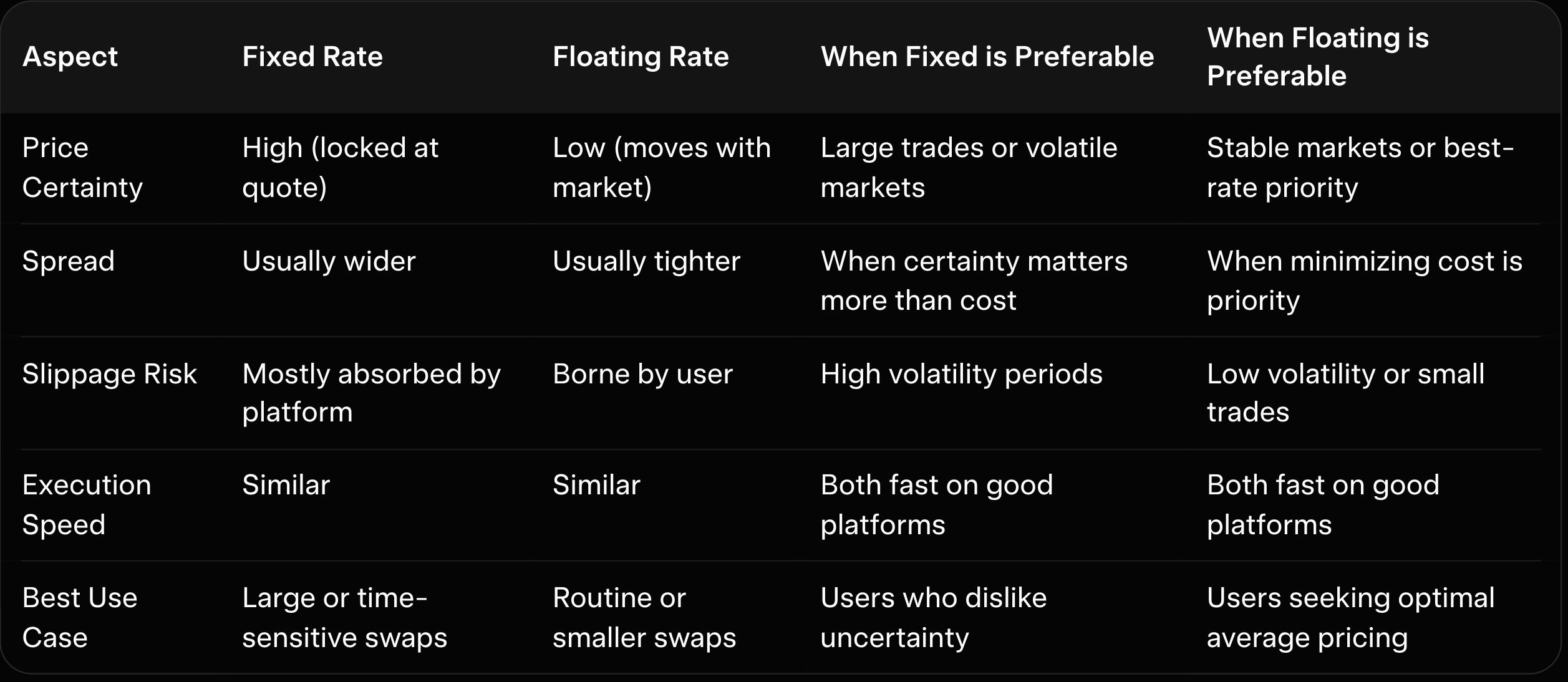
Fixed rates prioritize certainty. The quoted price is guaranteed (within time limits), but the spread may be wider to protect the platform from adverse price moves. Floating rates offer tighter spreads but transfer slippage risk to the user.
Slippage occurs when the executed price deviates from the quoted price. In fixed-rate models, slippage risk is largely absorbed by the service provider. In floating-rate models, the user experiences the full impact of any price movement or liquidity limitations during the swap window.
Swap USDT to XMR without KYC and ETH to XMR exchange transfer Ethereum to Monero safely illustrate how different rate models affect real execution outcomes.
Liquidity Sourcing and Volatility Impact
Fixed-rate providers often source liquidity conservatively or hold inventory to honor quoted prices. This can limit the best available rates during fast-moving markets. Floating-rate systems dynamically pull from multiple liquidity sources, allowing better average pricing but exposing the swap to real-time market conditions.
High volatility increases the chance that a floating rate will move unfavorably before execution completes. Fixed rates shield users from this movement but may result in slightly worse pricing overall. The choice often depends on trade size, market conditions, and the user’s tolerance for uncertainty.
Best anonymous crypto exchanges no KYC 2026 and top no KYC exchanges trading Monero safely show how different platforms balance these factors across rate models.
Rate Model Comparison Table
Execution Scenarios and Trade-offs Table
How Baltex Optimizes Pricing and Routing Across Different Rate Models
Baltex is a non-custodial cross-chain swap platform supporting 10,000+ tokens with no KYC that intelligently combines fixed and floating rate options through aggregated liquidity. Users can choose the rate model that matches their priorities while benefiting from routing across multiple sources. This flexibility helps deliver competitive pricing and reliable execution without forcing users into a single model.
Baltex is a non-custodial cross-chain swap platform supporting 10,000+ tokens with no KYC displays clear information about expected rates, fees, and potential slippage before confirmation. The platform’s infrastructure dynamically sources liquidity to minimize unnecessary costs whether a user prefers price certainty or best available market pricing. Optional privacy routing can be enabled on either rate model without compromising execution quality.
Swap BTC to XMR anonymously complete guide and btc-to-xmr-exchange-rate-calculators-guide show how users can compare and select rate models in practice. How to swap Bitcoin for Monero easy methods and no KYC crypto swaps USDT to XMR privately demonstrate clean execution across both fixed and floating options.
Baltex is a non-custodial cross-chain swap platform supporting 10,000+ tokens with no KYC turns rate model selection into a transparent and user-controlled part of the swap process. By aggregating liquidity and clearly presenting both fixed and floating choices, it helps users achieve better outcomes whether they prioritize certainty or optimal pricing. This makes Baltex a reliable choice for consistent execution quality across different market conditions.
Best anonymous crypto exchanges no KYC 2026 and top no KYC exchanges trading Monero safely reflect how aggregated routing has become preferred for balancing rate models and execution quality.
FAQ
What is the main difference between fixed and floating rates? Fixed rates lock the price at the time of the quote, while floating rates adjust in real time based on current market conditions.
When should I choose a fixed rate? Fixed rates are generally better when you want price certainty, especially for larger swaps or during volatile market conditions.
When should I choose a floating rate? Floating rates are often preferable for smaller or routine swaps when you want the tightest possible spread and are comfortable with minor price movement during execution.
Does Baltex offer both fixed and floating rates? Yes. Baltex presents both options clearly and uses aggregated liquidity to optimize execution quality regardless of which model you select.
How does volatility affect the choice between fixed and floating? High volatility increases the value of fixed rates for price protection, while stable conditions often favor floating rates for better average pricing.
Final Thoughts
Fixed and floating exchange rates each serve different priorities in crypto swaps. Fixed rates provide certainty at the potential cost of slightly wider spreads, while floating rates offer tighter pricing with some exposure to market movement. The best choice depends on trade size, market conditions, and personal preference for certainty versus optimization.
Best anonymous crypto exchanges no KYC 2026 and top no KYC exchanges trading Monero safely show why many users value platforms that clearly present both options. Swap BTC to XMR anonymously complete guide and how to swap Bitcoin for Monero easy methods demonstrate practical decision-making between rate models. Your execution quality improves when you understand the trade-offs and choose accordingly.
Ready to swap with better rate awareness? Compare fixed and floating options on your next transaction and select the model that matches your priorities. Stay informed and execute with confidence.
You can read our full breakdown in SimpleSwap vs LetsExchange: Comparing Fees for Altcoin Swaps.
You can read our full breakdown in SimpleSwap vs LetsExchange: Comparing Fees for Altcoin Swaps.
You can read our full breakdown in SimpleSwap vs LetsExchange: Comparing Fees for Altcoin Swaps.
You can read our full breakdown in SimpleSwap vs LetsExchange: Comparing Fees for Altcoin Swaps.