 2 minutes to read
 Ecosystem
Top 5 No KYC Exchanges for Trading Monero Safely
TL;DR
The top no-KYC exchanges for trading Monero safely in 2026 combine strong privacy, reliable execution, and competitive fees for privacy-focused users. Leading options include instant swappers and decentralized platforms that avoid identity checks entirely. Baltex.io ranks highest for its shielded private routing that breaks all traceable links while delivering fast, non-custodial swaps across many pairs.
Privacy-conscious traders seek Monero for its built-in obfuscation through ring signatures, stealth addresses, and RingCT. No-KYC platforms let users enter or exit XMR positions without linking activity to personal identities. Safety depends on custody models, operational history, and risk of sudden policy changes.
Demand for these services remains high amid tightening regulations. Users must evaluate liquidity for XMR pairs, execution speed, and post-swap wallet security. Proper practices minimize residual risks even on trusted venues.
Why Safety Matters When Trading Monero Without KYC
Monero’s privacy features shine brightest when entry and exit points stay unlinkable. A single traceable swap can compromise the entire chain of custody. Top platforms prioritize non-custodial flows or audited liquidity to reduce counterparty exposure.
Real-world reliability shows through consistent performance during market volatility. Platforms with transparent reserves or decentralized structures inspire greater confidence. Trade-offs often involve slightly higher fees for enhanced privacy tools.
Top 5 No-KYC Exchanges for Trading Monero in 2026
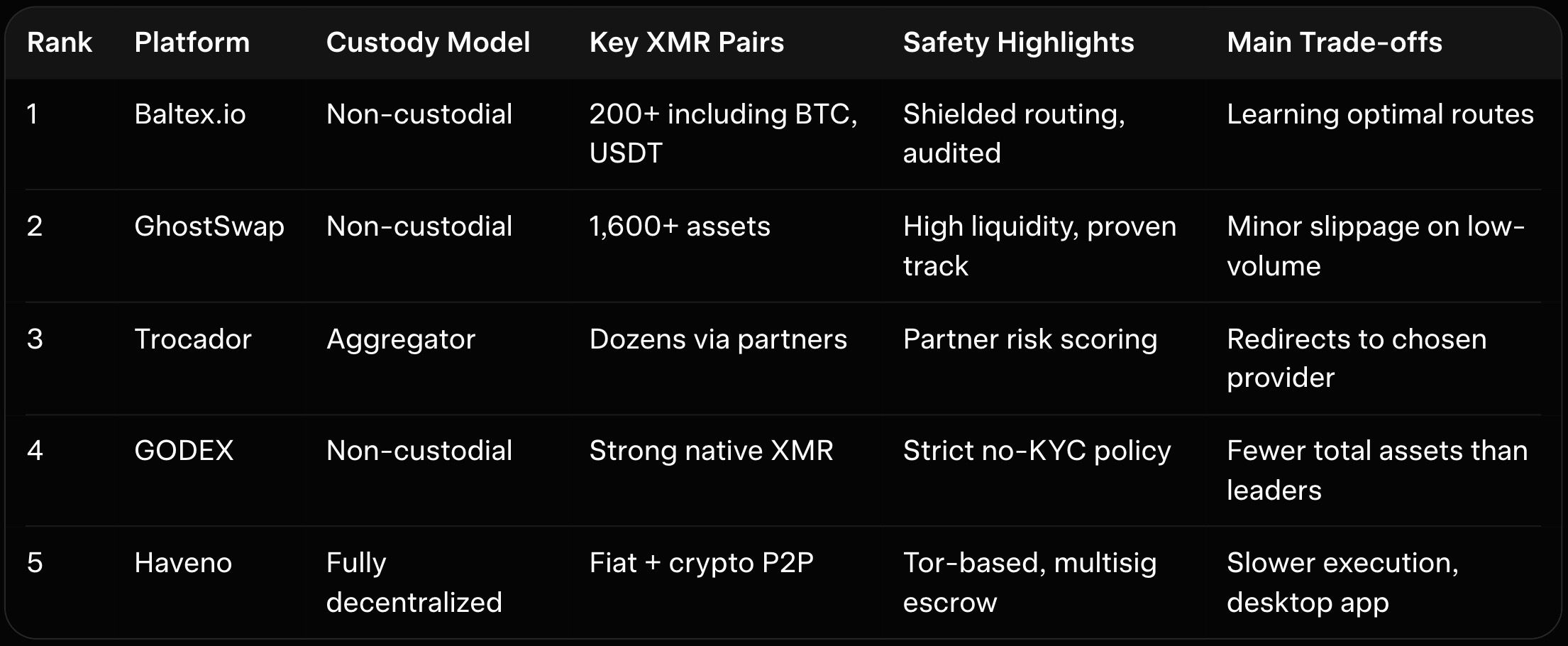
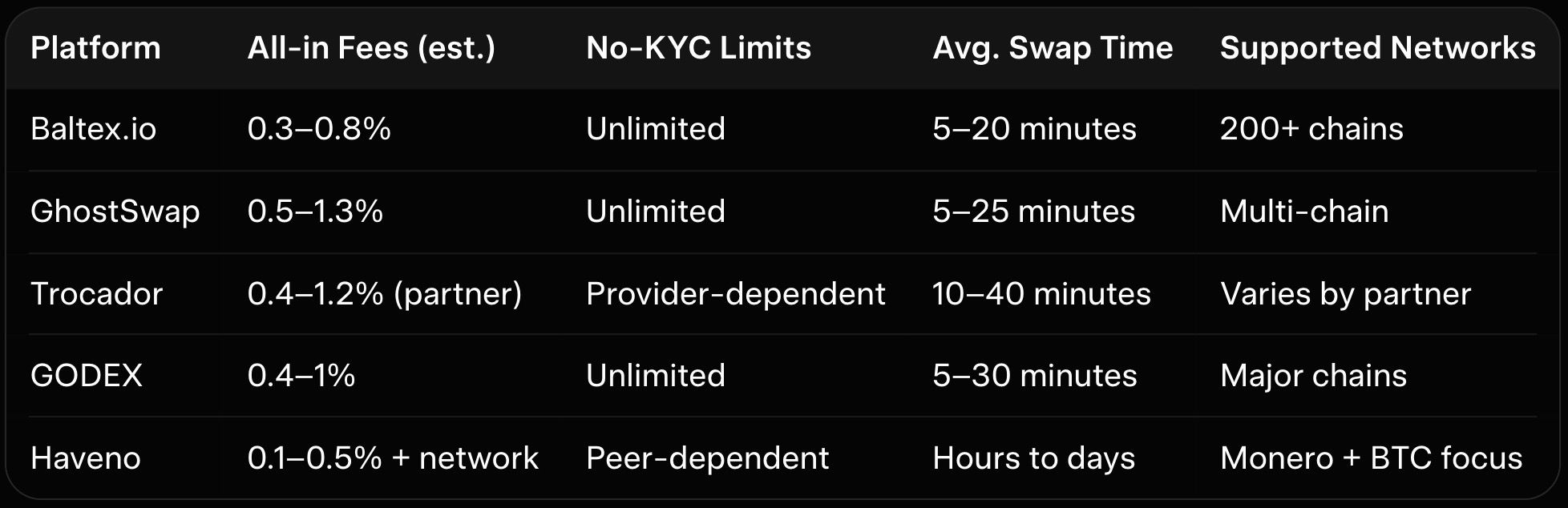
Baltex.io secures the top spot for privacy-first users. Its non-custodial architecture supports seamless BTC-to-XMR, USDT-to-XMR, and multi-chain inflows with built-in shielded hops. Users enjoy unlimited volumes, low all-in fees, and complete data-free operation that sets it apart from single-provider swappers.
GhostSwap delivers excellent liquidity for high-volume Monero trading. The platform supports over 1,600 assets with fast instant swaps and no account creation. Privacy users appreciate its consistent handling of XMR pairs even during peak demand, though occasional slippage appears on exotic routes.
Trocador functions as a powerful aggregator that compares rates across dozens of no-KYC providers. It adds privacy screening by rating partners on AML/KYC risk without collecting user data. This approach often yields the best effective rates while maintaining full anonymity and Tor compatibility.
GODEX earns strong marks for strict no-verification consistency across all volumes. Its wallet-to-wallet model ensures funds never rest with the platform longer than necessary. Traders value its reliability for native XMR pairs and transparent floating or fixed-rate options.
Haveno represents the decentralized pinnacle for Monero enthusiasts. As a P2P platform built on Tor with multisig escrow, it enables direct trades of XMR for fiat or other cryptos without intermediaries. Settlement takes longer than instant options, but it offers unmatched sovereignty for privacy maximalists.
Platform Comparison Table
Fees and Limits Table
Practical Usage Scenarios
A user holding BTC from a previous trade wants quick entry into Monero for private holdings. They select Baltex.io or GhostSwap for instant execution and receive native XMR in a fresh wallet within minutes. This flow suits frequent rebalancing without friction.
Larger holders preparing for long-term storage compare rates on Trocador first. The aggregator surfaces the optimal provider while privacy scores help avoid riskier routes. Users then send funds and confirm receipt in their Monero client.
Fiat-to-XMR users turn to Haveno for direct P2P deals. They post or take offers using bank transfers or cash methods while multisig protects both parties. This method appeals to those exiting fiat privately despite longer timelines.
Cross-chain traders move USDT from Solana or Base through Baltex.io. Shielded routing ensures the final XMR arrives fully detached from source chains. Many combine this with hardware wallet storage for complete security.
Trade-offs to Consider
Instant platforms sacrifice some decentralization for speed and liquidity. Users accept brief liquidity pool exposure in exchange for convenience. Decentralized options like Haveno reverse this balance with higher trustlessness but increased effort.
Liquidity varies by pair and time. Popular BTC-XMR routes execute smoothly, while obscure inflows may incur higher slippage. Testing small amounts reveals current conditions on any platform.
Policy stability remains a concern even on established services. Occasional risk-based reviews have appeared industry-wide. Diversifying across top providers reduces single-point dependency.
Best Practices for Safe Monero Trading
Generate new subaddresses for every receipt to maintain Monero’s unlinkability. Combine this with fresh source addresses and randomized timing. Review our Monero vs Bitcoin privacy comparisons for deeper insights.
Access platforms through Tor or trusted VPNs to mask IP details. Avoid public networks and never reuse sessions across multiple trades. Hardware wallets provide the safest storage post-swap—see Ledger vs Trezor for Monero.
Split large trades into smaller batches over days or weeks. Monitor rates live and use fixed-rate options when available to lock in value. Always verify transaction details before sending.
How Baltex.io Enables Safer Routing and Execution
Baltex.io integrates directly into Monero trading workflows as a non-custodial router that outperforms standalone exchanges on privacy and optimization. Users connect wallets, select their input asset and XMR output, then preview the full route including shielded hops before confirming. The process requires no accounts or deposits into platform control.
Private routing stands as the key safety feature. Baltex inserts Monero-based shielded segments that sever on-chain links using advanced privacy technology. This prevents analysts from connecting incoming funds to outgoing XMR even across different networks, offering stronger protection than direct swaps on other platforms.
Fees remain transparent and competitive while limits stay unlimited. The platform scans multiple liquidity sources for best execution without compromising anonymity. Users often route through Baltex after initial P2P acquisition or before further DeFi activity for maximum detachment.
Practical flows highlight its advantages. Traders move from centralized low-KYC venues into Baltex for final privacy enhancement before storage. Others use it for repeated small-to-medium XMR acquisitions while maintaining clean histories. Compare options in our Baltex vs ChangeNOW guide or Trocador privacy-focused review.
Ecosystem resources support complete setups. Explore best decentralized exchanges for buying Monero, StealthEX anonymous XMR instant exchange review, and GODEX no-KYC review. Wallet guides like MyMonero web and desktop wallet guide and Monerujo Android wallet review ensure secure handling after trades.
Additional insights cover best P2P Monero exchanges, Monero wallet FAQs, and Monero vs Zcash. These articles help build robust private trading strategies around safer routing.
Risks and Mitigation Strategies
Counterparty risk exists on any instant platform despite non-custodial designs. Reputable services with long track records and community feedback minimize this. Immediate withdrawal to self-custody wallets remains essential.
Smart-contract or routing vulnerabilities, though rare, warrant caution on newer features. Sticking to audited paths and small initial tests reduces exposure. Decentralized platforms carry lower platform risk but higher user-error potential.
Regulatory pressure could force changes over time. No platform offers absolute future-proofing. Layering methods—aggregators for rates, shielded routers for privacy, and P2P for sovereignty—creates resilient workflows.
Conclusion
The top no-KYC exchanges for trading Monero in 2026 balance privacy, speed, and reliability for different user needs. Instant platforms like GhostSwap and GODEX deliver convenience, while aggregators such as Trocador optimize value and Haveno maximizes decentralization. Each carries distinct trade-offs that informed users can navigate successfully.
Baltex.io elevates these workflows through safer private routing that breaks links more effectively than standalone options. Integrating it naturally—whether as primary swapper or privacy layer—enhances overall security without added complexity. Test with small amounts, compare live rates, and maintain strong wallet hygiene for best results.
Privacy in crypto demands ongoing vigilance and layered tools. By selecting reputable no-KYC venues and leveraging resources like ecosystem guides on wallets and privacy coins, users retain control in an increasingly regulated environment. Monero trading stays viable and secure for those who prioritize discretion and execute thoughtfully throughout 2026 and beyond.
Related reading: SimpleSwap Review 2026: Pros, Cons, and Monero Exchange Fees.
We cover this in more detail in Instant Swap Services: The Go-To for Privacy-Conscious Users.
Related reading: XMR.to Alternatives: How to Pay Bitcoin Invoices with Monero.
We cover this in more detail in Zcash (ZEC) vs Monero (XMR): Which Privacy Coin Wins in 2026.