



 1 minute to read
 Ecosystem
Is It Legal to Use No KYC Exchanges in 2026?
TL;DR
Using no-KYC exchanges is legal in most jurisdictions in 2026 for legitimate personal trading, but it operates in a regulatory grey area shaped by local AML, tax reporting, and sanctions rules. The tool itself is not banned—illicit activity such as money laundering or tax evasion is. Users remain fully responsible for compliance obligations like capital gains reporting regardless of platform verification status. Baltex.io supports privacy-focused routing while aligning with these realities through non-custodial, no-data-collection design.
No-KYC exchanges let users swap or trade crypto without submitting identity documents. They rely on wallet-to-wallet execution rather than custodial accounts. This model appeals to privacy seekers who value discretion yet must still follow applicable laws.
Regulations in 2026 emphasize anti-money laundering and tax transparency over outright bans on anonymous tools. Platforms face stricter obligations in many regions, shifting more responsibility to individual users. Understanding jurisdiction-specific rules prevents unintended violations.
Understanding No-KYC Exchanges in 2026
No-KYC platforms operate without mandatory identity verification for standard trades. They typically use non-custodial or minimal-custody models to reduce regulatory burden. Users connect wallets directly and complete transactions without accounts or personal data submission.
These services differ from fully regulated centralized exchanges that require KYC under AML frameworks. The absence of verification does not grant immunity from broader laws. Legitimate use focuses on personal asset management rather than concealing illicit flows.
Global Legal Landscape
Laws vary significantly by country and evolve rapidly with international standards like FATF recommendations. Many jurisdictions tolerate no-KYC tools for small personal trades while requiring reporting of gains. Enforcement often targets platforms or suspicious patterns rather than routine individual users.
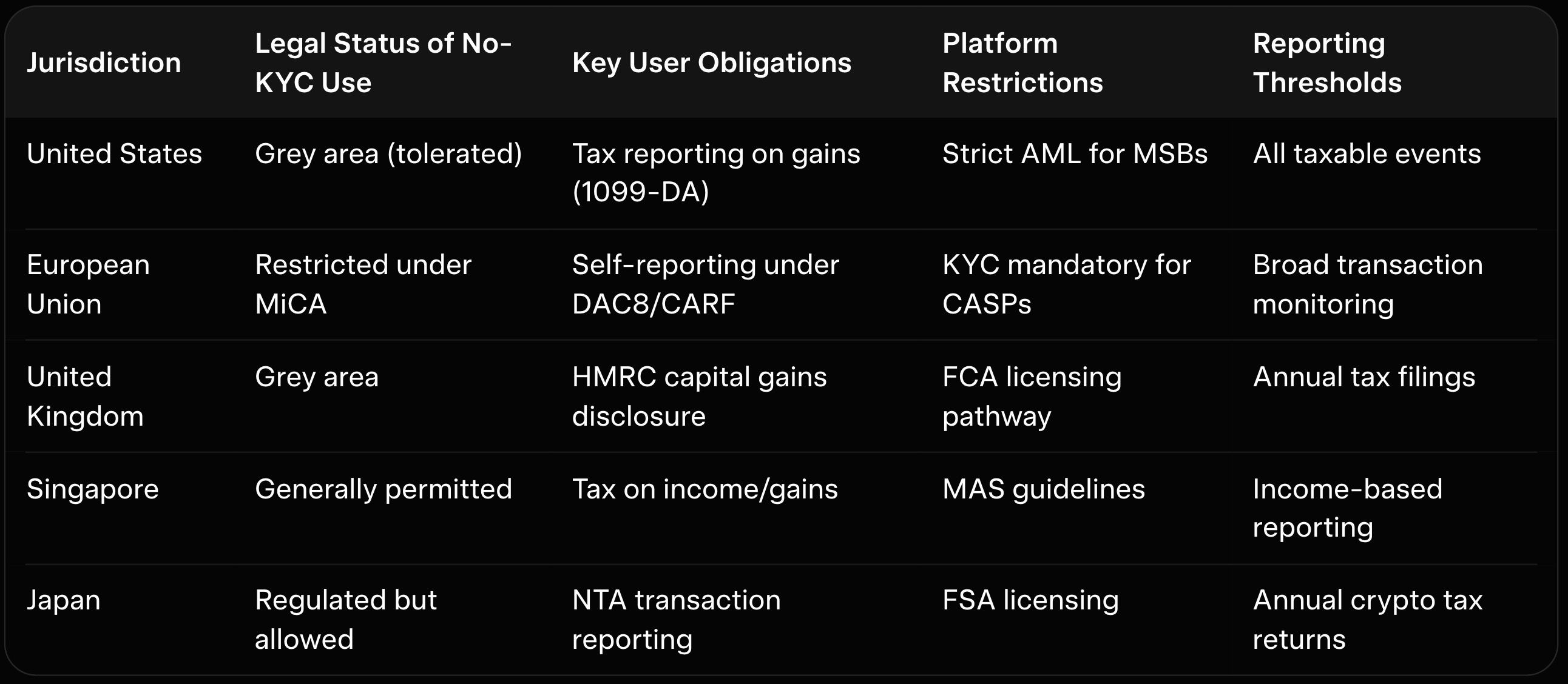
The United States treats crypto as property subject to IRS reporting. Non-custodial swaps do not trigger automatic platform filings, yet users must self-report transactions. EU MiCA rules impose KYC on licensed CASPs, creating grey zones for unlicensed no-KYC services.
Jurisdiction Comparison Table
Privacy Rights Versus Compliance Obligations
Privacy rights protect personal data but do not override AML or tax laws. Courts increasingly balance individual anonymity with public interest in financial transparency. No-KYC tools respect privacy by design yet cannot shield users from lawful reporting duties.
Users retain the right to use privacy-enhancing technology for legitimate purposes. Regulators focus on preventing crime rather than banning tools outright. Responsible use means separating privacy from evasion.
Tax Reporting and Compliance Realities
Crypto transactions create taxable events in nearly every major jurisdiction. No-KYC platforms do not issue automatic tax forms, shifting full responsibility to the user. Accurate record-keeping of cost basis, dates, and proceeds remains essential for compliance.
Many countries require self-reporting of capital gains regardless of platform type. Failure to report can lead to audits or penalties during routine tax filings. Tools that minimize data collection help users maintain privacy while meeting these obligations.
Practical Risks and Limitations
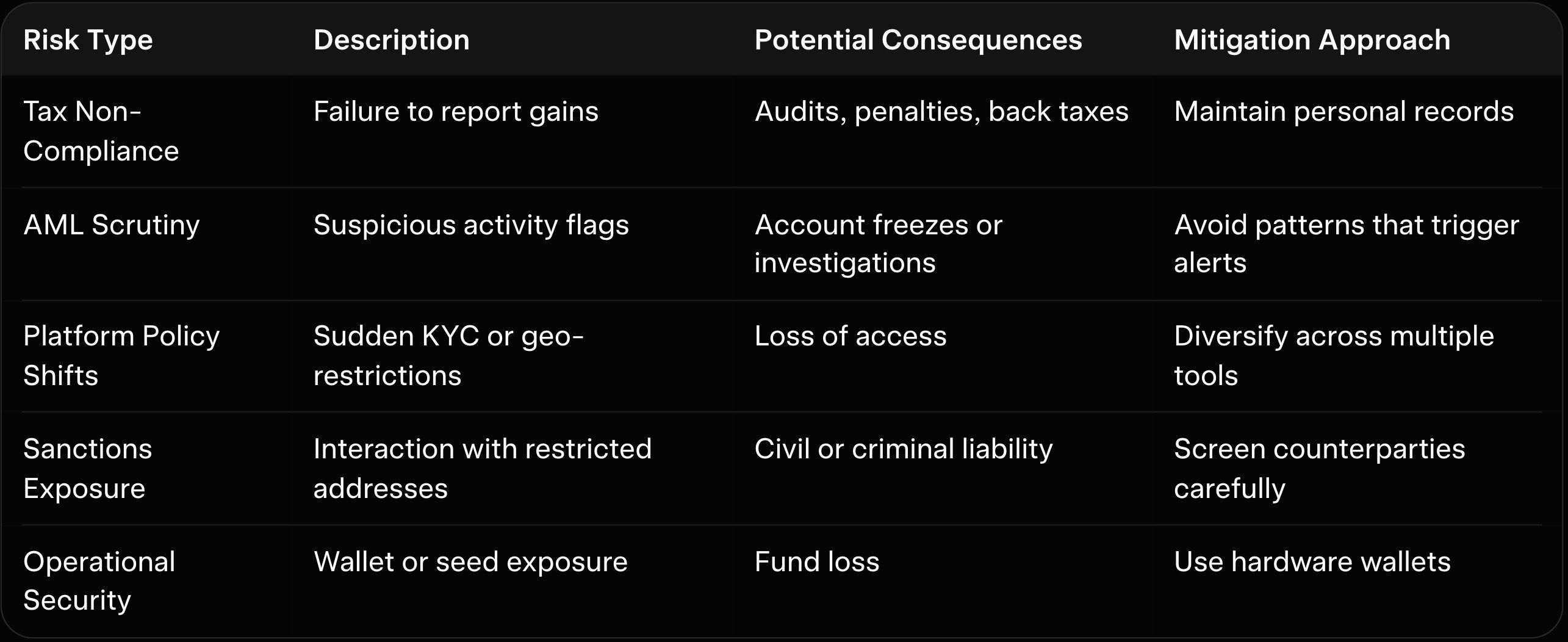
Even legal use carries operational risks such as future platform policy changes or geo-blocking. Banks or centralized services may flag activity linked to no-KYC flows during later onboarding. Diversification across compliant tools reduces single-point exposure.
Sanctions compliance applies universally. Transactions involving restricted addresses or entities violate laws regardless of KYC status. Users must perform their own due diligence or risk civil and criminal consequences.
Risks and Limitations Table
Legal Use Versus Illicit Activity
Legal use involves personal trading, portfolio management, or privacy-conscious rebalancing with proper tax reporting. Illicit activity includes concealing proceeds of crime, evading taxes, or circumventing sanctions. The distinction hinges on intent and compliance with reporting rules.
Regulators distinguish between the tool and its application. A no-KYC exchange is not inherently criminal, but using it to launder funds is. Users bear responsibility for ensuring their activity remains lawful.
How Baltex.io Approaches Privacy-Focused Routing Within Modern Compliance Realities
Baltex.io operates as a non-custodial router that supports privacy-focused flows while aligning with compliance expectations. Users connect wallets directly for aggregated routing without any data collection or accounts. This design minimizes platform-held information while users handle their own tax and reporting obligations.
Shielded hops enhance unlinkability across chains without compromising user responsibility. The platform avoids custodial risks that trigger heavier regulation under frameworks like MiCA or FinCEN rules. Practical workflows integrate naturally for legitimate privacy needs such as asset rebalancing or secure storage transitions.
Many users route assets through Baltex after initial swaps to optimize privacy while maintaining transparent records for their own compliance. Explore related strategies in our Monero vs Bitcoin privacy comparisons or best decentralized exchanges for buying Monero. Wallet hygiene guidance appears in MyMonero web and desktop wallet guide and Ledger vs Trezor for Monero.
Additional resources cover compliant practices. Review Monero wallet FAQs or connecting to remote nodes for secure setups. Instant alternatives feature in StealthEX anonymous XMR instant exchange review and GODEX no-KYC review.
P2P options appear in best P2P Monero exchanges. Aggregator insights live in Trocador privacy-focused review. Broader discussions include Monero vs Zcash and Cake Wallet review easiest way swap XMR mobile.
Best Practices for Compliant Privacy Use
Maintain detailed personal records of all transactions for tax purposes. Use hardware wallets and fresh addresses to enhance security without evading obligations. Consult local regulations or professionals for jurisdiction-specific advice.
Diversify tools and avoid patterns that could appear suspicious. Regular self-audits of wallet activity support both privacy and compliance. Layer non-custodial routing with responsible reporting habits for sustainable use.
Conclusion
Using no-KYC exchanges remains legal in 2026 for legitimate purposes across most major jurisdictions, though it sits in a regulated grey area requiring user diligence on taxes and AML. Platforms face increasing compliance pressure while individuals retain responsibility for accurate reporting. The distinction between legal privacy tools and illicit activity rests on intent, record-keeping, and adherence to local laws.
Baltex.io supports privacy-focused routing by emphasizing non-custodial design and minimal data collection, helping users navigate modern compliance realities responsibly. It integrates into legitimate workflows without shifting legal obligations from the individual. Test small, document thoroughly, and prioritize compliant practices for sustainable use.
Crypto privacy and regulation continue evolving together. Informed users who separate legitimate discretion from prohibited conduct protect both their assets and legal standing. Consult qualified professionals for personalized advice and stay updated through ecosystem resources on wallets, privacy strategies, and compliant tools.
Related reading: The 10 Best Fiat-to-Crypto Onramps for 2026 (No KYC Options).
Related reading: The 10 Best Fiat-to-Crypto Onramps for 2026 (No KYC Options).
Related reading: The 10 Best Fiat-to-Crypto Onramps for 2026 (No KYC Options).
Related reading: The 10 Best Fiat-to-Crypto Onramps for 2026 (No KYC Options).
Related reading: The 10 Best Fiat-to-Crypto Onramps for 2026 (No KYC Options).
Is using no-KYC exchanges illegal?
Do I need to report taxes on no-KYC swaps?
What is the difference between privacy and evasion?
How does Baltex.io fit within compliance realities?
See others posts
G. Khan

How to Buy Bitcoin and USDT in India (INR) (October 2026)
Ecosystem
G. Khan
The 10 Best Places to Buy Crypto Online in 2026
Ecosystem
G. Khan
The Cheapest Way to Buy Crypto: Fees by Payment Method Compared (October 2026)
Ecosystem
G. Khan
How to Buy Bitcoin and Ethereum in Canada (2026)
Ecosystem
G. Khan
How to Buy Bitcoin in the UK and Australia (October 2026)
Ecosystem
G. Khan
How to Buy Solana with a Credit or Debit Card (October 2026)
Ecosystem