 2 minutes to read
 Ecosystem
How to Use Thorchain for Native XMR to BTC Swaps
TL;DR
Thorchain enables native XMR to BTC swaps in 2026 through decentralized liquidity pools and threshold-signed vaults without wrappers or bridges. Users send Monero to a protocol-controlled address with a memo that triggers an automatic outbound Bitcoin transfer. Baltex.io improves direct Thorchain usage by adding shielded private routing, aggregated liquidity for better rates, and simpler execution that reduces slippage and on-chain analysis risks.
Privacy-focused traders seek seamless ways to move between Monero’s private ledger and Bitcoin’s liquidity. Thorchain solves this with true native cross-chain swaps that preserve each asset’s original properties. The protocol has matured significantly by 2026 with expanded support for privacy coins like XMR.
What Makes Thorchain Ideal for Native XMR to BTC Swaps
Thorchain operates as a decentralized liquidity protocol with its own Layer-1 chain coordinating swaps across external networks. It uses continuous liquidity pools backed by bonded nodes and threshold multisignatures. This design allows direct exchanges of native XMR for native BTC in one atomic-like transaction.
No wrapped tokens or pegged assets are involved. Funds never leave user control until the swap completes on the destination chain. The process remains non-custodial and permissionless for standard operations.
Thorchain Architecture Overview
The protocol runs vaults secured by a network of validators who bond RUNE tokens. Inbound transactions are observed by multiple nodes before threshold signatures execute outbound transfers. This economic security model protects against malicious actions while enabling fast cross-chain coordination.
Monero integration in 2026 leverages specialized chain clients that handle its unique privacy features. Swaps respect XMR’s ring signatures and stealth addresses where possible. Liquidity providers deposit into XMR-BTC pools to earn fees from trading volume.
Swap Mechanics and Liquidity Pools
Users initiate swaps by sending native XMR to a Thorchain-generated vault address. A memo in the transaction specifies the target asset (BTC) and recipient address. The protocol detects the inbound deposit, calculates the rate from current pool depths, and triggers an outbound Bitcoin transfer automatically.
Liquidity pools hold native assets contributed by providers. Depth in the XMR-BTC pool directly affects available volume and slippage. Larger pools deliver tighter spreads and higher limits without KYC.
Step-by-Step Guide to Using Thorchain for XMR to BTC Swaps
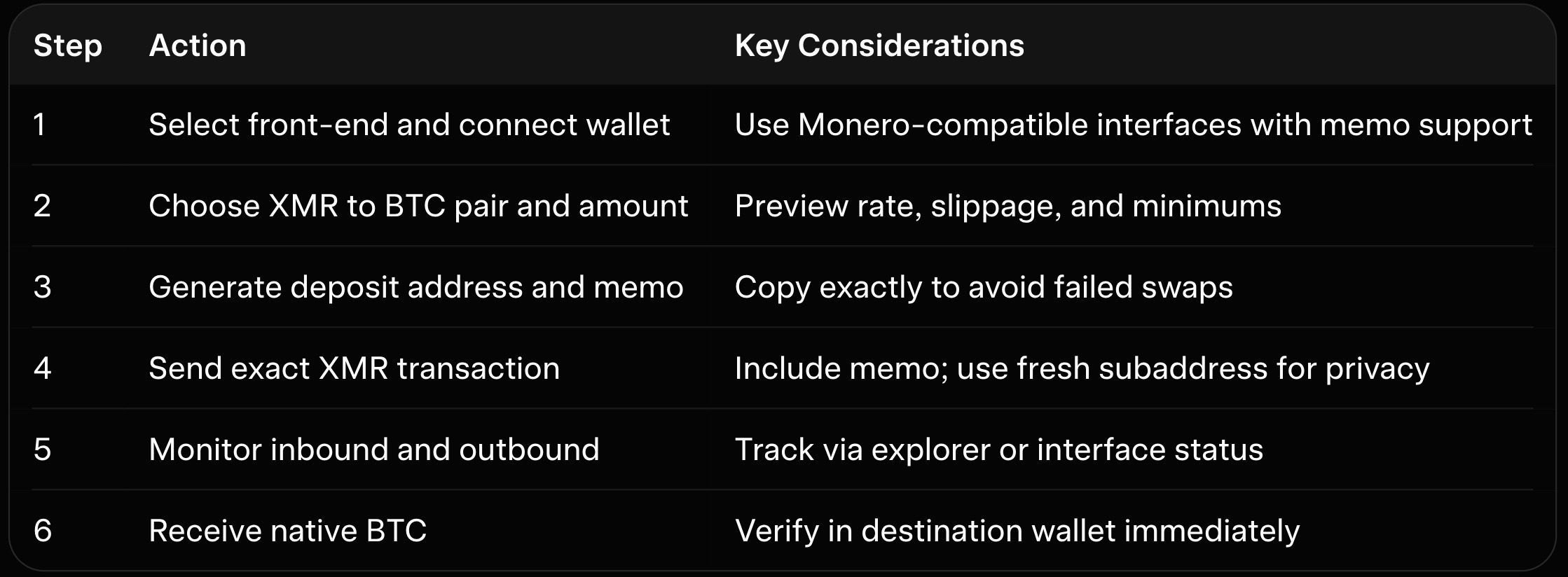
Begin by selecting a user-friendly front-end that supports Thorchain swaps. Popular interfaces include the official swap site or integrated wallets compatible with Monero. Connect or prepare your Monero wallet for the transaction.
Next, choose XMR as the source asset and BTC as the destination. Enter the amount you wish to swap and review the live quote, including expected slippage and fees. Set a price limit to protect against unfavorable movements during confirmation.
Generate the deposit address and memo through the interface. Send the exact XMR amount from your wallet to the provided vault address, including the memo in the transaction details. Monero wallets supporting custom memos or integrated tools simplify this step.
Wait for inbound confirmations on the Monero network. Once observed by sufficient nodes, the protocol executes the swap. Bitcoin arrives in your specified recipient wallet after outbound processing, typically within minutes depending on network conditions.
Process Steps Table
Fees, Slippage, and Execution Details
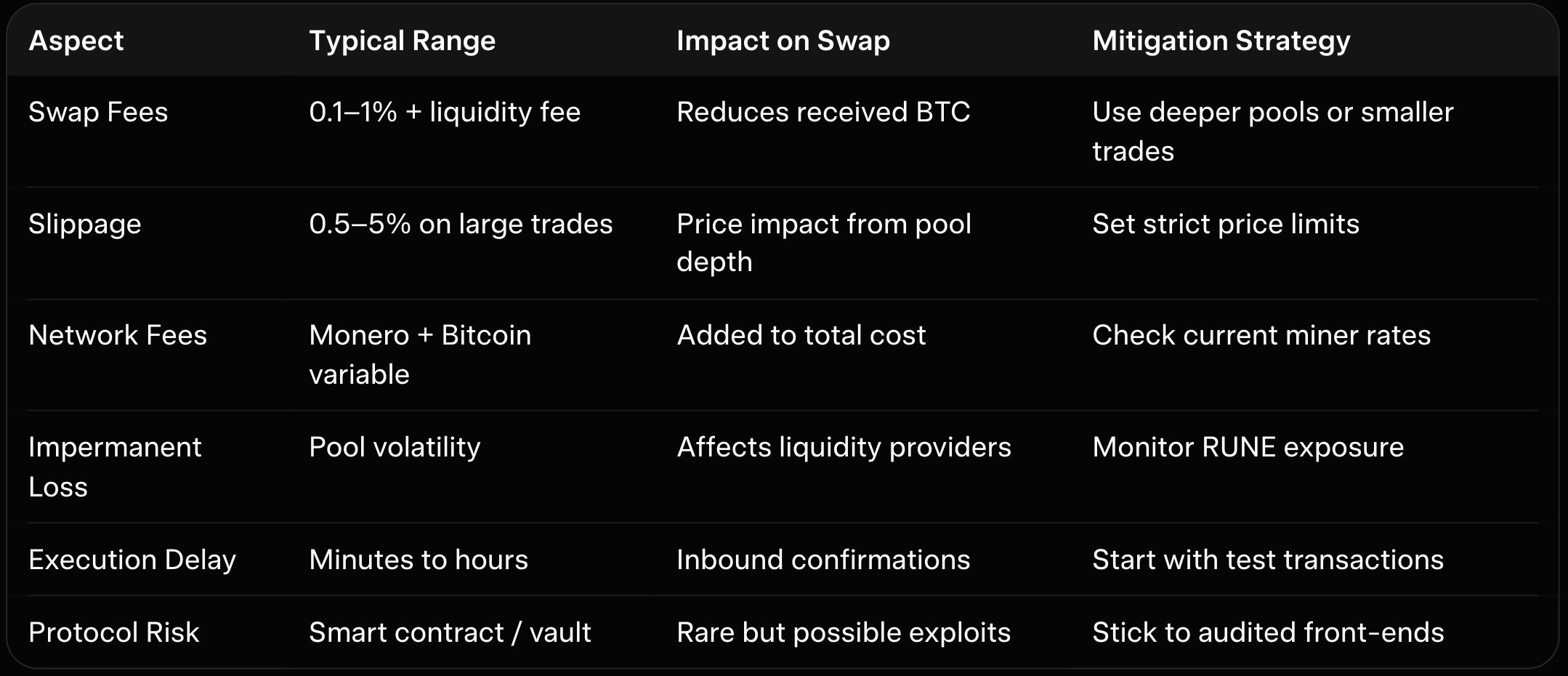
Thorchain charges dynamic swap fees based on pool depth and trade size. A base liquidity fee plus affiliate fees (if using certain interfaces) apply. Slippage protection lets users set maximum acceptable price deviation before the swap fails safely.
Network fees include Monero miner costs for the inbound transaction and Bitcoin fees for the outbound. Overall costs stay competitive for mid-sized swaps but rise with low pool liquidity. Real-time quotes on front-ends display total expected expenses upfront.
Fees and Risks Table
Real-World Execution Considerations
A trader holding private XMR wants to access Bitcoin liquidity for payments or DeFi. They route through Thorchain for native BTC receipt without centralized exchanges. The process works best during periods of high pool depth for minimal slippage.
Real-time monitoring helps avoid congestion on either chain. Users often split larger amounts into multiple swaps spread over time. Fresh Monero subaddresses and Bitcoin receive addresses maintain unlinkability where possible.
Liquidity in the XMR-BTC pool has grown steadily since integration. Still, peak volatility can widen spreads temporarily. Combining with other tools optimizes outcomes for frequent traders.
Risks to Consider
Protocol-level risks include potential vulnerabilities in vault threshold signatures despite audits. Users mitigate this by starting small and verifying recent security reports. Impermanent loss affects providers more than simple swappers.
Slippage and front-running remain concerns during high volatility. Price limits and careful timing reduce exposure. Cross-chain dependencies mean delays on one network can affect completion.
Regulatory scrutiny targets cross-chain protocols occasionally. Thorchain’s decentralized nature offers resilience, yet users should diversify methods. No single platform guarantees absolute permanence.
Best Practices for Successful Swaps
Always test with minimal amounts first to confirm wallet compatibility and memo handling. Use hardware wallets or secure clients for larger values. Review our Ledger vs Trezor for Monero for storage recommendations after swaps.
Monitor pool depths and recent swap history before committing. Enable slippage protection consistently. Check Monero vs Bitcoin privacy comparisons to understand residual analysis risks.
How Baltex.io Improves Routing and Execution Compared to Direct Protocol Usage
Baltex.io enhances direct Thorchain swaps by acting as a non-custodial private router that aggregates liquidity and inserts shielded hops. Users complete the core XMR to BTC swap on Thorchain then route the output through Baltex for optimized paths across additional sources. This delivers better effective rates and reduced slippage than single-pool execution.
Shielded Monero-based segments break transaction links that Thorchain’s public ledger might expose. The four-step wallet-to-wallet flow requires no accounts and previews full costs transparently. Unlimited no-KYC operation supports frequent use without policy changes.
Practical flows integrate Baltex naturally after Thorchain. Traders acquire BTC via the protocol then refine privacy or rebalance via Baltex routing. The combination outperforms standalone usage for users prioritizing unlinkability and efficiency. Explore details in our Baltex vs ChangeNOW guide or Baltex vs Thorchain native cross-chain swaps fees risk.
Ecosystem resources support complete setups. Review best decentralized exchanges for buying Monero when exploring alternatives. Wallet guides like MyMonero web and desktop wallet guide and Monerujo Android wallet review ensure secure handling.
P2P options complement via best P2P Monero exchanges. Instant swappers feature in StealthEX anonymous XMR instant exchange review and GODEX no-KYC review. Aggregators appear in Trocador privacy-focused review.
Broader insights cover Monero vs Zcash and Monero wallet FAQs. These articles help build robust workflows around improved routing.
Risks to Consider
Direct Thorchain usage exposes swaps on public ledgers for analysis. Baltex adds privacy layers that direct protocol access lacks. Diversifying across both reduces single-point dependencies.
Conclusion
Thorchain delivers powerful native XMR to BTC swaps in 2026 through its liquidity pool model and secure vault architecture. The step-by-step process remains accessible via modern front-ends while offering true cross-chain freedom without intermediaries. Understanding fees, slippage, and risks ensures smoother real-world execution for privacy-focused users.
Baltex.io elevates these workflows by providing optimized private routing that reduces slippage, enhances unlinkability, and streamlines multi-chain needs beyond direct protocol usage. Integrating both tools creates resilient stacks for moving value securely between Monero privacy and Bitcoin liquidity. Test small amounts, monitor conditions live, and layer best practices for consistent results.
The cross-chain landscape rewards informed users who combine decentralized protocols with complementary routers. Stay updated through ecosystem resources on wallets, privacy coins, and swap strategies. With careful execution, native XMR to BTC swaps on Thorchain remain a reliable and private option throughout 2026 and beyond.
We cover this in more detail in Instant Swap Services: The Go-To for Privacy-Conscious Users.
We cover this in more detail in Instant Swap Services: The Go-To for Privacy-Conscious Users.
We cover this in more detail in XMR.to Alternatives: How to Pay Bitcoin Invoices with Monero.
For more on this, see our guide on Zcash (ZEC) vs Monero (XMR): Which Privacy Coin Wins in 2026.