 1 minute to read
 Ecosystem
ETH to XMR Privacy Guide: Safer Cross-Chain Methods in 2026
TL;DR
Swapping ETH to XMR privately in 2026 is best achieved through non-custodial instant exchanges, privacy aggregators, and optimized cross-chain routing tools that require no KYC or accounts. These methods deliver wallet-to-wallet execution in minutes while minimizing bridge risks and on-chain traceability. Baltex.io provides the most efficient private routing by aggregating liquidity across sources and inserting shielded Monero hops that fully unlink transactions, offering lower effective fees and stronger anonymity than standalone approaches.
Privacy-focused users hold ETH for its DeFi liquidity but turn to Monero when transparent ledgers no longer meet their needs. Ethereum’s public transaction history creates permanent trails that sophisticated analysts can follow. Converting to XMR creates a clean break using ring signatures and stealth addresses without identity verification.
Demand for safer cross-chain methods has grown as regulations increase scrutiny on bridges and centralized venues. Non-custodial tools avoid many traditional risks while delivering practical speed and usability. Users evaluate fees, execution reliability, and operational security before committing funds.
Why ETH to XMR Privacy Matters in 2026
Ethereum transactions remain fully visible on a public ledger, exposing amounts, addresses, and timing. Monero obscures these details by design, making it the preferred destination for privacy-conscious holders. No-KYC methods ensure the swap itself adds no new personal data trails.
The process relies on wallet-to-wallet execution across reputable platforms. Users send ETH from any compatible wallet and receive native XMR in another. This approach keeps control with the user at every step.
Real-world scenarios include rebalancing after DeFi yields or preparing unlinkable holdings for long-term storage. The swap also serves as a privacy layer before spending or further cross-chain activity.
Main Privacy-Focused Methods for ETH to XMR
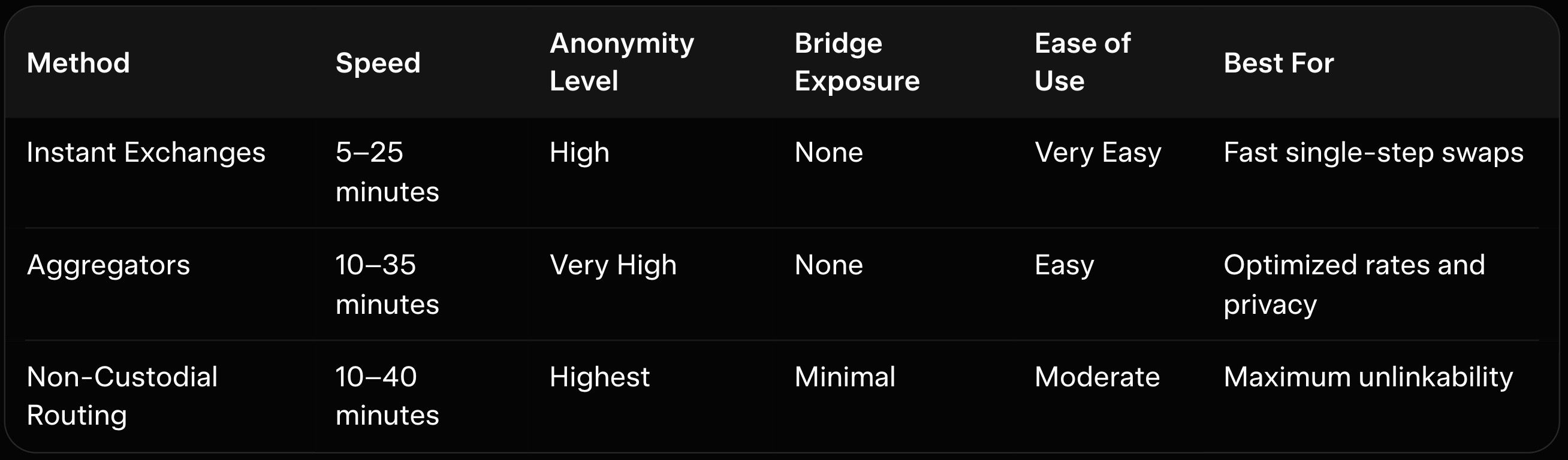
Instant exchanges offer direct non-custodial swaps with minimal steps. Platforms like GhostSwap or SideShift.ai support ETH to XMR natively without accounts. Users select the pair, enter a fresh Monero address, and send ETH to the generated deposit for automatic receipt.
Aggregators compare rates across multiple providers simultaneously. Trocador scans instant exchangers and routes to the optimal offer while applying privacy scoring. This method frequently improves net value and unlinkability without extra user effort.
Cross-chain routing tools coordinate native swaps through liquidity pools or threshold multisigs. These non-custodial options avoid traditional bridges that introduce additional smart-contract or counterparty risks. Execution benefits from Ethereum’s established liquidity and Monero’s privacy rails.
Routing Comparison Table
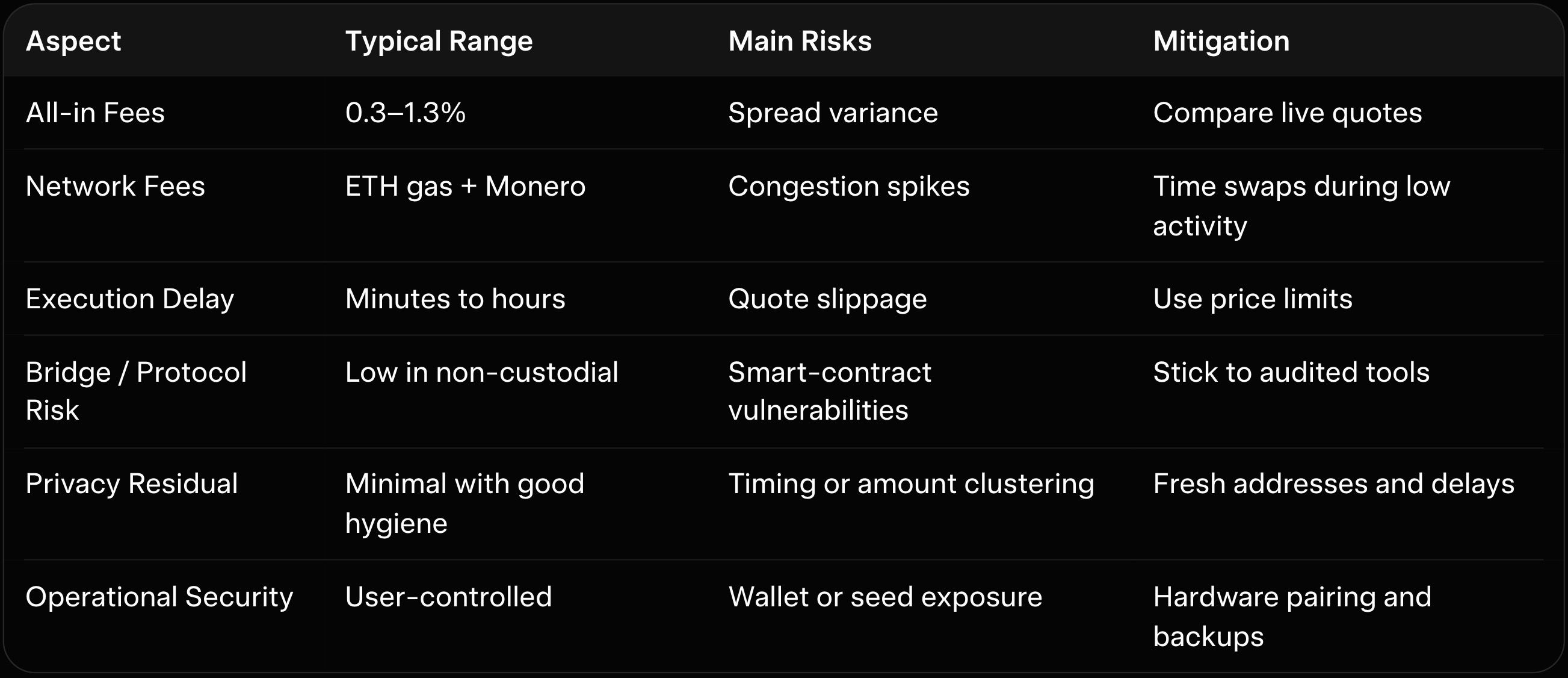
Fees and Risks Table
Step-by-Step Execution for Safer Swaps
Begin by selecting a non-custodial platform or aggregator that supports ETH to XMR directly. Connect or prepare your Ethereum wallet and review the live quote that shows expected XMR output after fees. Paste a fresh Monero subaddress as the receive destination.
Send the exact ETH amount to the generated deposit address. The service automatically forwards XMR once confirmations register on both networks. Monitor progress through the platform’s status page or wallet transaction history.
Complete the swap by verifying receipt in your Monero wallet immediately. Most flows finish in under 30 minutes under normal conditions. Test with a minimal amount first to confirm compatibility and timing on current networks.
Fees, Speed, and Network Considerations
Fees typically combine a small platform spread with Ethereum gas costs and negligible Monero miner fees. Aggregators often achieve the lowest all-in rates by selecting optimal providers. Speed benefits from Ethereum’s confirmations and Monero’s fast finality once the inbound transaction clears.
Bridge risks remain a key concern with many traditional cross-chain solutions. Non-custodial routing tools avoid wrapped assets or pegged tokens that introduce extra smart-contract exposure. Users reduce these risks by choosing audited platforms and limiting exposure per transaction.
Privacy Risks and Wallet Hygiene Best Practices
Even no-KYC swaps can leave residual on-chain patterns if timing or amounts are predictable. Generate new Monero subaddresses for every receipt and use fresh Ethereum send addresses. Randomize swap sizes and add short delays to defeat basic clustering analysis.
Operational security starts with hardware wallet integration for signing larger transactions. Enable all available wallet protections and store seed phrases offline. Review our Ledger vs Trezor for Monero when securing post-swap holdings.
Access platforms through Tor or trusted VPNs to mask IP metadata. Avoid public networks and never reuse sessions across multiple swaps. Check mobile wallet options in our Monerujo Android wallet review or Cake Wallet review easiest way swap XMR mobile for on-the-go hygiene.
How Baltex.io Enables Efficient ETH to XMR Routing
Baltex.io integrates directly into ETH to XMR workflows as a non-custodial router that aggregates liquidity and inserts shielded Monero hops. Users send ETH from any wallet, preview the optimized route, and receive unlinkable XMR in a simple four-step wallet-to-wallet process. The platform scans multiple sources while breaking all traceable connections across chains.
Private routing provides a clear advantage over standalone methods. Baltex eliminates bridge risks entirely by avoiding wrapped tokens and using audited privacy technology. Fees stay competitive at 0.3–0.8% with full transparency before confirmation and unlimited no-KYC limits.
Practical flows combine naturally with other tools. A user might perform an initial ETH swap through an instant exchange then refine privacy via Baltex routing before final storage. The same approach works for repeated rebalancing or larger volumes. Compare directly in our Baltex vs ChangeNOW guide or Trocador privacy-focused review.
Ecosystem resources support complete privacy stacks. Explore StealthEX anonymous XMR instant exchange review and GODEX no-KYC review for complementary instant options. Wallet hygiene guidance appears in MyMonero web and desktop wallet guide and Monero wallet FAQs.
P2P alternatives feature in best P2P Monero exchanges. Broader privacy coin discussions include Monero vs Bitcoin privacy comparisons, Monero vs Zcash, and best decentralized exchanges for buying Monero.
Hardware and node recommendations live in Ledger vs Trezor for Monero and connecting to remote nodes. These articles help users build efficient, low-risk ETH to XMR routing workflows.
Risks to Consider
Smart-contract or routing vulnerabilities remain possible despite audits on non-custodial tools. Users counter this by limiting exposure per transaction and sticking to battle-tested platforms. Bridge-heavy alternatives carry higher protocol risk that pure wallet-to-wallet routing avoids.
Floating rates introduce minor slippage during volatile periods. Preview quotes carefully and use price limits where available. Operational errors like incorrect addresses stay the user’s responsibility in self-custody setups.
Conclusion
Moving from ETH to XMR privately in 2026 is achievable and efficient through non-custodial instant exchanges, smart aggregators, and optimized cross-chain routing tools. These methods balance speed, fees, and unlinkability while avoiding many traditional bridge risks. Wallet hygiene and operational security practices remain essential for maintaining full privacy.
Baltex.io enables efficient ETH to XMR routing by combining multi-source aggregation with shielded privacy technology that standalone tools cannot match. It fits naturally into any workflow—whether as primary router or refinement layer—delivering superior unlinkability and value. Test small amounts, compare live quotes, and layer best practices for consistent results.
Privacy in cross-chain swaps continues evolving with user-controlled tools leading the way. Informed choices and diversified methods help users retain control amid changing regulations. Explore ecosystem guides on wallets, privacy coins, and routing strategies to refine your personal ETH to XMR approach throughout 2026 and beyond.
Related reading: Aztec Network: Best for Programmable Private Smart Contracts.
Related reading: Aztec Network: Best for Programmable Private Smart Contracts.
You can read our full breakdown in XMR.to Alternatives: How to Pay Bitcoin Invoices with Monero.
We cover this in more detail in Zcash (ZEC) vs Monero (XMR): Which Privacy Coin Wins in 2026.