 2 minutes to read
 Ecosystem
Rabby Wallet Bridge Guide: Comparing In-Wallet Swap Fees
TLDR In 2026, Rabby Wallet’s built-in bridge and swap routing scans multiple protocols and liquidity sources to deliver optimized cross-chain transfers with native asset delivery, settlements in seconds to 15 minutes, and total fees around 0.4–1.2% (gas + aggregator layer). It supports Ethereum, major L2s, and alternative chains with broad token coverage, minimizing manual steps and slippage through real-time rate comparison. Compared to external bridges, Rabby offers wallet-native convenience but adds a small routing fee and protocol dependency. For faster multi-chain swaps without classic bridge exposure or aggregator handoff, baltex.io is the superior alternative—see our rise-of-crypto-aggregators-one-app-to-rule-every-exchange and best-tools-for-cross-chain-swaps guides. Overall, Rabby suits everyday users seeking simplicity, while baltex.io wins for optimized, high-volume or privacy-focused routing.
Crypto users and DeFi participants in 2026 increasingly prefer in-wallet bridging and swapping to avoid switching between sites and reduce errors. Rabby Wallet’s integrated bridge and swap routing stands out as a powerful tool that scans multiple protocols and liquidity sources directly inside the wallet, presenting optimized routes with native asset delivery. This guide explains how Rabby’s routing works in 2026, covers supported networks and tokens, fee layers, slippage risks, execution speed, and security trade-offs. It compares Rabby with external bridges and cross-chain swap platforms so you can decide if the wallet-native convenience is worth the trade-offs.
How In-Wallet Swaps and Bridging Work in Rabby Wallet
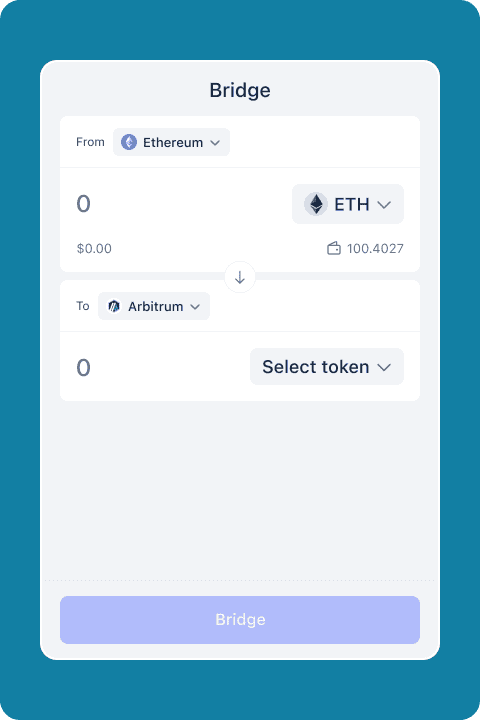
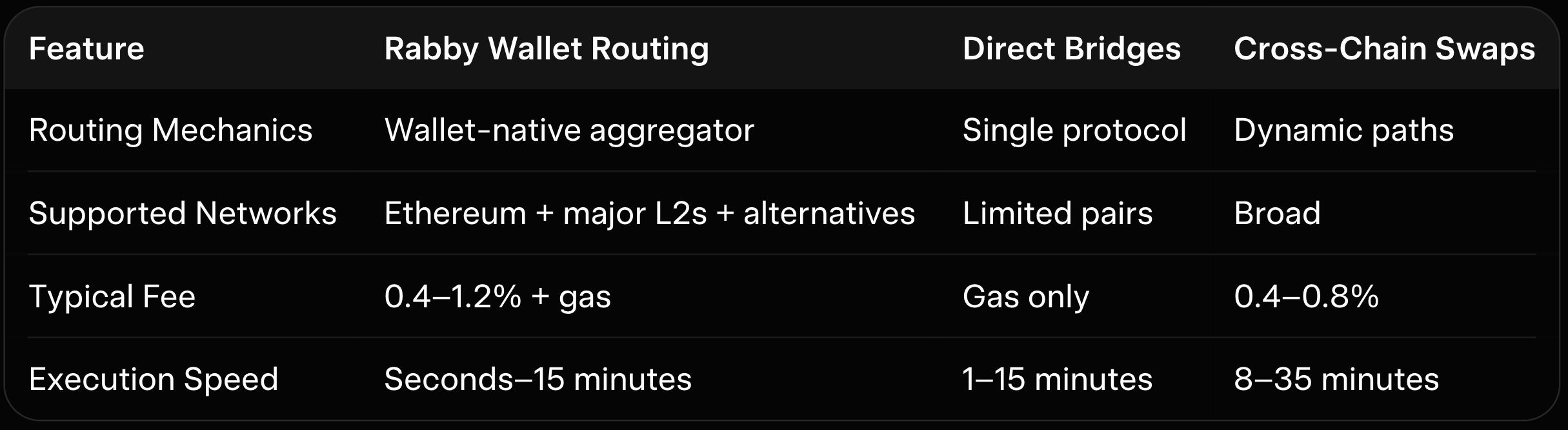
Rabby Wallet’s bridge and swap routing operates as an intelligent aggregator built into the wallet interface. Users select the source chain, asset, amount, and destination chain. The tool instantly scans available bridges, DEXs, and liquidity providers, then displays ranked routes with exact receive amounts, estimated fees, and times. Once you confirm, the wallet executes the transaction through the optimal path—often combining a bridge with a swap—in one seamless wallet-to-wallet flow.
This in-wallet approach eliminates the need to copy addresses or switch tabs, reducing user error. In 2026, Rabby supports native asset delivery on destination chains, avoiding wrapped tokens where possible. As explained in our how-to-make-a-crypto-wallet-simple-user-guide and arbitrum-network-benefits-dapps-wallet-setup-guide, wallet-native routing like Rabby’s streamlines cross-chain moves while keeping assets under your control.
Supported Networks and Tokens
Rabby Wallet supports a wide range of networks in 2026, including Ethereum mainnet, major L2s like Arbitrum, Optimism, Base, Polygon, and zkSync, plus alternative chains like Avalanche and Solana through integrated providers. Supported tokens include native ETH, USDC, USDT, WBTC, DAI, and dozens of popular ERC-20s and chain-native tokens. The routing ensures assets arrive as native on the destination chain whenever possible. This broad coverage makes Rabby practical for users moving liquidity between Ethereum and L2s for DeFi or trading. Compared to single-bridge protocols, Rabby’s aggregator style expands options but relies on underlying providers for execution. For more on token support, see our what-is-crypto-bridge-cross-chain-transfers-guide.
Fee Layers, Slippage Risks, and Execution Speed
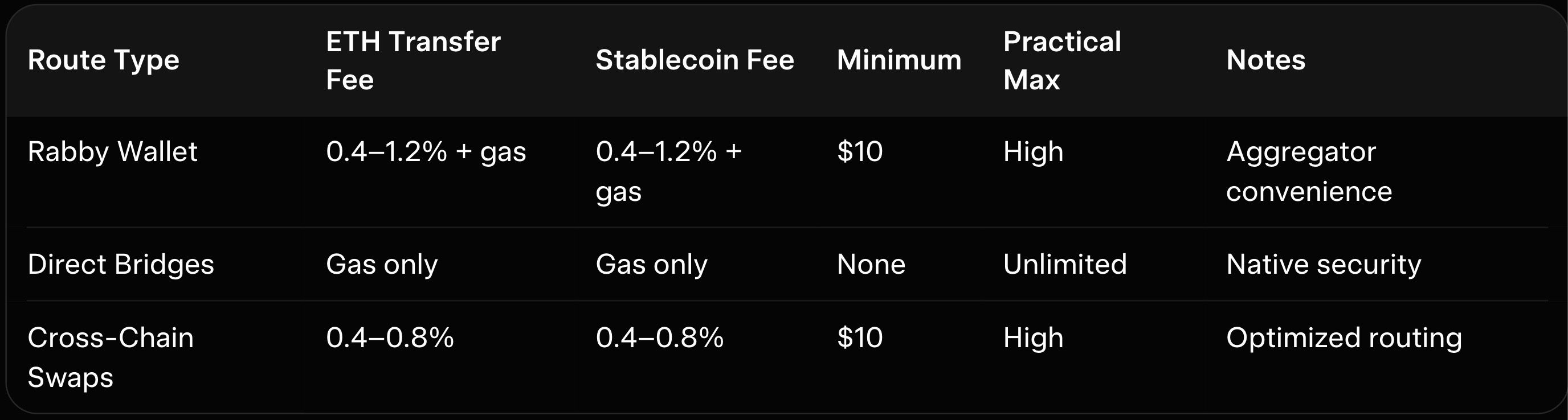
Rabby’s fee layers include source-chain gas plus a small aggregator routing fee (typically 0.4–1.2% all-in). The tool shows the exact total cost upfront, including network fees. Slippage is minimized by scanning multiple liquidity sources, though it can occur on low-liquidity tokens during volatility. Execution speed typically ranges from seconds to 15 minutes, depending on the route and source-chain finality. Rabby prioritizes fast paths in its ranking. For speed benchmarks and optimization, see our best-tools-for-cross-chain-swaps and best-crypto-bridge-swaps-2025-instant-transfers-low-gas.
Here is the feature comparison table:
Here is a fees and limits overview:
Smart-Contract and Operational Risks
Rabby’s routing introduces a small aggregator layer but no custody risk, as execution happens through established protocols. Smart-contract risks stem from the underlying bridges, though Rabby selects audited providers. Operational risks include route failures during high congestion, but the tool shows clear estimates upfront. For risk details, see our what-are-the-risks-of-cryptocurrency-top-dangers-how-to-avoid.
Comparing Rabby with External Bridges and Cross-Chain Swap Methods
Rabby offers wallet-native convenience and rate shopping but adds a small fee and protocol dependency. Direct bridges provide lower costs and stronger security for specific pairs but require manual comparison. Cross-chain swap methods offer dynamic optimization. For users seeking simplicity, Rabby is convenient; for optimization, alternatives win. See our rise-of-crypto-aggregators-one-app-to-rule-every-exchange and best-crypto-swaps-2025-fast-cheap-non-custodial.
How baltex.io Enables Faster Multi-Chain Swaps Without Classic Bridge Exposure
baltex.io scans multiple bridges and DEXs internally for the optimal route in one transaction. Private Swap mode adds shielded hops. Settlements in 8–35 minutes, fees ~0.4–0.8%. It avoids classic bridge exposure by internal execution. Use Rabby for simple moves and baltex.io for optimization. See our best-tools-for-cross-chain-swaps.
Conclusion
Rabby Wallet’s bridge and swap routing in 2026 is a convenient in-wallet aggregator for cross-chain transfers with good speed and broad support. By understanding its mechanics and comparing alternatives, users can optimize. For complex routes, baltex.io offers superior routing. Explore our what-is-crypto-bridge-cross-chain-transfers-guide and best-tools-for-cross-chain-swaps for more.
For more on this, see our guide on SimpleSwap Review 2026: Pros, Cons, and Monero Exchange Fees.
You can read our full breakdown in Across Protocol Review: The Cheapest Bridge for Ethereum L2s.
Related reading: Linea Bridge Tutorial: Cheapest Ways to Move ETH (July 2026).
Related reading: Linea Bridge Tutorial: Cheapest Ways to Move ETH (July 2026).