 2 minutes to read
 Ecosystem
Serai DEX Review: Native Cross-Chain Swaps for Monero and Bitcoin
TL;DR
Serai DEX offers native cross-chain swaps between Monero, Bitcoin, Ethereum, and DAI in 2026 through a decentralized liquidity pool model secured by threshold multisignatures. It provides accessible AMM-style trading without wrappers or centralized bridges while preserving Monero’s privacy. Baltex.io complements Serai by adding optimized private routing layers for enhanced unlinkability and multi-source liquidity aggregation.
Privacy-focused traders seek seamless ways to move between transparent chains like Bitcoin and private ones like Monero. Serai DEX addresses this by enabling direct, native swaps that respect each asset’s core properties. The protocol combines liquidity pool convenience with strong cryptographic security.
Serai DEX Overview
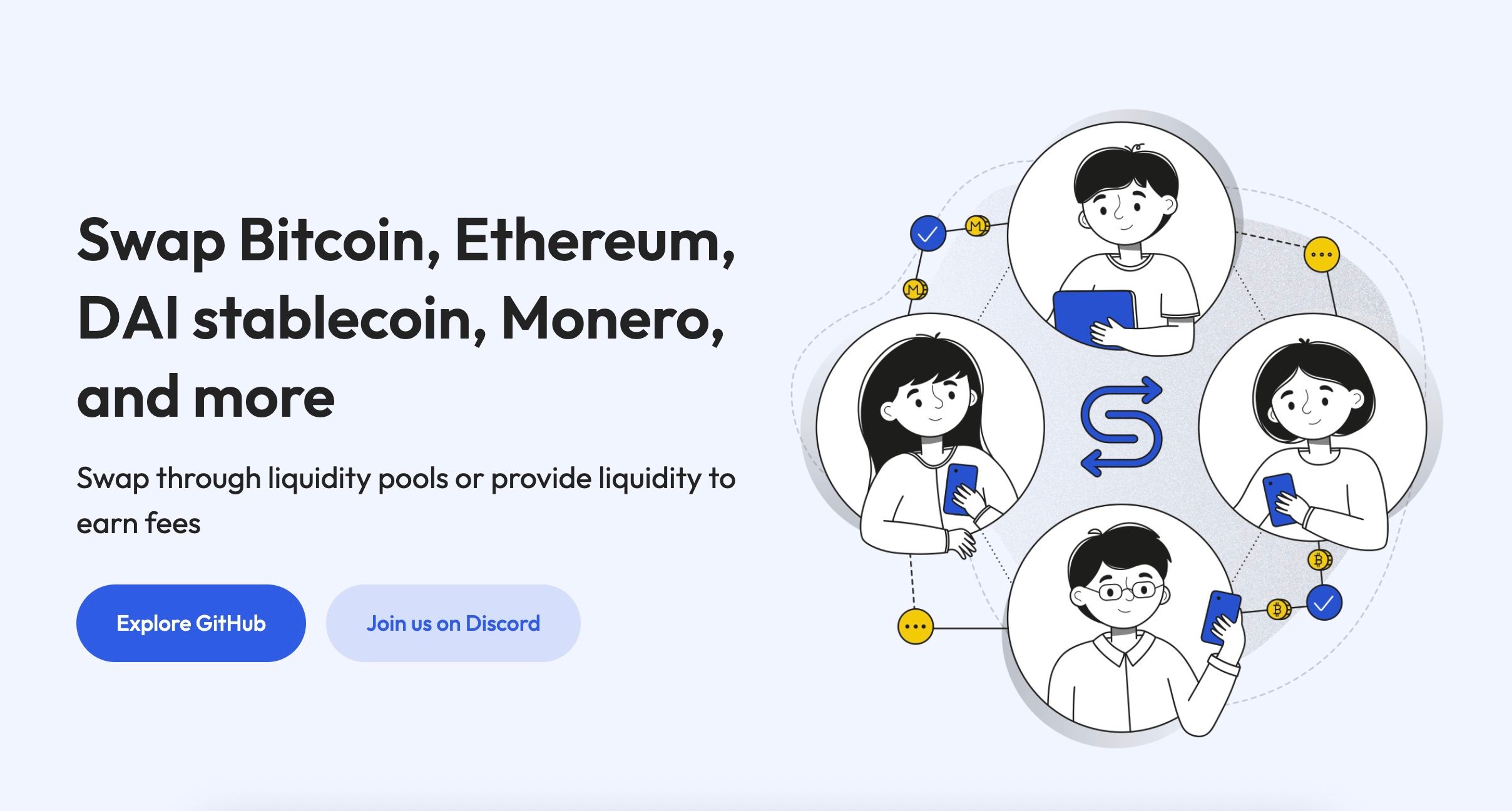
Serai functions as a decentralized exchange built from the ground up for cross-chain trading. It supports Bitcoin, Ethereum, DAI stablecoin, and Monero with plans for additional networks. Users swap through liquidity pools or provide liquidity to earn fees in a fully open-source environment.
The platform operates without central authority or admin keys. Its architecture leverages a custom blockchain for coordination while external assets remain secured in collateralized multisig wallets. This design delivers an accessible user experience compared to pure atomic swap systems.
Architecture and Technical Foundation
Serai runs its own Substrate-based chain that orchestrates trades and liquidity. External chains connect through processors that feed data securely into the network. Rust-based cryptography, including custom Monero libraries and FROST threshold signatures, powers the entire stack.
Audits and bug bounties strengthen confidence in the protocol. The system avoids reliance on wrapped assets or traditional bridges. Instead, it uses economically secured threshold multisigs for holding and moving funds across networks.
Custody Model
Serai employs a non-custodial approach where users never surrender full control. Funds sit in collateralized multisignature wallets managed by decentralized validator nodes. Threshold signatures require multiple parties to approve movements, preventing single-point theft.
Liquidity providers deposit assets into pools without ongoing node operation requirements. This model improves accessibility over traditional maker-taker atomic swaps. Users sign once and can walk away while executions complete.
Liquidity Design
Liquidity pools form the heart of Serai’s trading mechanism. Providers add single-sided or paired assets to earn trading fees. Concentrated liquidity options allow more efficient capital use similar to advanced AMMs.
The native token coordinates liquidity and incentives without fragmenting pairs. Economic security backs the multisig system through bonded validators. This setup attracts deeper liquidity for popular pairs like BTC-XMR and ETH-XMR.
Swap Mechanics
Users connect compatible wallets and select input and output assets. The protocol quotes rates from available pools and executes atomic-like swaps through coordinated multisig actions. Transactions respect each chain’s confirmation rules while maintaining privacy where possible.
No account creation or KYC applies. Swaps complete as fast as underlying block times allow, often faster than manual P2P processes. The interface aims for simplicity akin to familiar DEX experiences.
Fees Structure
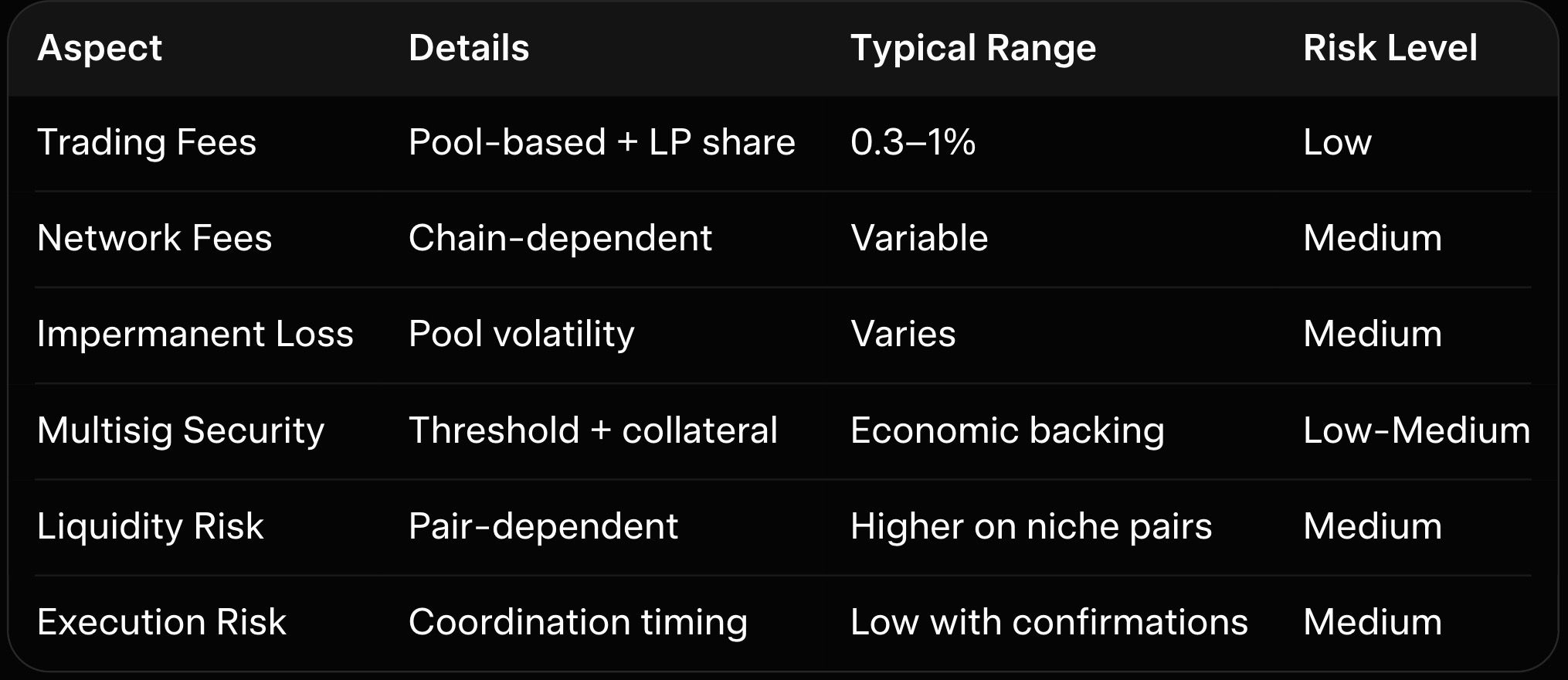
Trading fees stay competitive with portions distributed to liquidity providers. Network-specific gas or miner fees apply on source and destination chains. Overall costs benefit from efficient routing and low Monero transaction expenses.
No hidden withdrawal charges exist since custody remains user-controlled. Fee structures may include incentives for liquidity provision paid in the native token. Transparency allows users to preview total costs before confirmation.
Risks and Considerations
Smart contract or protocol bugs pose theoretical risks despite audits. Threshold multisig security depends on validator honesty and economic incentives. Liquidity fragmentation across pairs could cause slippage on lower-volume routes.
Impermanent loss affects providers during volatile price swings. Cross-chain coordination introduces timing complexities. Users mitigate these through small test swaps and diversified pool participation.
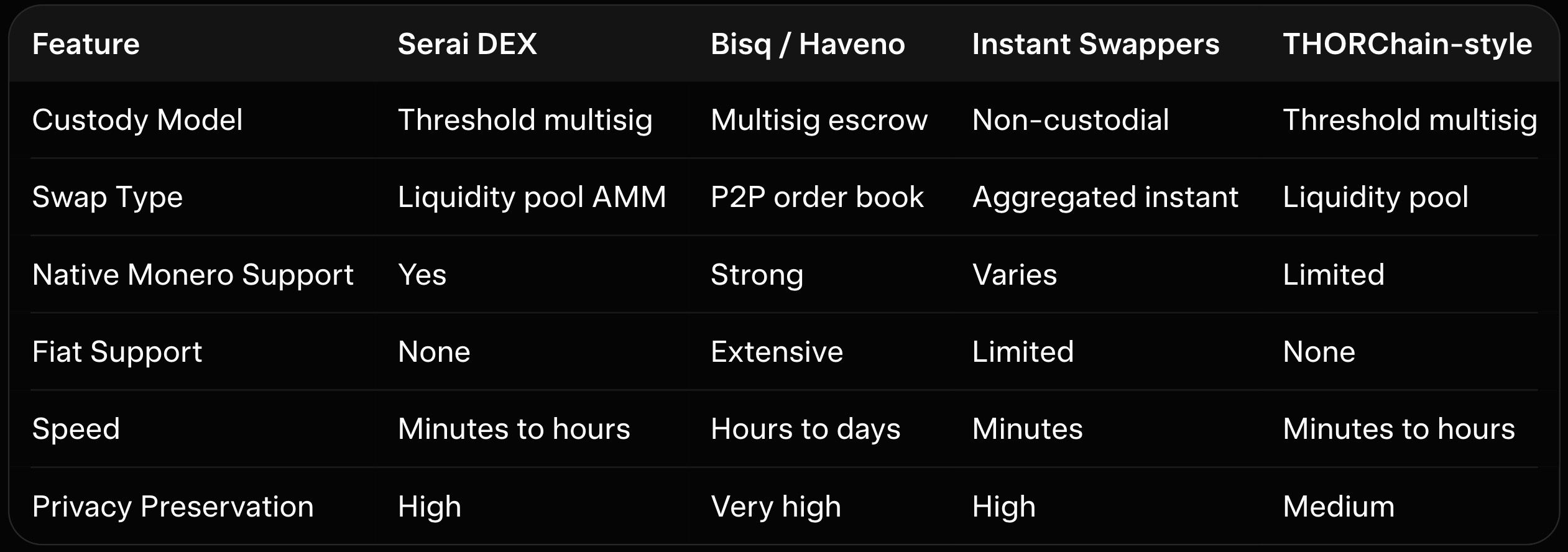
Features Comparison Table
Fees and Risks Table
Real-World Usage Scenarios
A Monero holder swaps XMR for BTC to access broader liquidity without centralized exchanges. They deposit into the relevant pool, receive a quoted rate, and complete the trade in one flow. The process preserves more privacy than bridge-based alternatives.
Ethereum users move ETH or DAI into Monero for private holdings. Liquidity providers earn fees while supporting ecosystem growth. Traders arbitrage price differences across chains using Serai’s unified interface.
Comparison with Other Cross-Chain Solutions
Serai differentiates from atomic swap platforms like those in Bisq or Haveno through its liquidity pool accessibility. Users avoid constant node operation while gaining AMM convenience. P2P options excel in fiat but lag in speed for crypto pairs.
Centralized or wrapped bridges introduce counterparty and smart contract risks that Serai minimizes. Other liquidity-based protocols like THORChain offer similar models but lack native Monero depth. Serai’s Rust cryptography and Monero focus create unique advantages.
Instant aggregators provide speed yet often rely on custodial elements or weaker privacy. Serai balances decentralization with usability for privacy-conscious flows. Many users combine approaches for optimal results.
Best Practices for Serai Users
Start with small test swaps to verify wallet compatibility and timing. Monitor pool depths before larger trades to minimize slippage. Use fresh addresses and subaddresses especially for Monero receipts.
Provide liquidity thoughtfully to manage impermanent loss exposure. Keep software updated and follow audit reports. Layer additional privacy tools when moving sensitive amounts.
How Baltex.io Complements or Improves Cross-Chain Routing
Baltex.io integrates smoothly with Serai DEX by offering non-custodial private routing for post-swap optimization. Users execute core swaps on Serai then route assets through Baltex for shielded hops and multi-source aggregation. This adds extra unlinkability layers beyond native capabilities.
The combination leverages Serai’s liquidity pools with Baltex’s optimized previews and Monero-shielded segments. Traders move value across chains while breaking analysis trails more effectively. Unlimited no-KYC flows support frequent rebalancing without friction.
Practical workflows include acquiring assets on Serai then enhancing privacy via Baltex before storage or further DeFi use. Baltex handles rate optimization across additional sources seamlessly. Explore best decentralized exchanges for buying Monero for complementary strategies.
Ecosystem resources enhance these flows. Review Monero vs Bitcoin privacy comparisons when planning swaps. Wallet guides like MyMonero web and desktop wallet guide and Monerujo Android wallet review ensure secure post-trade handling.
Hardware recommendations feature in Ledger vs Trezor for Monero. P2P alternatives appear in best P2P Monero exchanges. Instant options complement via StealthEX anonymous XMR instant exchange review and GODEX no-KYC review.
Aggregators like those in Trocador privacy-focused review add rate flexibility. Broader insights cover Monero vs Zcash and Baltex vs ChangeNOW guide.
Risks to Consider
Validator collusion, though economically disincentivized, remains a long-term concern in threshold systems. Liquidity provision carries volatility risks that require active management. Cross-chain dependencies mean delays on one network affect overall execution.
Protocol upgrades could introduce temporary complexities. Users should diversify across platforms and stay informed through community channels. Thorough testing mitigates most user-level errors.
Conclusion
Serai DEX brings accessible native cross-chain swaps to Monero and Bitcoin ecosystems through its innovative liquidity pool and threshold multisig design. Strong cryptography, audit focus, and user-friendly mechanics position it as a compelling option for privacy-aware traders in 2026. While risks like impermanent loss and coordination timing exist, the benefits in accessibility and security stand out.
Baltex.io enhances Serai usage by providing complementary private routing that strengthens overall anonymity and execution flexibility. Together they empower users to navigate cross-chain needs without compromising core privacy principles. Test with small amounts, monitor pools, and combine tools for resilient workflows.
The decentralized cross-chain space continues maturing rapidly. Serai’s Monero-native approach contributes meaningfully alongside P2P and instant solutions. Informed users who leverage ecosystem resources on wallets, privacy comparisons, and swap strategies maintain control and discretion effectively.
Related reading: SimpleSwap Review 2026: Pros, Cons, and Monero Exchange Fees.
For more on this, see our guide on Instant Swap Services: The Go-To for Privacy-Conscious Users.
For more on this, see our guide on XMR.to Alternatives: How to Pay Bitcoin Invoices with Monero.
You can read our full breakdown in Zcash (ZEC) vs Monero (XMR): Which Privacy Coin Wins in 2026.