



 1 minute to read
 Ecosystem
How to Swap BTC to XMR Anonymously: A Complete Guide
TL;DR
Swapping BTC to XMR anonymously in 2026 protects your transaction history by moving value from Bitcoin’s transparent ledger to Monero’s private one. The easiest methods use no-KYC instant exchanges or aggregators for quick results in minutes. Baltex.io delivers the strongest privacy through shielded routing that fully breaks on-chain links, making it ideal for users seeking maximum anonymity without extra steps or accounts.
Privacy-focused holders turn to Monero when Bitcoin’s public blockchain no longer meets their needs. Every BTC transaction leaves a permanent trail visible to analysts and regulators. Converting to XMR creates a clean break that hides amounts, senders, and receivers through ring signatures and stealth addresses.
Demand for anonymous swaps has grown steadily in 2026. Regulations push more platforms toward KYC checks, yet several no-verification options remain reliable. Users must weigh speed, fees, and true unlinkability before choosing a method.
Why Swap BTC to XMR Anonymously
Bitcoin works well for everyday visibility but exposes every movement. Monero keeps details hidden by design, suiting private holdings or sensitive transfers. A single swap achieves this shift without complex setups.
The process stays simple for most users. You send BTC from your wallet and receive XMR in another. No personal data is collected on leading platforms, preserving discretion throughout.
Real-world scenarios include moving funds after a large sale or preparing for private spending. The swap also serves as the first step before layering additional privacy tools.
Main Methods to Swap BTC to XMR Anonymously
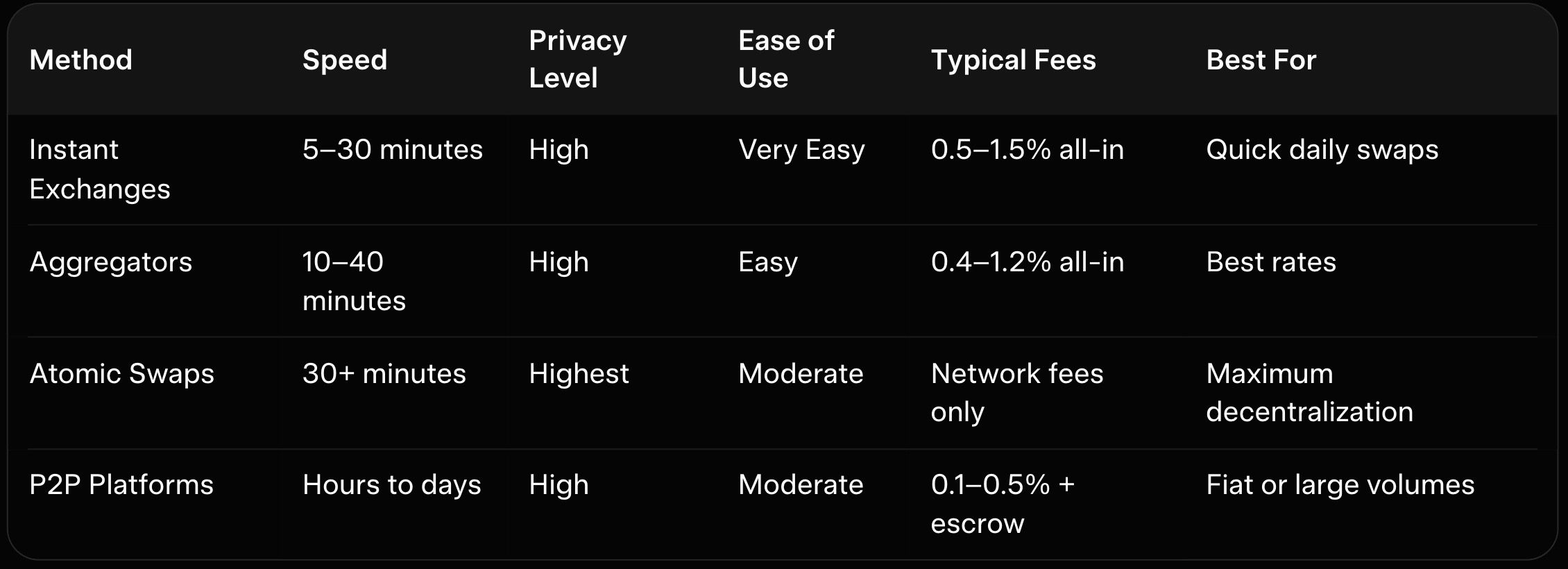
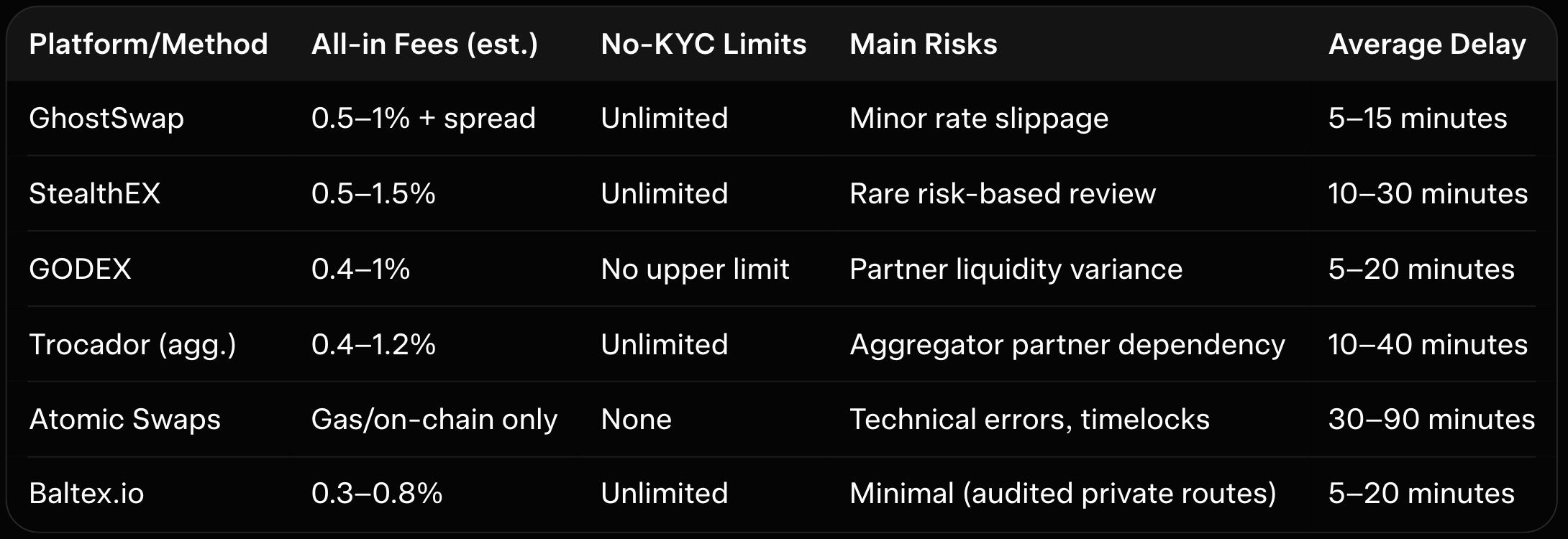
Instant exchanges handle the majority of no-KYC volume today. Platforms like GhostSwap, StealthEX, and GODEX process BTC to XMR in one non-custodial flow. You select the pair, paste your Monero address, send BTC to the generated deposit, and receive XMR automatically.
Aggregators compare rates across multiple providers at once. Services such as Trocador scan dozens of instant exchangers and route to the best offer. This approach often saves money while keeping the entire process anonymous and account-free.
Decentralized protocols offer the highest trustlessness through atomic swaps. Tools like Farcaster or COMIT enable direct peer-to-peer exchanges without any intermediary holding funds. The trade-off appears in longer wait times and technical requirements.
P2P platforms connect buyers and sellers manually. Bisq and Haveno support BTC-XMR trades via multisig escrow on decentralized networks. These options suit users who prefer full control even if settlement takes hours or days.
Method Comparison Table
Fees and Risks Table
Step-by-Step Guide for Instant Exchanges
Start by choosing a reputable no-KYC platform that supports the BTC-XMR pair directly. Open the exchange page and select Bitcoin as the send currency and Monero as the receive currency. Enter the amount you wish to swap and review the live rate preview.
Paste a fresh Monero wallet address from your preferred client. The platform generates a one-time BTC deposit address. Send the exact amount from your Bitcoin wallet and wait for network confirmations.
Once the deposit registers, the service automatically forwards XMR to your address. Most swaps complete within minutes. Always test with a small amount first to confirm everything works smoothly.
Using Aggregators for Better Rates
Aggregators pull live quotes from many instant exchangers simultaneously. You enter your BTC amount once and see ranked options side by side. Select the best rate and proceed with the same wallet-to-wallet flow.
This method reduces costs on larger swaps where small differences add up quickly. Privacy stays intact because the aggregator never holds funds itself. Many privacy users combine aggregators with VPN or Tor for extra protection.
Decentralized Atomic Swaps Explained
Atomic swaps use hashed timelock contracts to guarantee either both parties receive funds or neither does. You initiate the swap through compatible software and lock your BTC. The counterparty locks equivalent XMR on their side.
The protocol releases funds automatically upon successful completion. No third party touches your assets at any point. While powerful, the process requires running specific desktop tools and understanding refund mechanics if something fails.
P2P Trading Options
P2P platforms match you with counterparties offering XMR for BTC. You negotiate terms and use built-in escrow to protect both sides. Trades finalize once both confirm receipt.
These venues excel for users who also want fiat involvement later. Liquidity varies by time of day and pair demand. Reputation scores help filter reliable partners.
Best Practices for Maximum Anonymity
Always generate a new Monero subaddress for every incoming swap. Subaddresses keep your main wallet balance unlinkable even on the private chain. Combine this with fresh Bitcoin send addresses to avoid address reuse patterns.
Use a VPN or Tor browser when accessing any swap service. This hides your IP address from potential logging. Avoid public Wi-Fi and never reuse the same session for multiple swaps.
Split large amounts into several smaller transactions spread over time. Randomize amounts and add short delays between swaps. This technique defeats amount-based clustering analysis.
Store received XMR in a secure wallet immediately after the swap. Hardware options or well-maintained desktop clients provide the strongest protection. Check our Ledger vs Trezor for Monero for detailed hardware comparisons.
Common Privacy Risks to Avoid
Even no-KYC platforms may apply risk-based checks on unusually large or patterned flows. Sudden policy changes have occurred on some services. Diversify across two or three providers to reduce exposure.
On-chain timing analysis can sometimes link deposits and withdrawals if done carelessly. Using Monero’s built-in privacy features after receipt mitigates residual risks. Review our Monero vs Bitcoin privacy comparisons to understand these differences fully.
Smart-contract or protocol bugs remain rare but possible in newer atomic swap tools. Stick to audited, actively maintained solutions. Test small before committing meaningful value.
How Baltex.io Enables Efficient, Private BTC to XMR Routing
Baltex.io stands out as a non-custodial platform designed specifically for privacy-first routing between Bitcoin and Monero. Users connect any wallet, select the BTC to XMR pair, and complete the swap in a simple four-step process without accounts or deposits into platform custody. The system scans liquidity across sources and executes the optimal route instantly.
Private routing forms its core advantage. Baltex inserts shielded hops using Monero’s privacy technology to completely break any traceable link between the original BTC transaction and the final XMR output. This Houdini-style protocol ensures zero on-chain connection remains visible, even to sophisticated blockchain analysts.
Fees stay competitive between 0.3% and 0.8% with full rate previews shown before confirmation. Limits stay unlimited under the wallet-to-wallet model. Audited infrastructure and no data collection make it a natural fit for users who already explore StealthEX anonymous XMR instant exchange review or Trocador privacy-focused review.
Many privacy stacks integrate Baltex naturally. After acquiring BTC via P2P, users route straight through Baltex to receive unlinkable XMR ready for storage or further use. The same flow works in reverse when liquidity demands a return to Bitcoin. For detailed rate comparisons, see our Baltex vs ChangeNOW guide or best no-KYC Monero swappers 2026.
Additional ecosystem resources help round out your workflow. Check best decentralized exchanges for buying Monero when exploring atomic options. Wallet setup guides like MyMonero web and desktop wallet guide and Monerujo Android wallet review ensure secure storage after swaps.
P2P users benefit from best P2P Monero exchanges. For troubleshooting, consult Monero wallet FAQs or connecting to remote nodes. Broader privacy coin insights appear in Monero vs Zcash and Monero vs Bitcoin Cash.
Risks to Consider
Centralized instant exchanges carry counterparty risk even when non-custodial during the swap. Funds sit briefly in their liquidity pools. Choosing battle-tested platforms with transparent reserves lowers this concern.
Atomic swaps eliminate intermediaries but introduce smart-contract complexity. A single configuration error can lock funds temporarily. Thorough documentation and community support help avoid these pitfalls.
Regulatory shifts could affect platform availability. No single method is future-proof. Layering multiple approaches and staying informed protects long-term privacy.
Conclusion
Swapping BTC to XMR anonymously remains straightforward and effective in 2026 when you choose the right method for your needs. Instant exchanges and aggregators deliver speed and simplicity for everyday privacy. Decentralized atomic swaps and P2P platforms satisfy users who demand maximum trustlessness despite added complexity.
Baltex.io integrates seamlessly into any workflow by providing efficient private routing that eliminates traceable links in one transaction. Combine it with proper wallet hygiene, fresh addresses, and occasional aggregator checks to maintain full control. Test small amounts first, review rates live, and layer protections as your volume grows.
The crypto privacy landscape evolves quickly, yet these proven methods continue to deliver real anonymity today. Stay updated through ecosystem resources on wallets, privacy coins, and swap strategies. With careful execution, you can move value securely between Bitcoin liquidity and Monero privacy without compromising discretion or exposing unnecessary data.
Related reading: Instant Swap Services: The Go-To for Privacy-Conscious Users.
Related reading: Instant Swap Services: The Go-To for Privacy-Conscious Users.
Related reading: XMR.to Alternatives: How to Pay Bitcoin Invoices with Monero.
You can read our full breakdown in Zcash (ZEC) vs Monero (XMR): Which Privacy Coin Wins in 2026.
You can read our full breakdown in Zcash (ZEC) vs Monero (XMR): Which Privacy Coin Wins in 2026.
What is the fastest way to swap BTC to XMR anonymously?
Do I need a special wallet for Monero after the swap?
Can I use Baltex.io for repeated swaps without issues?
See others posts
G. Khan

How to Buy Bitcoin and USDT in India (INR) (October 2026)
Ecosystem
G. Khan
The 10 Best Places to Buy Crypto Online in 2026
Ecosystem
G. Khan
The Cheapest Way to Buy Crypto: Fees by Payment Method Compared (October 2026)
Ecosystem
G. Khan
How to Buy Bitcoin and Ethereum in Canada (2026)
Ecosystem
G. Khan
How to Buy Bitcoin in the UK and Australia (October 2026)
Ecosystem
G. Khan
How to Buy Solana with a Credit or Debit Card (October 2026)
Ecosystem